Stop Running Your Business on Last Month’s Numbers
How AI and workflow automation let SMBs track real performance in real time — by turning the software you already use into a live intelligence system.
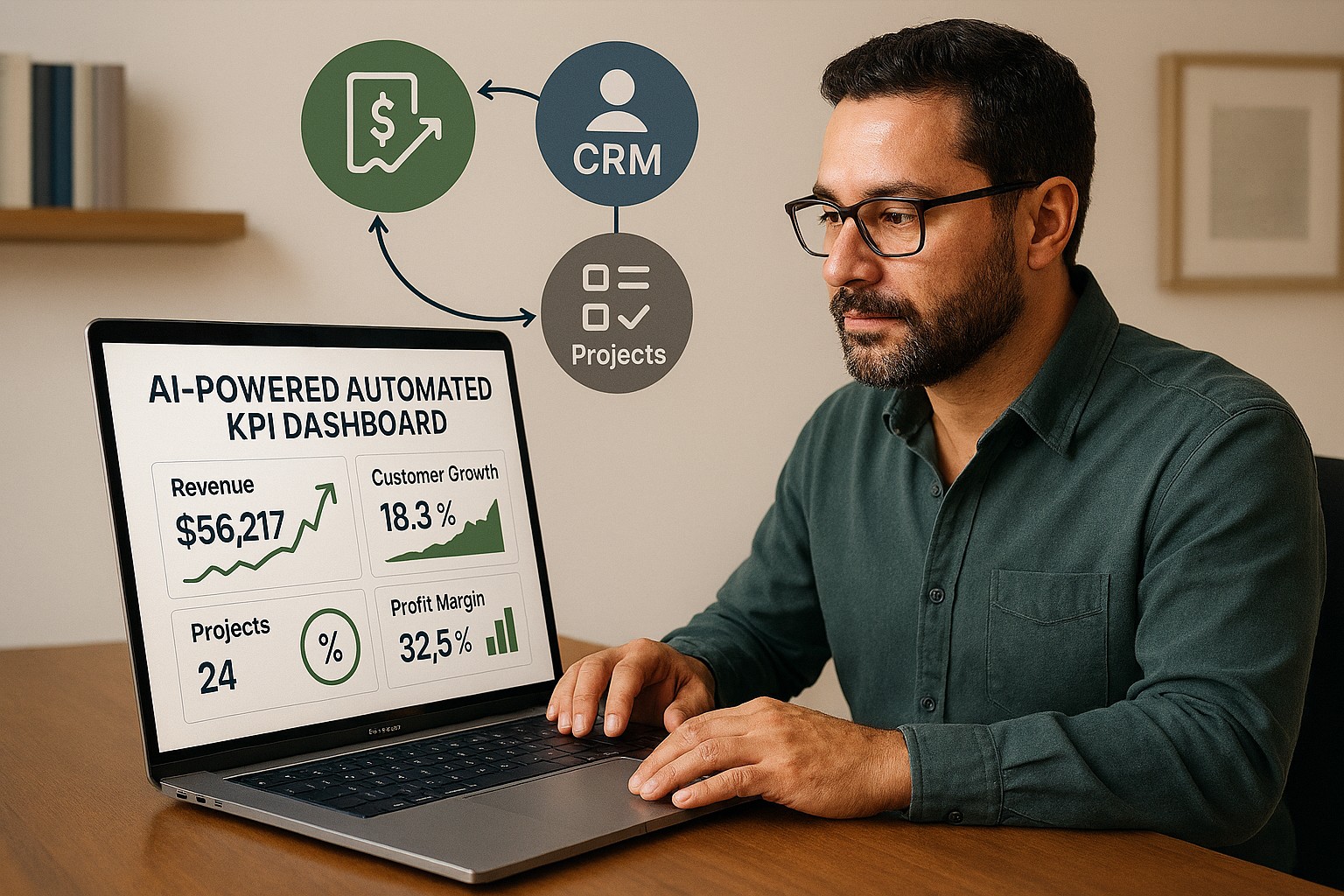
When your business software is connected and automated, your performance data works for you — in real time, without manual reporting.
Most small business owners make decisions based on incomplete information. Not because the data does not exist — it does. It’s sitting in your accounting software, your CRM, your project management tool, your inventory system, your scheduling platform, and half a dozen other applications your team uses every day.
The problem is that nobody has connected those systems. So instead of a clear, current view of your business performance, you get fragmented snapshots — last month’s financials here, a manual spreadsheet there, a gut feeling filling in the rest.
AI-powered workflow automation closes that gap. By connecting your line-of-business (LOB) applications and letting AI automatically harvest and analyze your key performance indicators (KPIs), you get a real-time picture of how your business is actually performing — without adding staff, without manual reporting, and without waiting until the end of the month.
What This Actually Means for Your Business
When your LOB applications are connected and your KPIs are being harvested automatically, you might open Monday morning to a dashboard showing: revenue versus target week-to-date, outstanding receivables by age, your five largest at-risk accounts, staff utilization rates, and inventory levels approaching reorder thresholds.
That dashboard was built by your systems, overnight, while you were not working. When a number moves outside its normal range, you receive an alert — before it becomes a crisis.
This is not technology reserved for large enterprises. The tools that make this possible are now accessible, affordable, and increasingly straightforward to implement for businesses of any size.
Practical Action Steps for You and Your IT Team
Step 1: List every software platform your business uses. Accounting, CRM, inventory, scheduling, project management, payroll, point of sale — document all of it. These are your data sources.
Step 2: Decide what your most important KPIs are. Revenue, gross margin, accounts receivable aging, customer acquisition cost, employee utilization, inventory turnover — agree on the ten numbers that, if you tracked them weekly, would help you make better decisions.
Step 3: Check your platforms’ integration capabilities. Most modern business software supports API connections or data exports. Your IT provider should assess what’s possible with your current tools before recommending anything new.
Step 4: Choose an automation and reporting platform. Tools like Microsoft Power Automate, Zapier, and Make connect thousands of business applications. Microsoft Power BI or similar tools turn that data into visual dashboards. Your IT provider can recommend the right fit for your size and stack.
Step 5: Configure your data pipelines. Have your IT provider build the automated connections between your platforms so that data flows into your reporting environment on a scheduled or real-time basis — without anyone manually exporting spreadsheets.
Step 6: Set up threshold alerts. Define the KPI boundaries that should trigger a notification — a receivable aging past 45 days, a sales pipeline dropping below a minimum, or inventory falling to reorder level. AI-driven alerting means you act on problems before they compound.
Step 7: Build a review habit. Dashboards create value when business owners and managers use them consistently. Set a weekly 20-minute review of your KPI dashboard as a fixed part of your management routine.
Questions You or Your Team Might Ask
“Is our business data safe passing between systems automatically?” Yes — when properly configured. Your IT provider should use encrypted, authenticated connections between platforms and ensure that access is controlled by role. Data security should be a stated requirement from day one.
“Do we need to replace our existing software?” No. Workflow automation connects the tools you already use. The goal is to make your existing stack smarter, not to start over.
“How long does it take to set this up?” A basic KPI dashboard connecting three to four applications can typically be implemented in two to four weeks. More complex environments take longer but are built in logical phases.
“What does it cost?” It depends on your complexity and existing platforms. Many of the core automation tools are available on subscription plans that are affordable for small businesses. Your IT provider should walk you through the realistic cost before any commitment is made.
How Farmhouse Networking Can Help
Farmhouse Networking helps small and mid-sized businesses build connected technology environments that make real-time KPI tracking practical and sustainable. We assess your current application stack, identify integration opportunities, configure secure data flows, and build dashboards that give you the clarity to lead your business with confidence.
We handle everything in-house — no outsourcing — and we focus on practical solutions that fit your size and budget. Our clients tell us we fix problems other IT firms cannot, and we answer the phone when they call.
You Should Know How Your Business Is Performing Right Now — Not Last Month
If your business decisions are based on delayed, manual, or fragmented data, your competitors who have automated this have an edge you can close.
Email us at support@farmhousenetworking.com to schedule a free consultation. We’ll take a look at your current systems, identify your best opportunities for automation and KPI visibility, and give you a clear picture of what’s possible — and what it will take to get there.
And God will generously provide all you need. Then you will always have everything you need and plenty left over to share with others. As the Scriptures say, “They share freely and give generously to the poor. Their good deeds will be remembered forever.” For God is the one who provides seed for the farmer and then bread to eat. In the same way, he will provide and increase your resources and then produce a great harvest of generosity in you. - 2 Corinthians 9:8-10
We use cookies to ensure that we give you the best experience on our website. If you continue to use this site we will assume that you are happy with it.