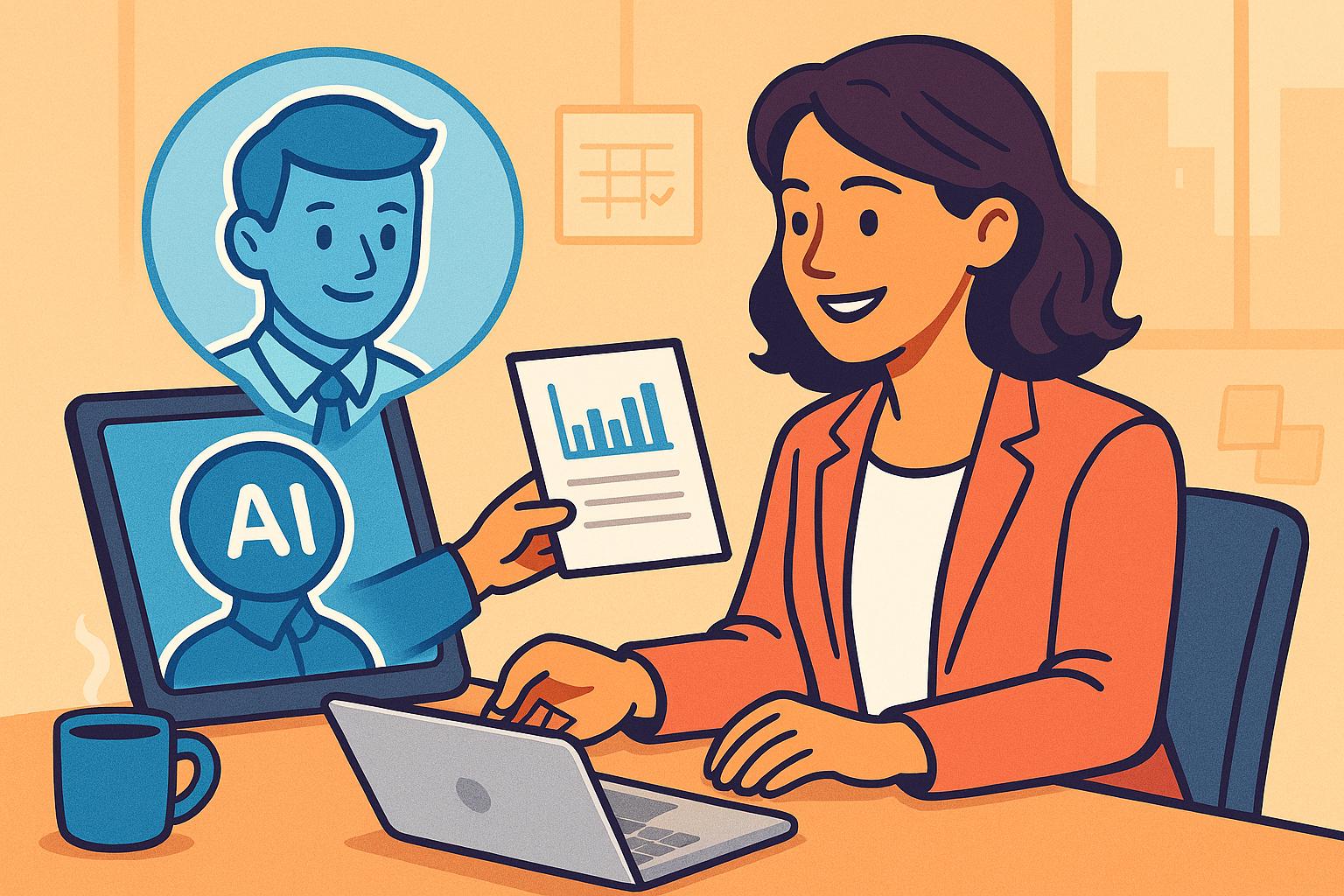
AI usage limits are now part of every business plan. Here is what happens when your team hits one, and how to keep company data from walking out the door with them.
When AI usage limits stop work, employees often switch to free AI tools. That is how shadow AI puts company data at risk.
It’s 3:40 on a Thursday. Your office manager is halfway through a customer proposal when the company AI assistant stops responding: usage limit reached, try again later. The deadline is 5:00. So she opens a free AI chatbot on her phone, pastes in the customer’s details, and finishes the job. The proposal goes out on time. The customer’s information now sits on a server you have never vetted, under terms nobody at your company has read.
That is the real risk behind AI token limits. The interruption is annoying. What your people do next can be expensive.
What Are AI Tokens and Why Do They Run Out?
Tokens are how AI tools measure work. A token is a small piece of text, often part of a word, and everything counts: the question, any file you attach, the running conversation history, and the answer. Business AI plans come with an allowance, whether the vendor calls it tokens, credits, or messages.
In 2026 those allowances are tighter and more closely metered. Vendors are moving away from flat, unlimited-feeling plans toward usage-based billing. Microsoft, for example, now bills some Copilot features in Copilot Credits with admin spending limits. At the same time, teams are using AI harder. AI agents that handle multi-step tasks, long chat threads, and large uploaded documents burn through tokens far faster than a quick question does.
What Happens When You Hit the Limit
Depending on the tool and plan, one of three things usually happens:
Work stops. New requests are blocked until the allowance resets or an admin raises it. One source reported one consultant waiting 13 hours for tokens to refresh.
The bill grows. Overage billing keeps things running, then shows up as a surprise on next month’s invoice.
People improvise. Employees switch to whatever AI tool they can reach, usually a free personal account.
That third outcome is called shadow AI: AI tools used for work without the company’s approval or oversight. Free consumer tools may retain what you paste in and, depending on settings, may use it to improve their models. IBM’s 2025 Cost of a Data Breach Report found that 63% of the breached organizations it studied had no AI governance policy, and that high levels of shadow AI added about $670,000 to the average cost of a breach.
Action Steps for Business Owners and IT
Inventory every AI tool in use. Ask staff what they use, including free and browser-based tools. IT should confirm with web traffic and application reports.
Standardize on business-grade plans. Choose approved tools with admin controls and contract terms that keep your data out of model training.
Right-size the allowance. Review usage reports monthly. Set spending caps and threshold alerts so IT hears about a limit before employees hit it.
Write an AI acceptable use policy. Spell out approved tools, data that must never be entered, and exactly what to do when a limit is reached.
Build a fast escalation path. If requesting more capacity takes a day, people will go around it. Make the safe option the easy option.
Restrict unapproved AI sites on company devices. Use web filtering and data loss prevention tools to block or flag sensitive data headed to unknown AI services.
Teach token-smart habits. Start a new chat for each new task, attach only the pages you need, and use lighter models for simple work.
Add AI to your continuity plan. List the workflows that depend on AI and document the manual fallback if the tool is unavailable.
Questions Your Customers May Ask
Do you put my information into AI tools? Only into tools we have approved and configured for business use, under agreements that keep your data out of model training. Our policy prohibits entering customer information into personal or free AI accounts.
What happens if an employee uses an unapproved AI app? Our systems restrict unapproved AI services on company devices, and our policy treats it as a security issue. We would investigate and respond just as we would to any other data concern.
If your AI tool goes down or hits a limit, will my project be delayed? No. AI helps our team work faster, but every AI-assisted process has a documented manual fallback.
Does a person check AI-generated work? Yes. A member of our team reviews anything AI helps produce before it reaches you.
How Farmhouse Networking Can Help
Most small businesses adopted AI one employee at a time, which means few owners know which tools are in use, what they cost, or where the data goes. Farmhouse Networking helps you take control without slowing your team down.
We start by identifying every AI tool touching your network, approved or not. From there we help you choose and configure business-grade accounts, set up usage alerts and spending controls, apply web filtering and data loss prevention to stop shadow AI, and write an acceptable use policy your staff will actually follow. We also train your team on efficient, secure AI habits and add AI dependencies to your continuity plan.
Our 100% U.S.-based team answers the phone live, and most issues are resolved in about 15 minutes, so a blocked tool never becomes an all-afternoon problem.
Get Your Free AI Acceptable Use Policy Template
Your employees are going to hit an AI limit. The only question is whether they have a safe path forward when it happens. Email support@farmhousenetworking.com with AI Policy in the subject line and we will send you our free AI Acceptable Use Policy template, ready to customize for your business.
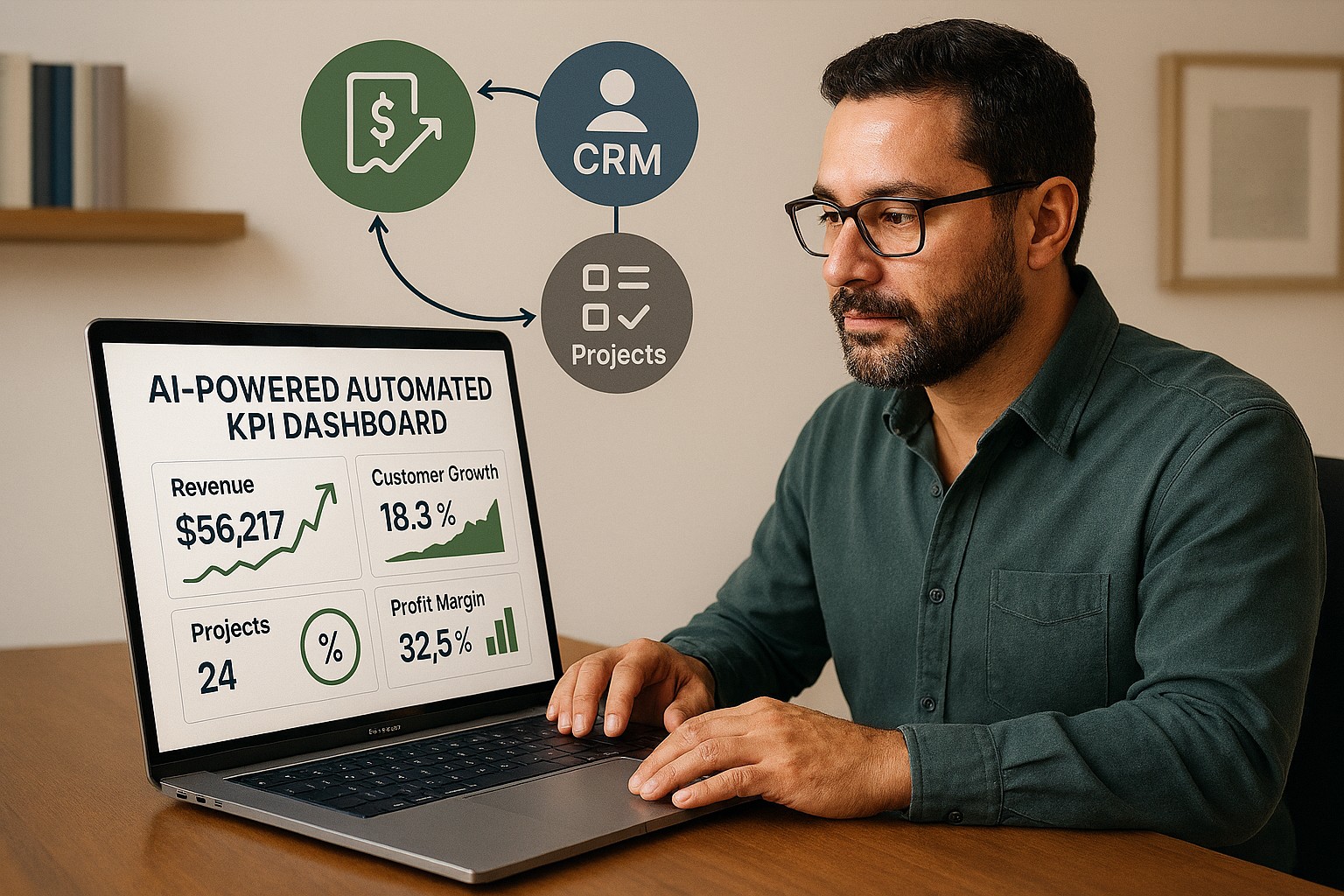
How AI and workflow automation let SMBs track real performance in real time — by turning the software you already use into a live intelligence system.
When your business software is connected and automated, your performance data works for you — in real time, without manual reporting.
Most small business owners make decisions based on incomplete information. Not because the data does not exist — it does. It’s sitting in your accounting software, your CRM, your project management tool, your inventory system, your scheduling platform, and half a dozen other applications your team uses every day.
The problem is that nobody has connected those systems. So instead of a clear, current view of your business performance, you get fragmented snapshots — last month’s financials here, a manual spreadsheet there, a gut feeling filling in the rest.
AI-powered workflow automation closes that gap. By connecting your line-of-business (LOB) applications and letting AI automatically harvest and analyze your key performance indicators (KPIs), you get a real-time picture of how your business is actually performing — without adding staff, without manual reporting, and without waiting until the end of the month.
What This Actually Means for Your Business
When your LOB applications are connected and your KPIs are being harvested automatically, you might open Monday morning to a dashboard showing: revenue versus target week-to-date, outstanding receivables by age, your five largest at-risk accounts, staff utilization rates, and inventory levels approaching reorder thresholds.
That dashboard was built by your systems, overnight, while you were not working. When a number moves outside its normal range, you receive an alert — before it becomes a crisis.
This is not technology reserved for large enterprises. The tools that make this possible are now accessible, affordable, and increasingly straightforward to implement for businesses of any size.
Practical Action Steps for You and Your IT Team
Step 1: List every software platform your business uses. Accounting, CRM, inventory, scheduling, project management, payroll, point of sale — document all of it. These are your data sources.
Step 2: Decide what your most important KPIs are. Revenue, gross margin, accounts receivable aging, customer acquisition cost, employee utilization, inventory turnover — agree on the ten numbers that, if you tracked them weekly, would help you make better decisions.
Step 3: Check your platforms’ integration capabilities. Most modern business software supports API connections or data exports. Your IT provider should assess what’s possible with your current tools before recommending anything new.
Step 4: Choose an automation and reporting platform. Tools like Microsoft Power Automate, Zapier, and Make connect thousands of business applications. Microsoft Power BI or similar tools turn that data into visual dashboards. Your IT provider can recommend the right fit for your size and stack.
Step 5: Configure your data pipelines. Have your IT provider build the automated connections between your platforms so that data flows into your reporting environment on a scheduled or real-time basis — without anyone manually exporting spreadsheets.
Step 6: Set up threshold alerts. Define the KPI boundaries that should trigger a notification — a receivable aging past 45 days, a sales pipeline dropping below a minimum, or inventory falling to reorder level. AI-driven alerting means you act on problems before they compound.
Step 7: Build a review habit. Dashboards create value when business owners and managers use them consistently. Set a weekly 20-minute review of your KPI dashboard as a fixed part of your management routine.
Questions You or Your Team Might Ask
“Is our business data safe passing between systems automatically?” Yes — when properly configured. Your IT provider should use encrypted, authenticated connections between platforms and ensure that access is controlled by role. Data security should be a stated requirement from day one.
“Do we need to replace our existing software?” No. Workflow automation connects the tools you already use. The goal is to make your existing stack smarter, not to start over.
“How long does it take to set this up?” A basic KPI dashboard connecting three to four applications can typically be implemented in two to four weeks. More complex environments take longer but are built in logical phases.
“What does it cost?” It depends on your complexity and existing platforms. Many of the core automation tools are available on subscription plans that are affordable for small businesses. Your IT provider should walk you through the realistic cost before any commitment is made.
How Farmhouse Networking Can Help
Farmhouse Networking helps small and mid-sized businesses build connected technology environments that make real-time KPI tracking practical and sustainable. We assess your current application stack, identify integration opportunities, configure secure data flows, and build dashboards that give you the clarity to lead your business with confidence.
We handle everything in-house — no outsourcing — and we focus on practical solutions that fit your size and budget. Our clients tell us we fix problems other IT firms cannot, and we answer the phone when they call.
You Should Know How Your Business Is Performing Right Now — Not Last Month
If your business decisions are based on delayed, manual, or fragmented data, your competitors who have automated this have an edge you can close.
Email us at support@farmhousenetworking.com to schedule a free consultation. We’ll take a look at your current systems, identify your best opportunities for automation and KPI visibility, and give you a clear picture of what’s possible — and what it will take to get there.
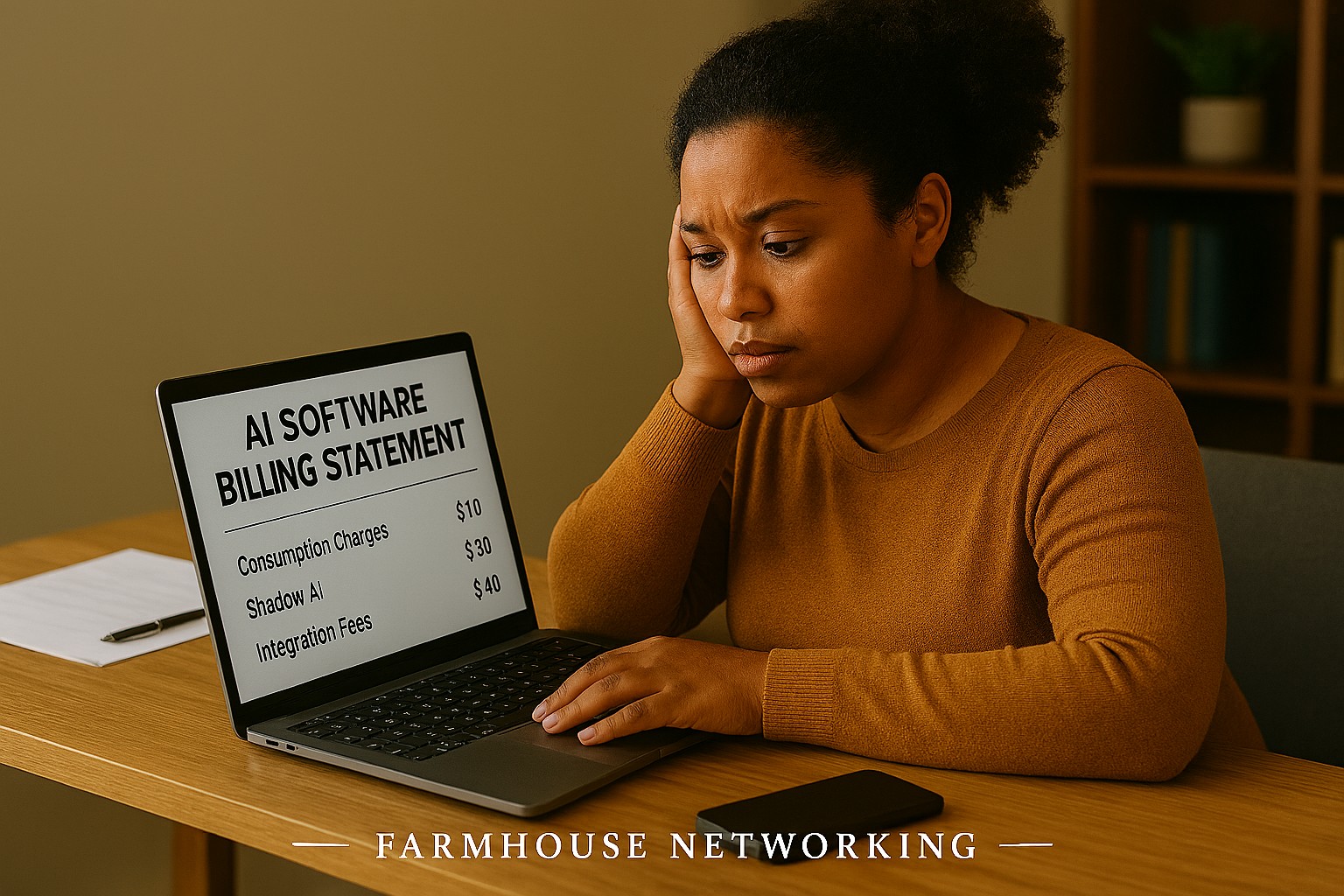
That AI tool looked affordable in the demo. Here’s what most small business owners discover after the first real invoice.
You signed up for a sleek AI tool. The demo was impressive. The monthly price seemed reasonable. Then three months later you’re staring at a vendor bill that’s twice what you expected, your team is still confused about how to use the software, and you’re not sure who owns the data you’ve been feeding into it.
If that sounds familiar, you’re not alone. According to a 2025 Fortune analysis, the advertised price of AI automation represents only 20–40% of the true first-year cost for most small businesses. The rest hides in plain sight — buried in data preparation, staff training, integration fees, security gaps, and consumption-based pricing that scales faster than your revenue does.
AI tools promise to save you money. But are they quietly spending it instead? Here’s what every business owner needs to know before the next invoice arrives.
What the Brochure Doesn’t Tell You: The 6 Hidden Costs of AI
1. Data Cleanup Costs: Before AI can do anything useful, it needs clean, structured data. Most businesses discover their records have duplicate entries, inconsistent formatting, or files locked in formats the AI can’t read. Getting data “AI-ready” commonly costs $1,000–$10,000 and is rarely mentioned upfront.
2. Consumption-Based Billing Surprises: Many AI tools — including Microsoft Copilot, ChatGPT, and Salesforce Agentforce — charge by usage (tokens, conversations, or seat upgrades). A 2025 Zylo survey found 78% of IT leaders reported unexpected charges from consumption-based AI pricing. The more your team uses the tool, the higher the bill climbs, often mid-contract.
3. Integration Expenses: Plugging an AI tool into your existing systems — your accounting software, CRM, email platform, or operations tools — typically costs 30–50% of your total AI budget on top of licensing fees. Legacy systems make this worse, adding another 30–50% to integration costs.
4. The Productivity Dip (The J-Curve): Staff productivity typically drops 15–25% for 3–6 months after an AI tool is introduced. Workflows change. People need training. Mistakes happen. This “J-curve” is a real cost that hits your output before the benefits kick in.
5. Ongoing Maintenance and Monitoring: AI tools don’t run themselves. They need updates, performance monitoring, and occasional retraining. Industry estimates put annual AI maintenance at 15–30% of the original implementation cost — every year.
6. Security and Compliance Gaps: When employees use unsanctioned AI tools — what experts call “shadow AI” — your data goes places you haven’t approved. This creates real liability, especially if you handle any customer financial, health, or personal data.
What You and Your IT Team Should Do Now
Audit every AI tool currently in use — sanctioned or not. Shadow AI is a real and growing problem.
Review your vendor contracts for consumption-based pricing clauses and usage caps.
Assess your data quality before adding any new AI tool. Budget time and money for cleanup.
Map out how each AI tool connects to your existing systems and what it costs to integrate.
Train your team with structured onboarding — not just a login link.
Set a usage policy that defines which AI tools are approved and what data can be shared with them.
Schedule quarterly AI cost reviews so billing surprises don’t compound.
Work with your IT provider to conduct a security review of all AI platforms you’ve adopted.
Questions Your Clients or Team May Ask You
Q: Is it really that expensive? The tool only costs $30 a month.
A: The license is just the entry fee. Once you add integration, training, data cleanup, and monitoring, that $30/month tool commonly becomes $300–$500/month in real total cost. Budgeting for only the license is the most common AI financial mistake small businesses make.
Q: Can’t we just let employees figure it out on their own?
A: Research shows that organizations with unstructured AI adoption see double the training costs and far lower ROI. Worse, employees who figure it out on their own often use unapproved tools that create security and compliance exposure.
Q: What happens if we don’t address the security side?
A: Unsanctioned AI usage has been linked to data breaches that add an average of $200,000 to breach costs, according to IBM’s 2025 Cost of a Data Breach report. For a small business, that’s potentially company-ending exposure.
Q: How do we know if our AI investment is actually paying off?
A: You need to measure specific KPIs before and after AI adoption — things like hours saved per week, error rates, and customer resolution times. Without baseline data, ROI is invisible.
How Farmhouse Networking Can Help
Farmhouse Networking specializes in helping SMBs navigate exactly these kinds of IT cost pitfalls. Our local team can help you:
Conduct a full AI tool audit to identify shadow AI and hidden spend across your organization.
Review your vendor contracts and consumption-based pricing to protect you from billing surprises.
Assess data readiness so you’re not paying for expensive data cleanup after the fact.
Build a secure AI governance policy so your team knows what’s approved, what’s not, and why.
Provide proactive IT monitoring that catches cost and security issues before they become crises.
Ready to Find Out What AI Is Really Costing You?
Don’t wait for the surprise invoice. Send us a message and we’ll schedule a free AI cost and security review for your business. We’ll show you exactly where you stand — no obligation, no jargon, no pressure. Email us today: support@farmhousenetworking.com
How SMB leaders can use an AI boardroom bot to improve preparation, analysis, and decision‑making in their meetings.
Lloyds Banking Group’s deployment of an AI boardroom bot is more than a banking headline. It shows that AI is becoming a serious business tool for better preparation, faster analysis, and smarter decision-making, and SMB owners who adopt it early—with proper controls—can gain a competitive edge.
Practical steps for owners and IT
Start with one business problem, such as meeting summaries, document review, or internal reporting.
Create a simple AI policy that defines approved tools, responsible users, and escalation rules.
Review security, permissions, and data retention before connecting AI to company information.
Put IT in charge of testing, monitoring, and patching any AI-related systems.
Measure results with clear metrics like time saved, error reduction, and decision speed.
Client questions and answers
Q: Is AI only for large enterprises? A: No. SMBs can benefit from targeted use cases if they adopt AI carefully and securely.
Q: What is the biggest risk? A: Uncontrolled access to sensitive information and overreliance on outputs without review.
How Farmhouse Networking helps
Farmhouse Networking helps SMB owners turn AI interest into a secure, practical rollout. We can support strategy, vendor evaluation, security hardening, and IT execution so your team can adopt AI without losing control.
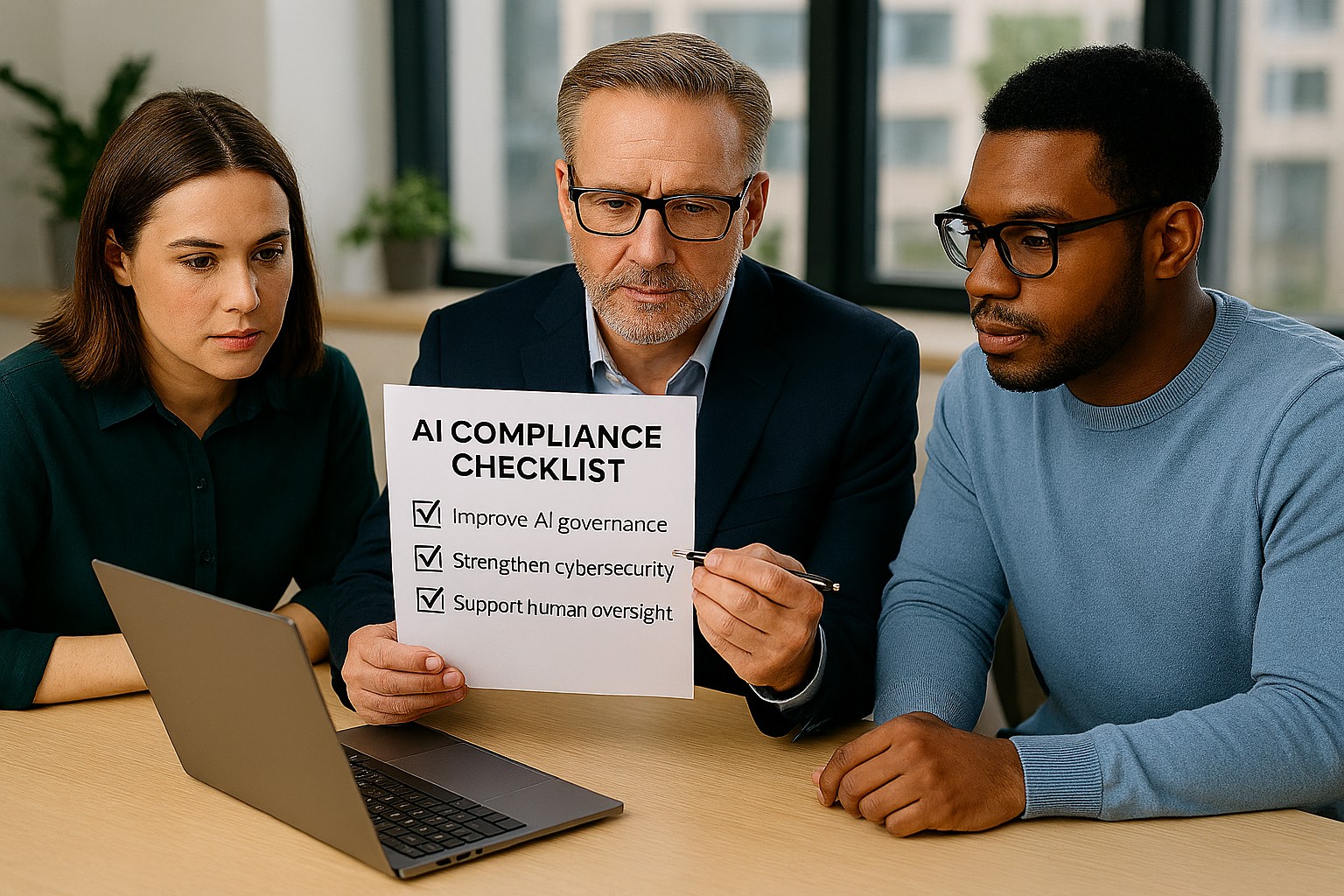
Small business leaders can reduce AI risk by building governance, review processes, and secure IT controls
Businesses are adopting AI faster than ever, often without realizing how many tools already include automation. The Colorado AI Act matters because if AI influences decisions that affect customers, employees, or applicants, your business may need to add oversight, disclosures, and human review.
For SMB owners, the best strategy is simple: know what AI you use, know what it affects, and know who is responsible. That keeps compliance manageable and reduces risk.
What your business should do
Start with an AI inventory across software, plugins, and cloud apps. Then identify which tools affect important decisions, customer experiences, or internal workflows.
Your IT team should review vendor contracts, access controls, logging, and data retention. They should also create a clear process for reviewing AI outputs, correcting mistakes, and responding to customer questions.
Questions customers may ask
Q: Is your business using AI to evaluate me? A: It may be, depending on the service or process.
Q: Can a person review the decision? A: Your business should be able to provide human review where needed.
Q: Why should I care about AI use? A: Because it affects fairness, accuracy, and transparency.
How Farmhouse Networking can help
Farmhouse Networking helps SMBs build a stronger IT foundation for AI governance, security, and compliance. We can help you identify risks, secure systems, and support the operational steps your business needs to take.
Email support@farmhousenetworking.com for more information about how Farmhouse Networking can help improve their business.
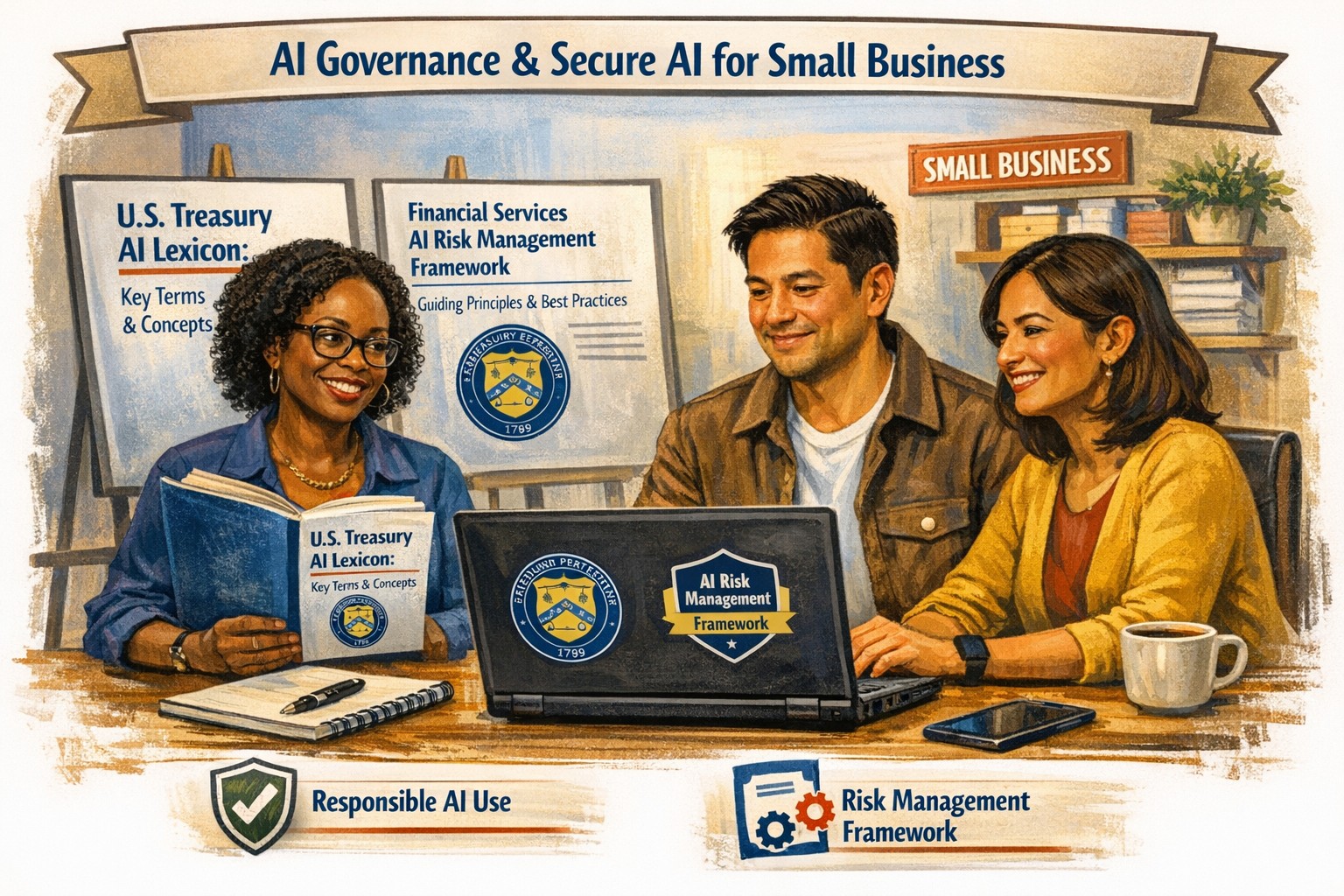
What the U.S. Treasury’s New AI Framework Means for You
How the U.S. Treasury’s AI Lexicon and Financial Services AI Risk Management Framework help small businesses govern AI safely and securely
From chatbots to cloud‑based “smart” bookkeeping tools, AI is quietly embedded in many SMB software platforms. The Treasury’s AI Lexicon and Financial Services AI Risk Management Framework give small‑business owners a practical way to manage AI‑related risks—without needing a corporate‑level compliance team.
What SMB owners should do
Create a simple AI inventory: List tools that say they use “AI,” “machine learning,” or “smart automation.”
Ask vendors clear questions: How does the AI work? What data does it use? How are models updated and monitored?
Limit AI for sensitive decisions: Use AI for tasks like email filtering, data entry, or basic analytics, but keep humans in the loop for pricing, hiring, or customer‑impact decisions.
Add AI‑governance to your cybersecurity plan: Treat AI‑enabled tools the same way as any other SaaS—review access, permissions, and data‑handling practices.
Sample Q&A for customers and partners
“Do you use AI to decide which customers get service?” You can say: “AI helps us manage communications and prioritize tasks, but a real person makes decisions that affect you.”
“How do you ensure AI isn’t biased or insecure?” You can reference documented vendor‑review processes, human oversight, and your commitment to strong cybersecurity and data‑protection practices.
Farmhouse can help
Farmhouse Networking can:
Help you build a simple AI‑inventory checklist for your SMB.
Assist with drafting light‑touch AI‑governance language for your policies and customer‑facing communications.
Integrate AI‑risk checks into your existing IT and cybersecurity processes.
Call to action: Email support@farmhousenetworking.com to start a conversation about how AI is already in your business—and how to manage it in a way that’s both powerful and defensible.
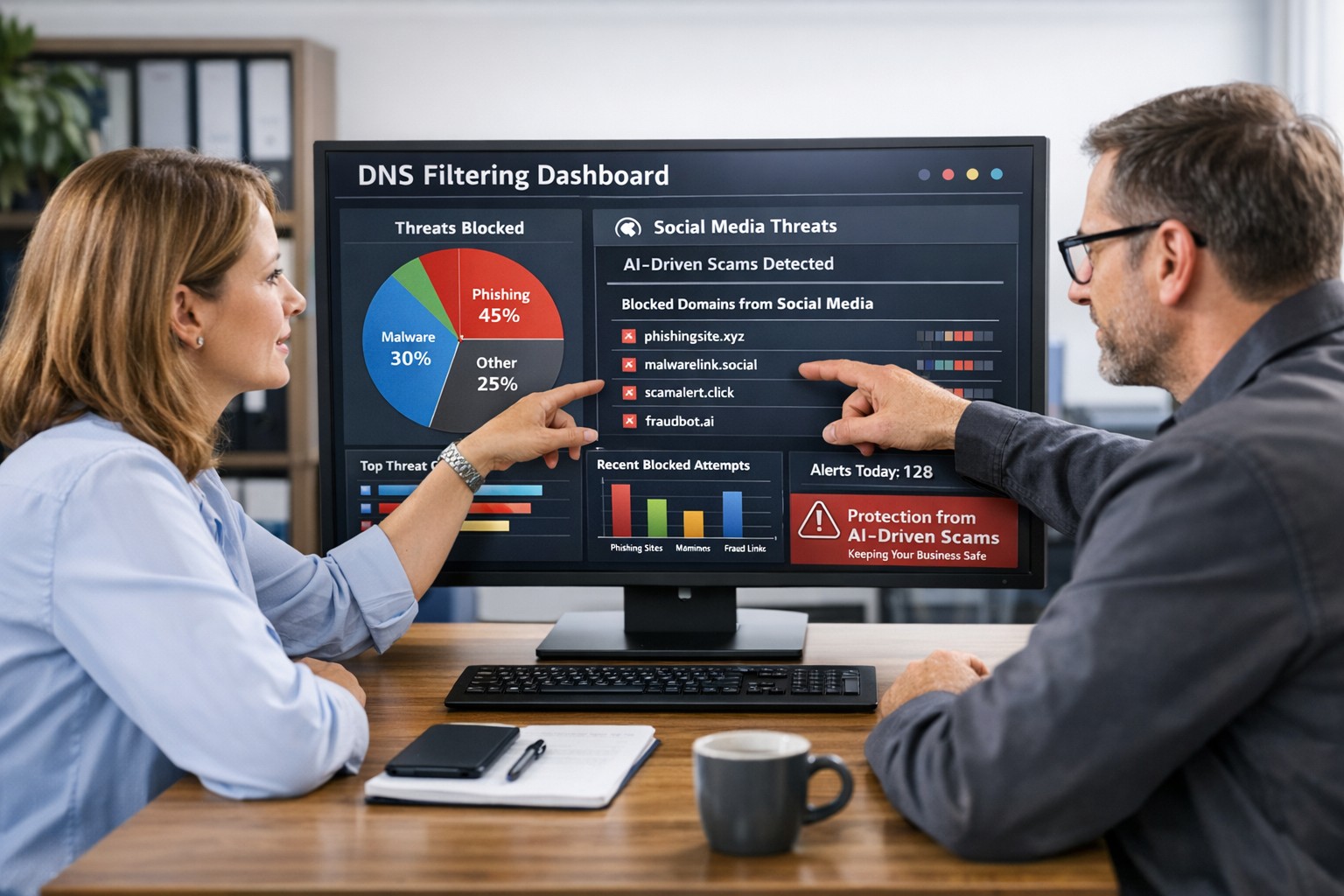
Use DNS Filtering to Stay Safe and Open for Business
DNS filtering helps small business owners block AI powered social media scams before employees can reach malicious websites
AI tools now let scammers quickly generate deepfake videos, realistic ads, and convincing phishing messages that target small and mid‑sized businesses on social media. These attacks trick employees into clicking malicious links that steal logins, install ransomware, or divert payments, and incident rates and losses are climbing. DNS filtering offers your business a practical, affordable way to block dangerous sites at the network level before a bad click turns into downtime.
Why AI-Driven Social Media Threats Matter for SMBs
AI deepfakes and fake ads can impersonate your brand or suppliers and lead to look‑alike scam sites.
AI-enhanced phishing leverages details from your website and social media to sound like real customers, partners, or executives.
Web‑based phishing and spoofing attempts are rising sharply year over year, driven by generative AI.
What DNS Filtering Does for Your Business
DNS filtering checks where your employees’ devices are trying to connect and blocks known or suspected malicious domains. For SMBs, this:
Prevents access to phishing pages and fake login screens linked from social media or email.
Reduces malware and ransomware risk by blocking communication with malicious servers.
Gives you visibility into risky browsing and helps enforce acceptable‑use policies.
Action Steps for Business Owners and IT
Document where and how your team uses social media for sales, support, and marketing.
Roll out DNS filtering to office networks, remote workers, and any company‑managed laptops or phones.
Integrate DNS filtering logs with your security monitoring to quickly investigate suspicious activity.
Establish a clear process for verifying unusual requests (wire transfers, password resets, gift card purchases) received via social media or email.
Sample Customer Questions and Answers
“Is it safe to click promotions I see about your business on social media?” We recommend visiting our official website or verified profiles directly, because scammers can create fake ads that lead to malicious sites.
“How do you protect my data from online scams?” We use layered security including DNS filtering to block malicious websites, alongside secure payment providers and strong internal controls.
How Farmhouse Networking Helps SMBs
Farmhouse Networking works with you to understand your business, social media use, and risk tolerance, then designs and manages a DNS filtering solution that fits your size and budget. We deploy, configure, and monitor the service, fine‑tune policies over time, and provide clear reports so you always know how your network is being protected. This is included at no additional cost to all our monthly managed IT services clients.
Call to Action: Email support@farmhousenetworking.com for more information about how Farmhouse Networking can help improve your business and defend against AI‑driven social media threats.
Farmhouse Networking helps small businesses integrate AI as their new intern, automating routine tasks for increased efficiency.
Small and medium businesses can treat AI as a new intern—handling repetitive tasks, data entry, customer inquiries, and reporting. This guide provides practical steps for SMB owners and their IT departments to deploy AI safely and effectively.
What AI interns do for SMBs
Automate repetitive admin tasks and data entry
Improve customer service with 24/7 basic support
Generate routine reports and insights for decision-making
Accelerate onboarding and vendor communications
Action steps for owners and IT
Step 1: Inventory tasks suitable for AI assistance and set success metrics.
Step 2: Ensure data security, governance, and access controls across systems.
Step 3: Choose AI tools with smooth integration into CRM, ERP, and helpdesk platforms.
Step 4: Create SOPs for AI outputs, approvals, and escalation paths.
Step 5: Run a phased pilot, monitor KPIs, and adjust workflows.
Step 6: Provide ongoing training and a clear policy for continued use and exit strategies.
FAQs from clients
Will AI reduce headcount? AI typically augments staff, enabling them to focus on strategic work while AI handles repetitive tasks.
How long before value is seen? Many SMBs see operational gains within 1–3 months, with compounding efficiency over time.
How to measure success? Track time saved, accuracy, customer satisfaction, and revenue impact where applicable.
How Farmhouse Networking helps
Offers scalable AI deployments with governance, security, and integration expertise.
Provides IT-side support for deployment planning, vendor selection, and risk management.
Delivers ongoing optimization and ROI reporting to justify investment.
To discuss how Farmhouse Networking can help your SMB adopt an AI intern, email support@farmhousenetworking.com
Unlocking Deeper Client Value: How Data Analytics and Farmhouse Networking Transform Accounting Firms
Farmhouse Networking data analytics drives client insights and firm growth
Accounting firms are under pressure to go beyond tax preparation and bookkeeping. Clients now expect actionable insights and forward-thinking advisory services. Enter data analytics—the game-changer that empowers accountants to deliver strategic value, not just numbers. But to leverage these tools effectively, you need a trusted partner who understands both technology and the unique needs of accounting firms. That’s where Farmhouse Networking stands out.
Farmhouse Networking: Your Edge in Data-Driven Advisory
While many Managed Service Providers (MSPs) offer IT support, Farmhouse Networking specializes in integrating advanced data analytics solutions tailored for the accounting sector. Unlike generic MSPs, Farmhouse Networking brings:
Industry-Specific Expertise: Deep knowledge of accounting workflows and compliance requirements ensures seamless integration of analytics tools with platforms like QuickBooks and Xero.
Security and Compliance Focus: Robust data governance and security protocols safeguard sensitive financial information, reducing compliance risk.
Scalable Solutions: As your firm grows, Farmhouse Networking ensures your analytics infrastructure evolves with you, supporting everything from small practices to large CPA firms.
Practical Steps Farmhouse Networking Implements for Accounting Firms
Assessment and Customization: Farmhouse Networking starts with a thorough assessment of your current systems and client needs, recommending the best-fit analytics tools.
Seamless Integration: They handle integration with your existing accounting software, ensuring data flows securely and efficiently between platforms like QuickBooks and Xero.
Automation and Reporting: By automating data collection and report generation, Farmhouse Networking frees your team from manual tasks, enabling faster, more accurate insights for your clients.
AI-Powered Insights: Leveraging AI and machine learning, they help you identify trends, forecast cash flow, and uncover client opportunities that drive advisory conversations.
Training and Ongoing Support: Farmhouse Networking provides training for your staff and ongoing technical support, so your team can confidently use analytics tools to deliver value-added services.
Ready to Elevate Your Firm’s Advisory Services?
Don’t let your firm fall behind in the data-driven era. Email us today to discover how Farmhouse Networking can empower your accounting practice with cutting-edge analytics—transforming client relationships and unlocking new revenue streams. Take the first step toward smarter, more strategic advisory services.
AI transcribes meetings in cloud, generates summaries, action items instantly.
AI technology has transforming how businesses operate, and one of the most practical applications for business owners today is AI-powered note taking during client interactions. Leveraging AI to take notes can revolutionize the way you capture, organize, and utilize information from meetings, calls, and other client engagements, delivering significant benefits to your business.
How AI Can Take Notes in Client Interactions
AI notetakers use advanced speech recognition and natural language processing to automatically transcribe spoken conversations in real time. These tools can:
Capture every detail accurately without the distraction of manual note-taking.
Organize notes by topics, speakers, and action items.
Summarize long discussions into concise, actionable points.
Integrate with other business tools like CRM systems, calendars, patient management systems, client document managers and project management software for seamless workflow coordination.
This means during patient or client meetings, whether virtual or in-person, you can focus fully on the conversation, knowing that the AI is reliably recording and structuring the information for you.
Benefits for Business Owners
1. Save Time and Increase Productivity
Traditional note taking is time consuming and often inefficient. Business owners typically spend 15-20 hours a week in meetings and an additional 5-7 hours on follow-ups and documentation. AI notetakers can reduce meeting follow-up time by up to 70%, saving you approximately 4-5 hours weekly that can be redirected towards strategic business activities.
2. Improve Accuracy and Decision-Making
AI-powered notes are more accurate and comprehensive than manual notes, capturing nuances, speaker distinctions, and context. This accuracy reduces the risk of missing critical details or misinterpreting client needs, enabling better-informed decisions and stronger client relationships.
3. Enhance Organization and Collaboration
AI note-taking tools standardize note formats, making it easier for you and your team to review and act on meeting outcomes. They automatically generate and distribute action items, improving accountability and ensuring everyone stays aligned—even those who missed the meeting.
4. Boost Client Service and Satisfaction
By capturing detailed client requirements and preferences accurately, AI notetakers help you deliver personalized service. This leads to improved client satisfaction and loyalty, as your business can respond more effectively to client needs and follow up promptly with relevant actions.
5. Gain Competitive Advantage
Utilizing AI for note taking and knowledge management frees up valuable time and mental bandwidth. This allows you to focus on innovation, market expansion, and personalized client engagement strategies that differentiate your business in a crowded marketplace.
Practical Applications in Your Business
Sales Calls: Automatically transcribe calls, sync notes to your CRM, and track commitments to close deals faster.
Project Meetings: Document discussions, assign tasks, and maintain searchable records for better project management.
Patient / Client Consultations: Capture detailed patient / client feedback and preferences to tailor your services effectively.
Internal Strategy Sessions: Focus on high-level thinking while AI handles the documentation and follow-up.
Embracing AI notetakers means freeing yourself and your team from administrative burdens and focusing on what truly matters: building relationships, making informed decisions, and growing your business.
Ready to transform the way your business handles client interactions?
Contact Farmhouse Networking today to discover how AI-powered note taking can save you time, boost accuracy, and elevate your client service. Let us show you how easy it is to get started – reach out now and take the first step toward smarter, more efficient meetings
And God will generously provide all you need. Then you will always have everything you need and plenty left over to share with others. As the Scriptures say, “They share freely and give generously to the poor. Their good deeds will be remembered forever.” For God is the one who provides seed for the farmer and then bread to eat. In the same way, he will provide and increase your resources and then produce a great harvest of generosity in you. - 2 Corinthians 9:8-10
We use cookies to ensure that we give you the best experience on our website. If you continue to use this site we will assume that you are happy with it.