That AI tool looked affordable in the demo. Here’s what most small business owners discover after the first real invoice.
You signed up for a sleek AI tool. The demo was impressive. The monthly price seemed reasonable. Then three months later you’re staring at a vendor bill that’s twice what you expected, your team is still confused about how to use the software, and you’re not sure who owns the data you’ve been feeding into it.
If that sounds familiar, you’re not alone. According to a 2025 Fortune analysis, the advertised price of AI automation represents only 20–40% of the true first-year cost for most small businesses. The rest hides in plain sight — buried in data preparation, staff training, integration fees, security gaps, and consumption-based pricing that scales faster than your revenue does.
AI tools promise to save you money. But are they quietly spending it instead? Here’s what every business owner needs to know before the next invoice arrives.
What the Brochure Doesn’t Tell You: The 6 Hidden Costs of AI
1. Data Cleanup Costs: Before AI can do anything useful, it needs clean, structured data. Most businesses discover their records have duplicate entries, inconsistent formatting, or files locked in formats the AI can’t read. Getting data “AI-ready” commonly costs $1,000–$10,000 and is rarely mentioned upfront.
2. Consumption-Based Billing Surprises: Many AI tools — including Microsoft Copilot, ChatGPT, and Salesforce Agentforce — charge by usage (tokens, conversations, or seat upgrades). A 2025 Zylo survey found 78% of IT leaders reported unexpected charges from consumption-based AI pricing. The more your team uses the tool, the higher the bill climbs, often mid-contract.
3. Integration Expenses: Plugging an AI tool into your existing systems — your accounting software, CRM, email platform, or operations tools — typically costs 30–50% of your total AI budget on top of licensing fees. Legacy systems make this worse, adding another 30–50% to integration costs.
4. The Productivity Dip (The J-Curve): Staff productivity typically drops 15–25% for 3–6 months after an AI tool is introduced. Workflows change. People need training. Mistakes happen. This “J-curve” is a real cost that hits your output before the benefits kick in.
5. Ongoing Maintenance and Monitoring: AI tools don’t run themselves. They need updates, performance monitoring, and occasional retraining. Industry estimates put annual AI maintenance at 15–30% of the original implementation cost — every year.
6. Security and Compliance Gaps: When employees use unsanctioned AI tools — what experts call “shadow AI” — your data goes places you haven’t approved. This creates real liability, especially if you handle any customer financial, health, or personal data.
What You and Your IT Team Should Do Now
Audit every AI tool currently in use — sanctioned or not. Shadow AI is a real and growing problem.
Review your vendor contracts for consumption-based pricing clauses and usage caps.
Assess your data quality before adding any new AI tool. Budget time and money for cleanup.
Map out how each AI tool connects to your existing systems and what it costs to integrate.
Train your team with structured onboarding — not just a login link.
Set a usage policy that defines which AI tools are approved and what data can be shared with them.
Schedule quarterly AI cost reviews so billing surprises don’t compound.
Work with your IT provider to conduct a security review of all AI platforms you’ve adopted.
Questions Your Clients or Team May Ask You
Q: Is it really that expensive? The tool only costs $30 a month.
A: The license is just the entry fee. Once you add integration, training, data cleanup, and monitoring, that $30/month tool commonly becomes $300–$500/month in real total cost. Budgeting for only the license is the most common AI financial mistake small businesses make.
Q: Can’t we just let employees figure it out on their own?
A: Research shows that organizations with unstructured AI adoption see double the training costs and far lower ROI. Worse, employees who figure it out on their own often use unapproved tools that create security and compliance exposure.
Q: What happens if we don’t address the security side?
A: Unsanctioned AI usage has been linked to data breaches that add an average of $200,000 to breach costs, according to IBM’s 2025 Cost of a Data Breach report. For a small business, that’s potentially company-ending exposure.
Q: How do we know if our AI investment is actually paying off?
A: You need to measure specific KPIs before and after AI adoption — things like hours saved per week, error rates, and customer resolution times. Without baseline data, ROI is invisible.
How Farmhouse Networking Can Help
Farmhouse Networking specializes in helping SMBs navigate exactly these kinds of IT cost pitfalls. Our local team can help you:
Conduct a full AI tool audit to identify shadow AI and hidden spend across your organization.
Review your vendor contracts and consumption-based pricing to protect you from billing surprises.
Assess data readiness so you’re not paying for expensive data cleanup after the fact.
Build a secure AI governance policy so your team knows what’s approved, what’s not, and why.
Provide proactive IT monitoring that catches cost and security issues before they become crises.
Ready to Find Out What AI Is Really Costing You?
Don’t wait for the surprise invoice. Send us a message and we’ll schedule a free AI cost and security review for your business. We’ll show you exactly where you stand — no obligation, no jargon, no pressure. Email us today: support@farmhousenetworking.com
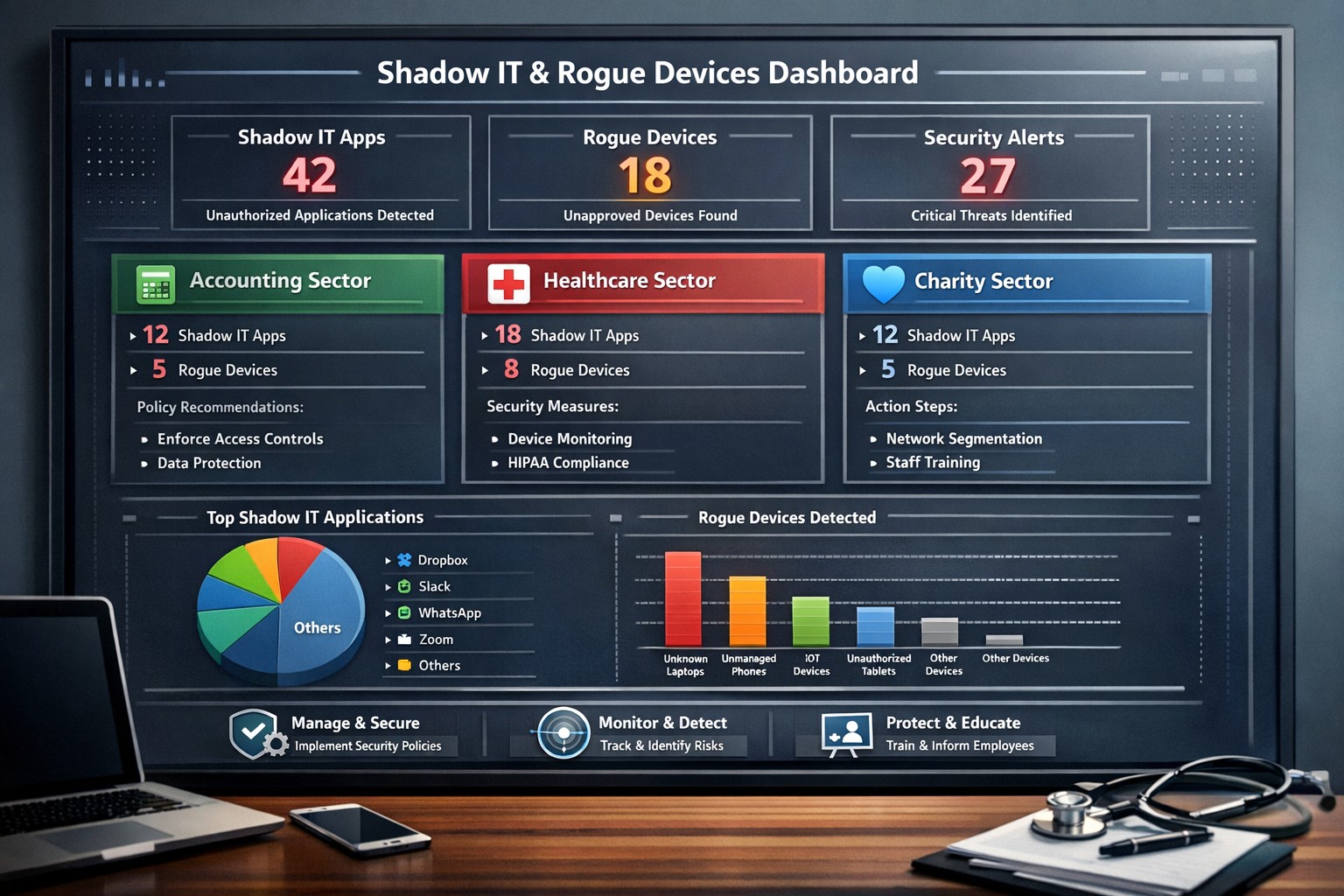
Discovering unauthorized apps or devices on your network can feel like finding hidden leaks in your revenue stream—silent threats draining security and compliance. Shadow IT (unsanctioned software and cloud services) and rogue devices (unapproved hardware like personal laptops or IoT gadgets) expose you to data breaches, regulatory fines, and productivity black holes, with studies showing companies often have 8-10x more unknown SaaS apps than expected. This guide delivers practical steps to detect, manage, and policy-proof your operations, keeping your business agile and protected.
Spotting Shadow IT and Rogue Devices
Start with network traffic analysis using tools like Wireshark or SolarWinds to flag unusual DNS queries, encrypted traffic to unknown IPs, or data spikes indicating unsanctioned cloud uploads. Deploy endpoint detection and response (EDR) solutions such as CrowdStrike or Microsoft Defender for Endpoint to inventory software on devices, spot unauthorized installs, and monitor browser extensions that sneak in risks. Conduct quarterly audits: Review firewall logs, SIEM systems for anomalous patterns, and survey departments on their tools—many shadow IT instances stem from unmet needs like faster collaboration.
Practical Steps to Manage and Secure
Follow these actionable steps with your IT team to reclaim control.
Audit and Inventory Everything: Run full network scans and correlate with identity systems (e.g., SSO logs) to map users, apps, and devices. Prioritize high-risk items like apps without MFA or excessive data access.
Implement Detection Tech: Layer network monitoring (Nagios), EDR, and Cloud Access Security Brokers (CASBs) for continuous visibility. Automate alerts for new SaaS signups or rogue MAC addresses.
Contain and Remediate: Enforce identity controls—lock non-SSO accounts, apply MFA everywhere, and quarantine rogues via NAC (Network Access Control). Onboard valuable shadow tools by sanctioning them with policies.
Roll Out Policies: Draft a clear Shadow IT policy covering app approvals, device registration, and data handling. Require fast-track requests for new tools to avoid workarounds.
Train and Iterate: Hold mandatory sessions on risks (e.g., data leaks from unvetted apps) and alternatives. Review quarterly, adjusting based on audits.
These steps reduce risks without stifling innovation—block outright less, guide instead.
FAQs: Client Questions Answered
Q: How much shadow IT does a typical business have? A: Expect 80-90% of apps to be unmanaged initially, with 8-10x more SaaS accounts than tracked—common even in mid-sized firms.
Q: What are the biggest risks? A: Data breaches via weak OAuth scopes, no MFA, orphaned accounts; compliance failures (GDPR, HIPAA); and expanded attack surfaces from rogue IoT.
Q: Can I fully eliminate shadow IT? A: No, but manage it via discover-evaluate-mitigate loops: Continuous identity-based discovery, risk-tiering, and automated controls keep it in check.
Q: What tools work best for small businesses? A: Start with Microsoft Defender for Cloud Apps for discovery/blocking, or free tiers of Wireshark/EDR trials. Scale to SIEM for growth.
Q: How do policies prevent recurrence? A: Define approval workflows, penalties, and approved alternatives; communicate via training to build a security-first culture.
How Farmhouse Networking Supercharges Your Efforts
Farmhouse Networking specializes in tailored strategies for accounting, healthcare, and charity sectors—industries hit hard by compliance demands like HIPAA or SOC 2. We deploy advanced EDR, CASB, and NAC setups customized to your network, conduct initial shadow IT audits, and craft enforceable policies that align with your workflows. Our team integrates Microsoft 365 security for app risk analysis and rogue device monitoring, ensuring seamless mobility without breaches. Past clients cut unmanaged apps by 70% in months, boosting security scores while freeing IT for growth initiatives.
Take Control Today
Don’t let shadow IT sabotage your business—email support@farmhousenetworking.com now for a free shadow IT risk assessment and personalized roadmap.
And God will generously provide all you need. Then you will always have everything you need and plenty left over to share with others. As the Scriptures say,
“They share freely and give generously to the poor. Their good deeds will be remembered forever.”
For God is the one who provides seed for the farmer and then bread to eat. In the same way, he will provide and increase your resources and then produce a great harvest of generosity in you. - 2 Corinthians 9:8-10
We use cookies to ensure that we give you the best experience on our website. If you continue to use this site we will assume that you are happy with it.