AI usage limits are now part of every business plan. Here is what happens when your team hits one, and how to keep company data from walking out the door with them.
When AI usage limits stop work, employees often switch to free AI tools. That is how shadow AI puts company data at risk.
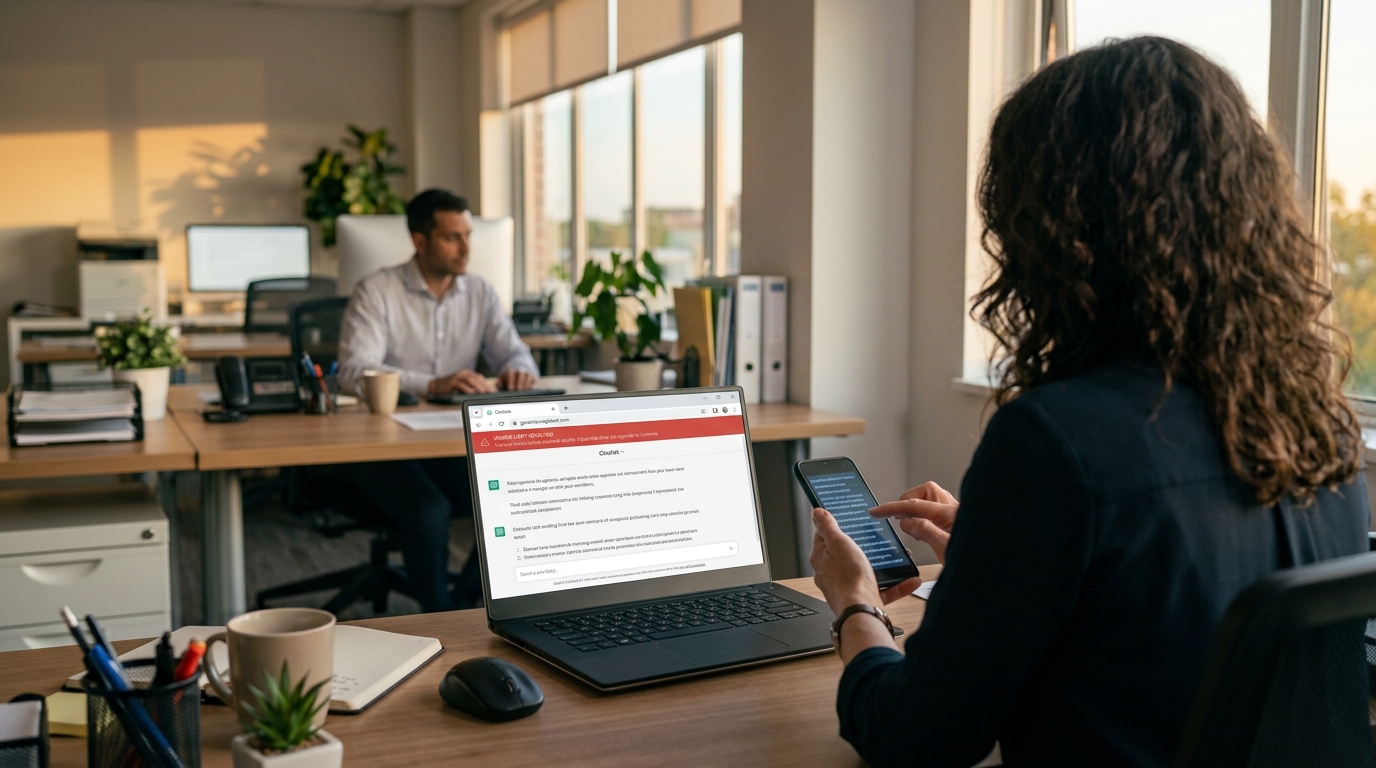
It’s 3:40 on a Thursday. Your office manager is halfway through a customer proposal when the company AI assistant stops responding: usage limit reached, try again later. The deadline is 5:00. So she opens a free AI chatbot on her phone, pastes in the customer’s details, and finishes the job. The proposal goes out on time. The customer’s information now sits on a server you have never vetted, under terms nobody at your company has read.
That is the real risk behind AI token limits. The interruption is annoying. What your people do next can be expensive.
What Are AI Tokens and Why Do They Run Out?
Tokens are how AI tools measure work. A token is a small piece of text, often part of a word, and everything counts: the question, any file you attach, the running conversation history, and the answer. Business AI plans come with an allowance, whether the vendor calls it tokens, credits, or messages.
In 2026 those allowances are tighter and more closely metered. Vendors are moving away from flat, unlimited-feeling plans toward usage-based billing. Microsoft, for example, now bills some Copilot features in Copilot Credits with admin spending limits. At the same time, teams are using AI harder. AI agents that handle multi-step tasks, long chat threads, and large uploaded documents burn through tokens far faster than a quick question does.
What Happens When You Hit the Limit
Depending on the tool and plan, one of three things usually happens:
Work stops. New requests are blocked until the allowance resets or an admin raises it. One source reported one consultant waiting 13 hours for tokens to refresh.
The bill grows. Overage billing keeps things running, then shows up as a surprise on next month’s invoice.
People improvise. Employees switch to whatever AI tool they can reach, usually a free personal account.
That third outcome is called shadow AI: AI tools used for work without the company’s approval or oversight. Free consumer tools may retain what you paste in and, depending on settings, may use it to improve their models. IBM’s 2025 Cost of a Data Breach Report found that 63% of the breached organizations it studied had no AI governance policy, and that high levels of shadow AI added about $670,000 to the average cost of a breach.
Action Steps for Business Owners and IT
Inventory every AI tool in use. Ask staff what they use, including free and browser-based tools. IT should confirm with web traffic and application reports.
Standardize on business-grade plans. Choose approved tools with admin controls and contract terms that keep your data out of model training.
Right-size the allowance. Review usage reports monthly. Set spending caps and threshold alerts so IT hears about a limit before employees hit it.
Write an AI acceptable use policy. Spell out approved tools, data that must never be entered, and exactly what to do when a limit is reached.
Build a fast escalation path. If requesting more capacity takes a day, people will go around it. Make the safe option the easy option.
Restrict unapproved AI sites on company devices. Use web filtering and data loss prevention tools to block or flag sensitive data headed to unknown AI services.
Teach token-smart habits. Start a new chat for each new task, attach only the pages you need, and use lighter models for simple work.
Add AI to your continuity plan. List the workflows that depend on AI and document the manual fallback if the tool is unavailable.
Questions Your Customers May Ask
Do you put my information into AI tools? Only into tools we have approved and configured for business use, under agreements that keep your data out of model training. Our policy prohibits entering customer information into personal or free AI accounts.
What happens if an employee uses an unapproved AI app? Our systems restrict unapproved AI services on company devices, and our policy treats it as a security issue. We would investigate and respond just as we would to any other data concern.
If your AI tool goes down or hits a limit, will my project be delayed? No. AI helps our team work faster, but every AI-assisted process has a documented manual fallback.
Does a person check AI-generated work? Yes. A member of our team reviews anything AI helps produce before it reaches you.
How Farmhouse Networking Can Help
Most small businesses adopted AI one employee at a time, which means few owners know which tools are in use, what they cost, or where the data goes. Farmhouse Networking helps you take control without slowing your team down.
We start by identifying every AI tool touching your network, approved or not. From there we help you choose and configure business-grade accounts, set up usage alerts and spending controls, apply web filtering and data loss prevention to stop shadow AI, and write an acceptable use policy your staff will actually follow. We also train your team on efficient, secure AI habits and add AI dependencies to your continuity plan.
Our 100% U.S.-based team answers the phone live, and most issues are resolved in about 15 minutes, so a blocked tool never becomes an all-afternoon problem.
Get Your Free AI Acceptable Use Policy Template
Your employees are going to hit an AI limit. The only question is whether they have a safe path forward when it happens. Email support@farmhousenetworking.com with AI Policy in the subject line and we will send you our free AI Acceptable Use Policy template, ready to customize for your business.
What the growing patchwork of state laws means for your business, and how to track activity responsibly without eroding staff trust.
A clear, written policy is the starting point for legal, trust-friendly employee monitoring
More states are passing laws that require you to tell employees, in writing, when and how you’re monitoring their electronic activity. At the same time, insider incidents, whether malicious or just careless, remain one of the more expensive risks a small business can face. Those two facts point the same direction: employee activity monitoring is worth doing, but only if it’s built on a clear policy rather than software quietly running in the background. Handled well, it protects your business and your staff know exactly where they stand. Handled poorly, it’s a legal risk and a trust problem rolled into one.
Practical Steps to Take
Put a written monitoring and acceptable use policy in place before you turn on any tracking tool. Define what’s monitored, why, and who sees the reports.
Check your state’s specific requirements, and confirm with an employment attorney if you operate in more than one state. New York, Delaware, Connecticut, Illinois, and Colorado already require written notice or signed acknowledgment before monitoring electronic activity, and more states are following.
If you’re in Oregon, note that state law separately requires notifying everyone in a conversation before it’s recorded, which matters for call and video monitoring specifically. If you have employees or customers in California, remember that state privacy law now covers employee data too, so you need clear notice about what you collect and why.
Scope monitoring to company-owned devices and accounts. Personal phones and personal email should stay out of it unless your BYOD policy explicitly says otherwise.
Get signed acknowledgment from every employee, and update it when the policy changes.
Give your IT provider clear rules for who can see monitoring data, and keep that group small.
Set a schedule for reviewing logs and for deleting them. Don’t let data pile up indefinitely just because storage is cheap.
Revisit the whole policy at least once a year. Both the laws and the tools are changing quickly.
Questions Customers May Ask You
“Is it a red flag that your employees are being monitored? Should I trust this business less?” No, it’s the opposite. It means access to your information is tracked and controlled, not left to chance.
“How do you know an employee hasn’t misused my information?” Access to customer data is logged, and unusual activity, like someone accessing records outside their normal role, gets flagged rather than discovered later.
“Do your employees know they’re being monitored?” Yes. Every employee is given written notice and signs an acknowledgment. Transparency with staff is part of what makes the whole system work.
How Farmhouse Networking Can Help
Farmhouse Networking helps small and mid-sized businesses put together a written employee monitoring and acceptable use policy that matches what your state actually requires, then configures the access controls, activity logging, and secure retention to back it up. It’s part of our managed IT services, so you’re not left guessing whether your policy and your technology actually match, or whether either one would hold up if it were ever questioned.
Let’s Take a Look
If you don’t have a written employee monitoring policy, or you’re not sure your current one matches what your state requires, let’s fix that now. Email support@farmhousenetworking.com and we’ll review what you have and tell you plainly what’s missing.
And God will generously provide all you need. Then you will always have everything you need and plenty left over to share with others. As the Scriptures say, “They share freely and give generously to the poor. Their good deeds will be remembered forever.” For God is the one who provides seed for the farmer and then bread to eat. In the same way, he will provide and increase your resources and then produce a great harvest of generosity in you. - 2 Corinthians 9:8-10
We use cookies to ensure that we give you the best experience on our website. If you continue to use this site we will assume that you are happy with it.