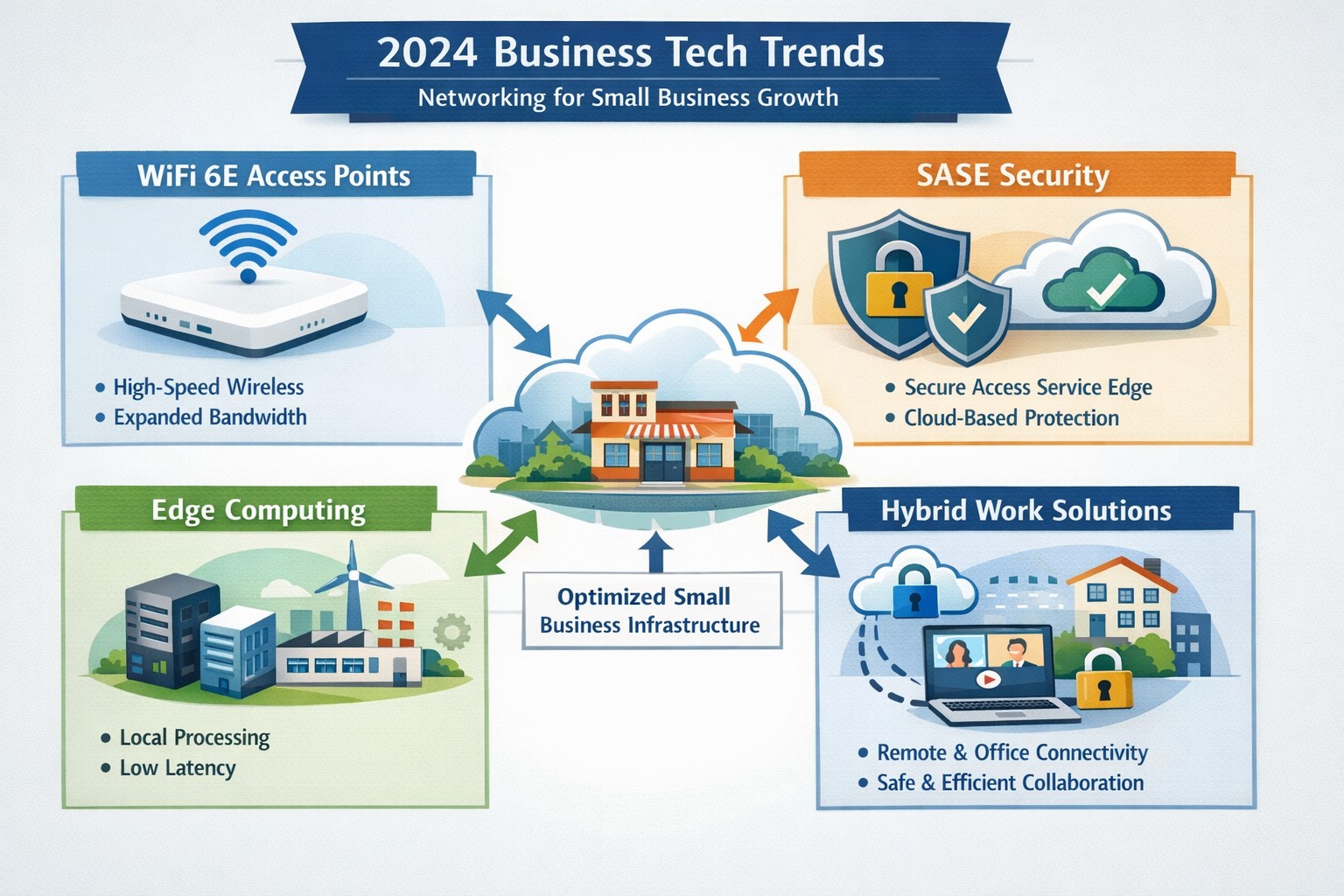
2024 networking trends like WiFi 6E and zero trust architecture prepare small businesses for hybrid work and cybersecurity demands.
As we enter 2024, the U.S. Chamber of Commerce reports that 64% of business owners believe their businesses are in good health, showing confidence in navigating the future. Technology has emerged as a key driver of success, enabling businesses to thrive in uncertain times. Farmhouse Networking has identified four essential technology trends that will empower businesses in 2024, propelling them towards growth and success.
1. Harnessing the Power of Artificial Intelligence
Artificial intelligence (AI) has moved beyond the realm of technology discussions and is now at the forefront of business success. Businesses utilizing AI credit it for increased success, as it offers game changing assistance in various areas of operations. AI tools can automate tasks, saving time and resources for businesses.
AI for Operational Efficiency
Businesses can leverage AI to automate expense management, correlate data from multiple sources to create meaningful reports, create sales presentations that address customer needs, and tackle tasks that were previously time-consuming. By harnessing AI, manufactures can optimize inventory, align staffing with peak hours, and identify opportunities for targeted promotions. Although implementing AI may require an initial investment, the positive impact it can have on businesses in 2024 is promising.
AI for Enhanced Customer Experiences
Customer experience plays a pivotal role in business success, with 34% of business leaders recognizing the pivotal role of technology in delivering exceptional experiences. Upgrading systems to ditch outdated tech and manual methods is a priority for many businesses in 2024. Chatbots, for instance, are invaluable for front-line customer service agents, providing round-the-clock support. Automated assistants and Unified Communications tools enhance customer interactions and employee productivity. These digital processes not only enhance retention and satisfaction but also create opportunities for cross-selling and upselling efforts.
2. Delivering Exceptional Digital Customer Experiences
Businesses understand the importance of delivering exceptional digital customer experiences in 2024. Upgrading systems and embracing efficient digital processes will be key to achieving this goal.
Upgrading Systems for Efficiency
Outdated technology and manual methods hinder efficiency. Businesses are expected to upgrade their systems by adopting AI, automating repetitive tasks, and migrating to the cloud. These solutions make information easily accessible, guide customers interactions, and improve employee productivity.
Embracing Cloud-based Solutions
A robust technology infrastructure is crucial for businesses to keep up with competition and exceed customer expectations. Automation software can save time and cut down on expenses by managing data and completing routine tasks. Mobile technology ensures network connectivity anywhere, anytime, allowing for collaboration on the go. Cloud based systems enables efficient management of IT costs plus offer flexibility and scalability, especially for businesses, as the workforce continues to move away from traditional office setups.
3. The Backbone of Business Operations: Fast and Reliable Connectivity
Fast and reliable connectivity is the backbone of efficient operations, seamless communication, and scalable expansion. Businesses across different sectors can benefit from investing in connectivity solutions.
Optimizing Inventory and Collaboration
Manufactures can leverage fast and reliable a to optimize inventory management. By having real-time visibility into inventory levels, manufactures can prevent stockouts and ensure they have the right products available when customers need them. Accountants can collaborate effectively without being limited by physical office spaces. Cloud connectivity allows them to access customer files, share updates, and communicate with team members regardless of their location.
Enhancing Healthcare Services
Connectivity plays a vital role in enhancing healthcare services. From telemedicine to remote patient monitoring, healthcare providers can offer more accessible and efficient care. Fast and reliable connectivity enables seamless communication between healthcare professionals and patients, facilitates the sharing of medical records, and supports the use of emerging technologies like artificial intelligence and Internet of Things (IoT) devices.
Safeguarding Customer and Company Devices
Investments in network connectivity not only benefit customers but also help safeguard customer and company devices. By adopting a complete network connectivity solution that includes reliable internet, network security measures, and disaster recovery solutions, businesses can protect sensitive data and ensure the smooth operation of their technology infrastructure.
4. Embracing the Future: Expanding Technology Spending
In 2024, CEOs are planning to expand their technology spending to stay competitive and meet evolving customer expectations. However, to fully leverage the benefits of technological investments, businesses need to partner with reputable companies that can provide robust network infrastructure.
Strengthening Technological Investments with Robust Networks
Businesses should partner with companies like Farmhouse Networking to reinforce their critical technological investments. Robust networks ensure reliable network connectivity, data security, and seamless integration of technology solutions. By partnering with trusted providers, businesses can enhance their technology infrastructure and drive growth.
Weathering Uncertainties with Tech Transformation
By staying ahead of technology trends, business owners can not only weather uncertainties but also emerge stronger and more resilient. Embracing the power of artificial intelligence, delivering exceptional digital customer experiences, building a strong technology infrastructure, and investing in fast and reliable network connectivity will position businesses for success in 2024 and beyond.
Embracing these tech trends and partnering with trusted providers will enable businesses to thrive in an ever-evolving business landscape.
Streamlining Your Company’s Technology Infrastructure
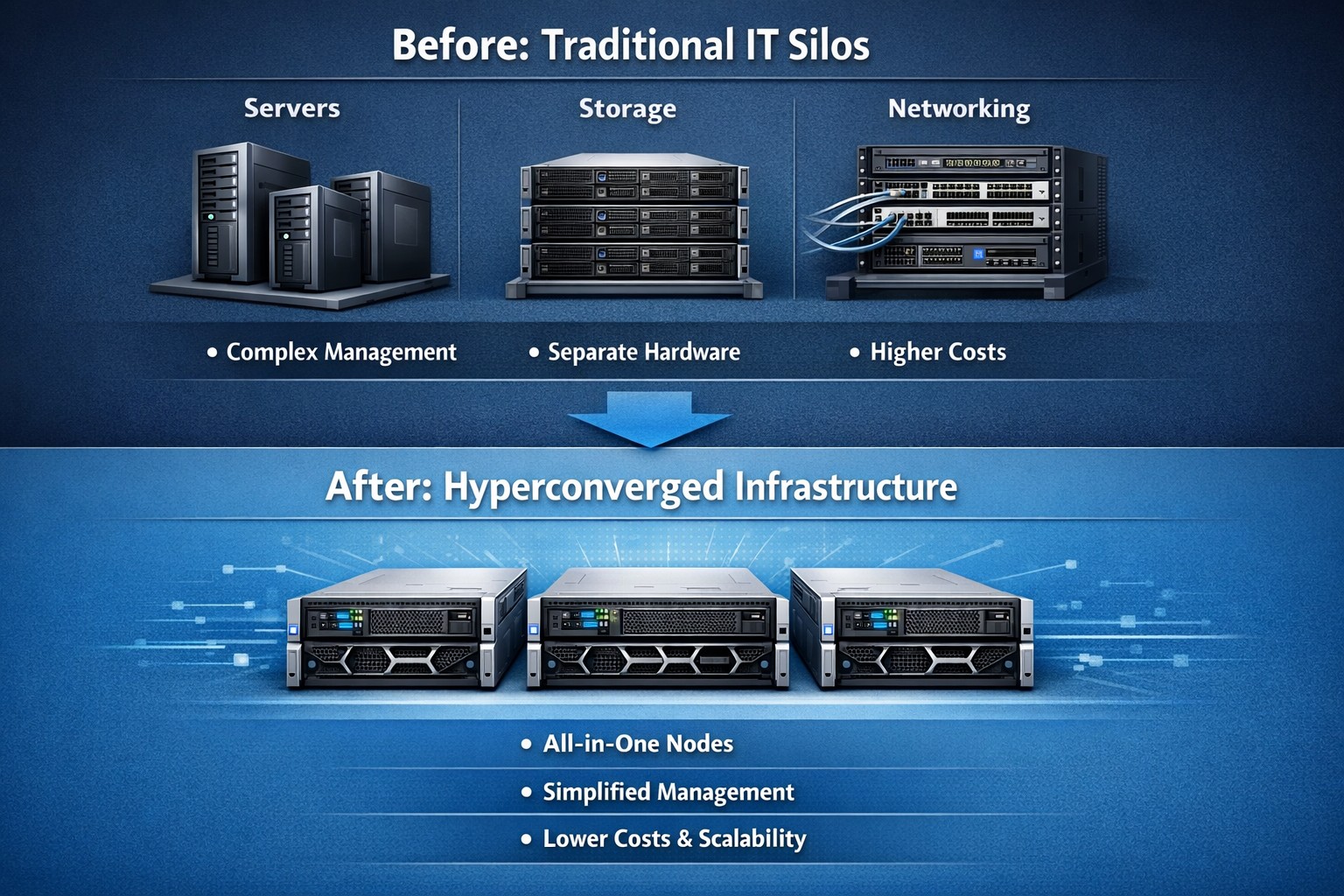
Hyperconvergence consolidates servers, storage, and networking into scalable HCI infrastructure, streamlining small business IT operations.
Modern businesses rely heavily on their IT infrastructure to operate efficiently and effectively. As companies grow, they often accumulate a hodgepodge of hardware and software systems that were never designed to work together. This lack of integration can lead to inefficiencies, increased costs, and a lack of agility in responding to changing business needs. To address these challenges, many businesses are turning to IT consolidation as a solution.
Understanding IT Consolidation
IT consolidation refers to the process of streamlining and centralizing a company’s technology infrastructure by combining multiple hardware and software systems into a cohesive and integrated environment. This consolidation can be done in various ways, such as merging separate hardware systems into a single platform or migrating to a hyperconverged infrastructure.
What is Hyperconvergence? Hyperconvergence is an emerging technology trend that combines storage, computing, and networking resources into a single, integrated system. It eliminates the need for separate hardware components and simplifies management. This approach offers several advantages, including increased efficiency, cost savings, improved business agility, and enhanced ability to support it.
The Benefits of IT Consolidation
Consolidating your technology infrastructure offers numerous benefits to businesses of all sizes. Let’s explore some of the key advantages:
Increased Efficiency: When businesses have multiple vendors for various technology services, resolving issues becomes a time-consuming and disjointed process. With consolidation, businesses can rely on a single managed service provider (MSP) who understands their entire system and can provide comprehensive support. This streamlines troubleshooting and reduces downtime, ultimately improving overall operational efficiency.
Cost Savings: Consolidating your technology with a single provider can also lead to significant cost savings. With a holistic view of your technology infrastructure, an MSP can identify redundancies, eliminate unnecessary services, and recommend more cost-effective solutions. Additionally, by bundling services under a single monthly fee, businesses can simplify their billing process and gain better visibility into their technology expenses.
Improved Business Agility: IT consolidation enables businesses to respond quickly to changing market conditions by simplifying processes and reducing the complexity of their technology environment. With a consolidated infrastructure, businesses can easily scale their operations, adopt new technologies, and implement changes without disruption.
Enhanced Support and Expertise: Working with an MSP for IT consolidation provides businesses with a supportive partner who understands their unique needs and goals. Unlike individual vendors who focus on selling their specific services, an MSP takes a holistic approach to ensure that all technology components work together seamlessly. They offer expert guidance, make better purchasing decisions, and provide ongoing support to optimize performance and security.
Implementing IT Consolidation
Implementing an IT consolidation strategy requires careful planning and execution. Here is a three-step process to guide you:
Step 1: Assess Your Technology Landscape: Before embarking on IT consolidation, it’s essential to assess your current technology landscape. Conduct a thorough audit of your hardware and software systems, identifying any gaps or redundancies. Consider your business needs and goals, as well as feedback from your employees and clients. This assessment will serve as a foundation for identifying areas where consolidation can bring the most significant benefits.
Step 2: Explore Hyperconvergence Solutions: As mentioned earlier, hyperconvergence is an increasingly popular approach to IT consolidation. Research and explore hyperconverged infrastructure solutions that align with your business requirements. Look for platforms that offer seamless integration of storage, computing, and networking resources while providing scalability, performance, and ease of management.
Step 3: Execute a Phased Consolidation Plan: To minimize disruption and ensure a smooth transition, it’s recommended to execute the consolidation plan in phases. Start by implementing the selected hyperconverged infrastructure platform alongside your existing systems. This allows for gradual adoption, training, and adjustment to the new technology. Once the new platform is fully integrated and employees are familiar with its features, you can begin eliminating redundant systems and optimizing your technology environment.
Let Farmhouse Networking evaluate your technology landscape, explore appropriate solutions, and execute a phased consolidation plan to streamline your company’s technology infrastructure and propel your business forward.
And God will generously provide all you need. Then you will always have everything you need and plenty left over to share with others. As the Scriptures say,
“They share freely and give generously to the poor. Their good deeds will be remembered forever.”
For God is the one who provides seed for the farmer and then bread to eat. In the same way, he will provide and increase your resources and then produce a great harvest of generosity in you. - 2 Corinthians 9:8-10
We use cookies to ensure that we give you the best experience on our website. If you continue to use this site we will assume that you are happy with it.