Apply these 9 Microsoft Teams meetings tips to enhance productivity and secure client calls
Ineffective meetings drain time and productivity. Mastering Microsoft Teams meetings ensures seamless collaboration, especially for remote teams in accounting, healthcare, or charity sectors where compliance and client trust matter.
Actionable Setup Steps
Business owners and IT departments can implement these steps for optimal Teams performance.
Verify hardware and network: Upgrade to Teams-certified devices like HD webcams and headsets; ensure 1.5 Mbps upload/download speeds per user. IT: Run network assessments via Teams admin center.
Configure meeting policies: In Teams admin center, enable lobby for external guests, restrict presentations to organizers, and auto-mute participants. Test via a pilot meeting.
Pre-load apps and integrations: Install Whiteboard, Planner, and OneNote; share agendas/files 24 hours ahead using channel posts.
These steps cut setup time by 30-50% based on Microsoft benchmarks.
9 Key Tips for High-Impact Meetings
Apply these practical tips, drawn from Microsoft and expert sources, to run concise, engaging sessions.
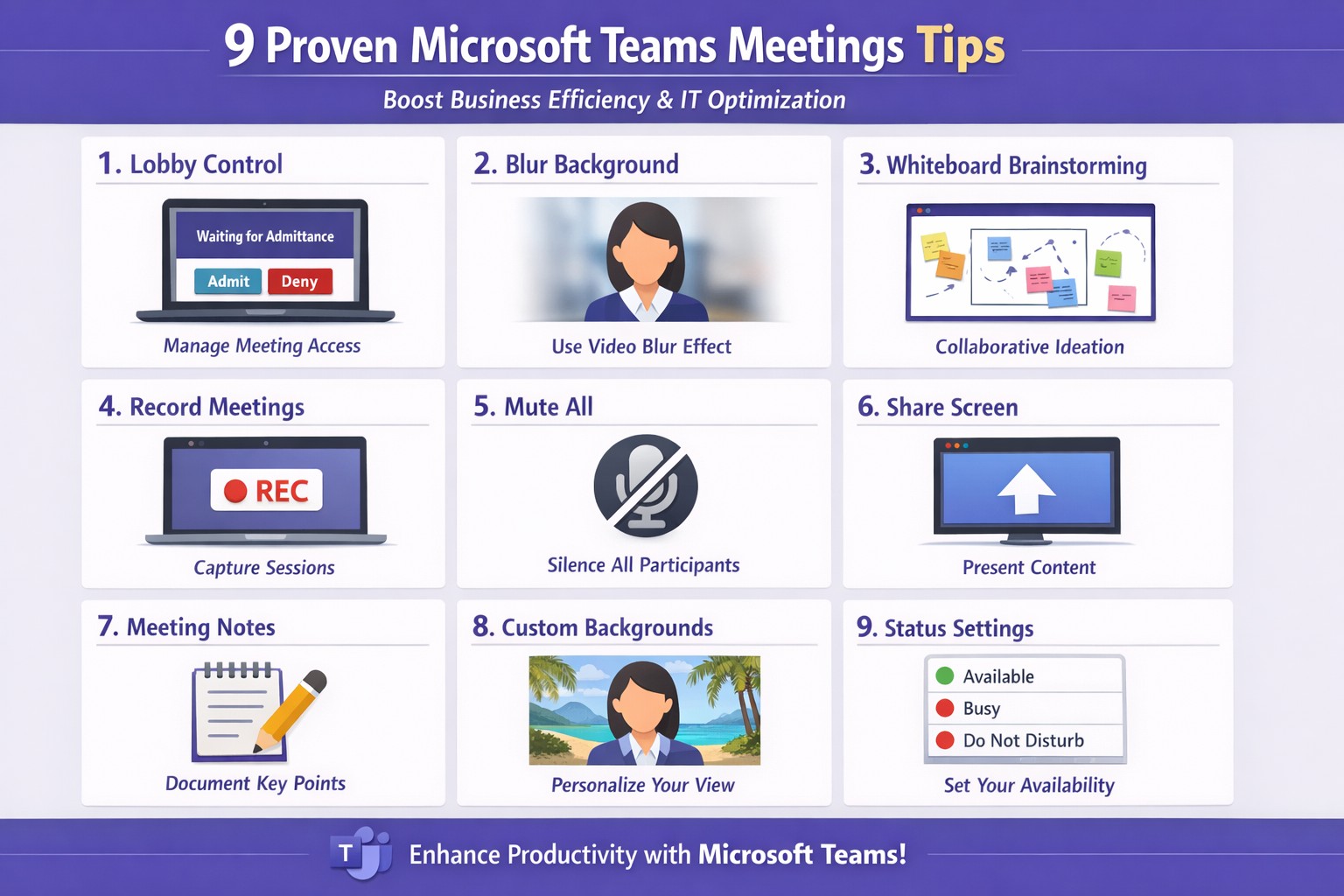
Control access with lobby: Require approval for entrants; mute all on join to minimize disruptions.
Mandate video with blur: Turn on cameras for face-to-face feel; use background blur to focus on faces.
Share selectively: Present specific windows/apps, not full desktop; request control for annotations.
Brainstorm via Whiteboard: Co-edit in real-time; save sessions automatically for follow-up.
Assign roles: Designate leader for flow, admin for tech (muting, lobby); use chat for side notes.
Leverage transcripts: Enable live captions/transcripts for accuracy, accessibility.
Keep short with breaks: Target 15-30 min huddles; park off-topic items.
Record and review: Auto-transcribe; search keywords post-meeting for action items.
Tip Category
Benefit
IT Action
Access Control
Reduces chaos
Set policies in admin center
Video/Sharing
Boosts engagement
Test bandwidth tools
Collaboration Tools
Enhances output
Integrate apps pre-rollout
FAQs for Client Inquiries
Q: How do we handle external clients securely? A: Use guest access with lobby approval and end-to-end encryption; review compliance in Teams settings.
Q: What if bandwidth lags? A: Lower video to 720p, disable HD; IT can prioritize QoS on routers.
Q: Can non-Teams users join? A: Yes, via browser link—no install needed; limit to view-only if sensitive.
Q: How to track action items? A: Assign in chat/Whiteboard; use Planner integration for tasks.
How Farmhouse Networking Helps
Farmhouse Networking specializes in tailored Microsoft 365 setups for accounting, healthcare, and charity businesses. We audit your Teams environment, implement these tips via custom policies, and optimize for SEO-driven branding—driving organic traffic and B2B leads. Our IT experts handle migrations, training, and 24/7 support to convert visitors into clients.
IT-backed strategies for business owners: standardize platforms and automate follow-ups for productive remote team meetings.
Wasted virtual meetings cost small businesses thousands in lost productivity annually. As a business owner managing remote teams, you need IT-backed strategies that deliver results fast. This post reveals five practical, tech-focused steps—tailored for you and your IT department—to transform chaotic calls into high-impact sessions that drive growth.
Standardize Your Meeting Platform
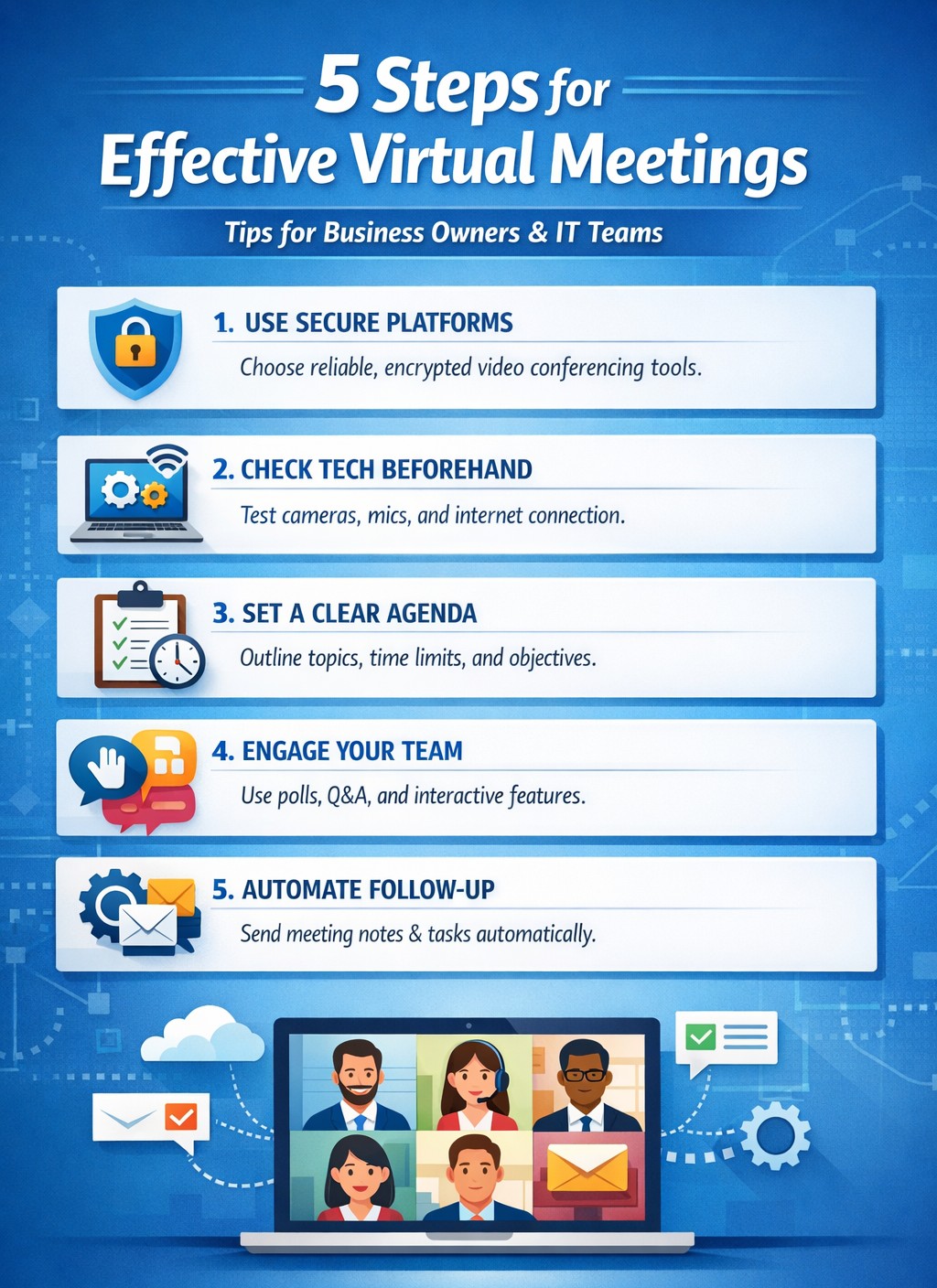
Choose one secure, scalable platform like Microsoft Teams or Zoom Enterprise to eliminate tool-switching chaos. IT teams should evaluate bandwidth needs, enable end-to-end encryption, and integrate with calendars/CRMs for seamless scheduling.
Business owners: Mandate platform use in your remote work policy.
IT steps: Deploy single sign-on (SSO), test integrations with tools like Slack or Google Workspace, and set up auto-updates to prevent vulnerabilities. This cuts setup time by 40% and boosts attendance reliability.
Pre-Meeting Tech Checks and Training
Technical glitches derail 30% of virtual meetings. Require all participants—including yourself—to test audio, video, and internet 15 minutes prior using platform diagnostics.
Business owners: Schedule mandatory quarterly training sessions.
IT steps: Roll out a “tech readiness checklist” via email automation, monitor network performance with tools like Wireshark, and provide on-call support during peak hours. Result: Fewer dropouts, higher engagement.
Create Structured Agendas with Role Assignments
Vague agendas lead to rambling; detailed ones keep teams focused. Share agendas 24 hours ahead via the platform, assigning roles like facilitator, note-taker, and timekeeper.
Business owners: Approve agendas before distribution to align with goals.
IT steps: Use platform features for polls, timers, and shared docs; integrate with project tools like Asana for real-time action item tracking. This ensures decisions stick post-meeting.
Enforce Engagement Tools and Moderation
Remote teams disengage twice as fast without visuals. Activate cameras, use polls/reactions, and designate an IT-trained moderator to manage chat and mute distractions.
Business owners: Set ground rules like “cameras on for key discussions.”
IT steps: Configure breakout rooms for sub-teams, enable AI transcription for recaps, and monitor for security breaches. Keeps meetings interactive and inclusive.
Post-Meeting Follow-Up Automation
Meetings fail without accountability. Send automated recaps with action items, recordings, and feedback surveys within 30 minutes.
Business owners: Review metrics like completion rates weekly.
IT steps: Automate via platform APIs (e.g., Zapier integrations), archive securely, and analyze attendance data for trends. Drives 25% better follow-through.
Common Questions from Business Owners
Q: How do we secure meetings against hacks? A: IT should enable waiting rooms, passcodes, and regular firmware updates; avoid free tiers prone to breaches.
Q: What if team internet varies by location? A: IT assesses remote setups, recommends VPNs or QoS routing, and offers audio-only fallbacks.
Q: How to measure meeting ROI? A: Track via platform analytics: engagement scores, task completion rates, and time saved.
How Farmhouse Networking Helps
Farmhouse Networking specializes in IT infrastructure for remote teams in accounting, healthcare, and nonprofits. We audit your setup, deploy secure platforms, train staff, and monitor 24/7—ensuring zero downtime. Our clients see 35% productivity gains from optimized virtual collaboration.
Call to Action
Ready to supercharge your virtual meetings? Email support@farmhousenetworking.com for a free IT assessment tailored to your business.
Configure Teams meeting privacy: Turn off anonymous access and activate lobby to protect business discussions.
Microsoft Teams meetings often involve sensitive discussions on finances, strategies, and client data—yet unauthorized access risks data leaks and disruptions. Implementing targeted privacy controls ensures secure collaboration without stifling productivity.
Key Privacy Risks in Teams Meetings
Teams meetings face threats like “zoombombing,” where anonymous users join via public links, and data exposure through screen shares or recordings. Microsoft reports that disabling anonymous join reduces unauthorized entries significantly. External bots and unverified guests compound these issues, especially in hybrid work setups common for accounting, healthcare, and charity sectors.
Practical Action Steps
Follow these steps with your IT department to lock down Teams privacy. Prioritize admin center changes for organization-wide impact.
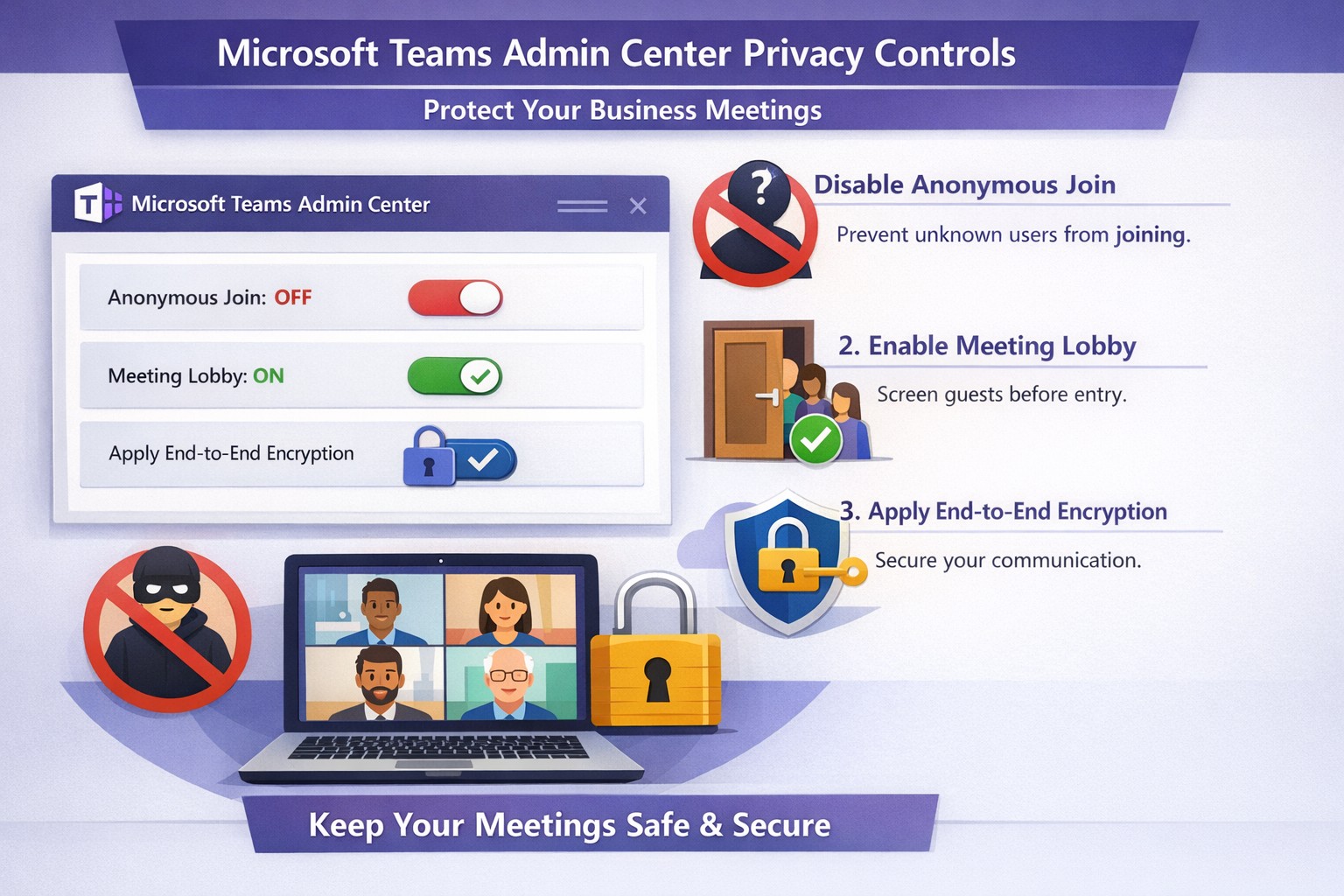
Disable Anonymous Joins: In the Teams admin center (admin.teams.microsoft.com), navigate to Meetings > Meeting policies. Set “Anonymous users can join” to Off. This blocks uninvited participants and recording bots.
Enable Meeting Lobby: Require all external participants to wait in the lobby. Under Meeting settings > Participants, toggle “Who can bypass the lobby?” to organizers and presenters only. Manually approve entrants to verify identities.
Activate CAPTCHA Verification: For remaining external access, enable CAPTCHA for anonymous users. This adds a human-check layer without fully restricting guests.
Use End-to-End Encryption (E2EE): For confidential calls, enable E2EE in meeting options (requires Teams Premium). Only participants decrypt audio/video; Microsoft cannot access it.
Apply Watermarking and Sensitivity Labels: With Teams Premium, turn on watermarks displaying participant emails over shared screens/videos. Create sensitivity labels enforcing lobby waits, auto-recording, and chat restrictions.
Control Recordings and Transcripts: Disable auto-recording for non-sensitive meetings. Inform participants and store files securely in OneDrive with 60-day retention.
Educate Users: Train staff to check participant lists, avoid public screen shares, and deny unknowns. Use quiet, private spaces for calls.
Implement via admin center first, then test in a pilot meeting. These steps balance security with usability.
FAQ: Client Inquiries Answered
Q: Can external clients still join securely? A: Yes—lobby approval and CAPTCHA allow vetted guests while blocking randos. Federated domains enable seamless access for partners.
Q: What’s needed for advanced features like E2EE? A: Teams Premium (or E5 for labels). Basic encryption is always on for transit/rest, but Premium adds layers.
Q: How do I prevent screenshot leaks? A: Watermarks overlay user IDs on shared content, deterring unauthorized captures. Combine with “Do not forward” calendar labels.
Q: Are recordings private? A: Stored in organizer’s OneDrive; participants notified. Get explicit consent for sensitive sessions, especially in healthcare/charities.
Q: What about one-on-one vs. group calls? A: One-on-one calls offer full E2EE by default; groups need Premium for equivalent protection.
How Farmhouse Networking Helps
Farmhouse Networking specializes in B2B IT for accounting, healthcare, and charity firms. We audit your Teams setup, deploy these privacy configs, and integrate with compliance needs like HIPAA or nonprofit data rules. Our SEO-optimized websites and lead-gen strategies turn secure Teams into a client magnet—showcasing reliability drives conversions. Skip the hassle; we handle migrations, training, and 24/7 monitoring.
Call to Action
Ready to safeguard your Teams meetings and boost client trust? Email support@farmhousenetworking.com for a free privacy audit and custom strategy.
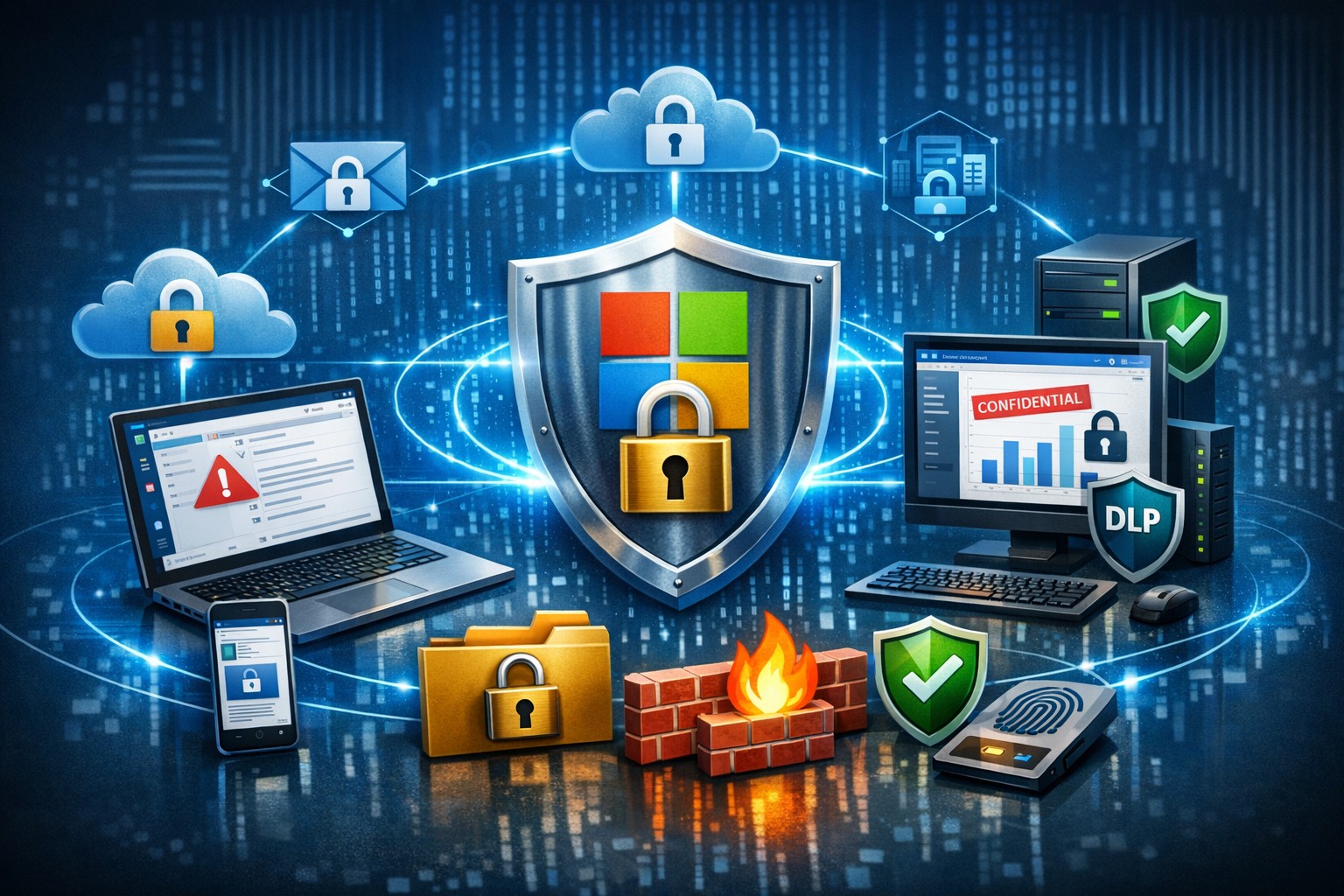
Microsoft 365 dashboard showing data protection across apps, devices, and endpoints—encrypt, prevent loss, stay compliant.
A single data breach can cost millions in losses, legal fees, and lost trust. Microsoft 365 provides robust, built-in tools to protect your company data across Exchange, Teams, OneDrive, SharePoint, and endpoints, ensuring security without disrupting productivity.
Key Microsoft 365 Protection Features
Microsoft 365 employs a defense-in-depth approach with encryption at rest and in transit using AES-256 standards, safeguarding data in cloud storage and during transfers. Data Loss Prevention (DLP) scans for sensitive info like financial data or PII across apps, blocking unauthorized shares in real-time. Additional layers include Microsoft Defender for phishing/malware defense, Azure AD for identity protection with MFA, and Purview for compliance labeling.
Practical Action Steps
Follow these steps with your IT team to implement protection quickly.
Enable Multi-Factor Authentication (MFA): In the Microsoft 365 admin center, go to Security > Authentication methods. Roll out to admins first, then all users—MFA blocks 99.9% of account compromises.
Configure DLP Policies: Navigate to Microsoft Purview > Data loss prevention. Create policies for sensitive data types (e.g., credit cards, health records) across Exchange, Teams, and OneDrive; test in audit mode before blocking.
Set Up Encryption and Labeling: Use Azure Information Protection to label files/emails as “Confidential.” Enable at-rest encryption (default) and transport rules for outbound emails.
Deploy Endpoint Protection: Integrate Microsoft Intune for device compliance—enforce policies like secure boot and BitLocker. Run Secure Score in the admin center to prioritize fixes.
Conduct Audits and Training: Review Unified Audit Logs weekly via Purview. Launch phishing simulations with Defender and train staff quarterly on recognizing threats.
Backup Critical Data: Supplement with retention policies, but add third-party backups for Teams/OneDrive as Microsoft retention isn’t full recovery.
These steps take 1-2 weeks for a small team and scale with business growth.
FAQ: Client Inquiries Answered
How does Microsoft 365 protect data on employee mobile devices? Intune manages apps/devices with conditional access, ensuring only compliant devices access data; it enforces encryption and remote wipe if lost.
Is DLP enough for healthcare/accounting compliance? Yes for HIPAA/GDPR basics via predefined templates, but customize policies and audit logs for audits; pair with insider risk tools in Purview.
What if we have hybrid/on-prem systems? Microsoft 365 integrates via Azure AD Connect for unified identity/security; extend DLP to on-prem Exchange with hybrid agents.
How much does advanced security cost? Core features are in E3/E5 plans; Defender/Advanced Threat Protection requires E5 or add-ons (~$5-12/user/month).
Can we recover deleted data? OneDrive/SharePoint offer 93-day retention; eDiscovery holds data longer. Full backups recommended beyond defaults.
How Farmhouse Networking Helps
Farmhouse Networking specializes in Microsoft 365 security for accounting, healthcare, and charity sectors, driving organic traffic via SEO-optimized blogs while converting visitors to B2B clients. We handle full implementation: assessing your Secure Score, deploying DLP/Intune, training staff, and optimizing branding/SEO for lead gen. Our custom strategies ensure compliance (e.g., HIPAA for healthcare), reduce breach risks by 80%+, and boost customer experience with zero-downtime setups. Past clients saw 40% traffic growth from secure, branded sites.
Ready to protect your data? Email support@farmhousenetworking.com for a free Microsoft 365 security audit and personalized strategy.
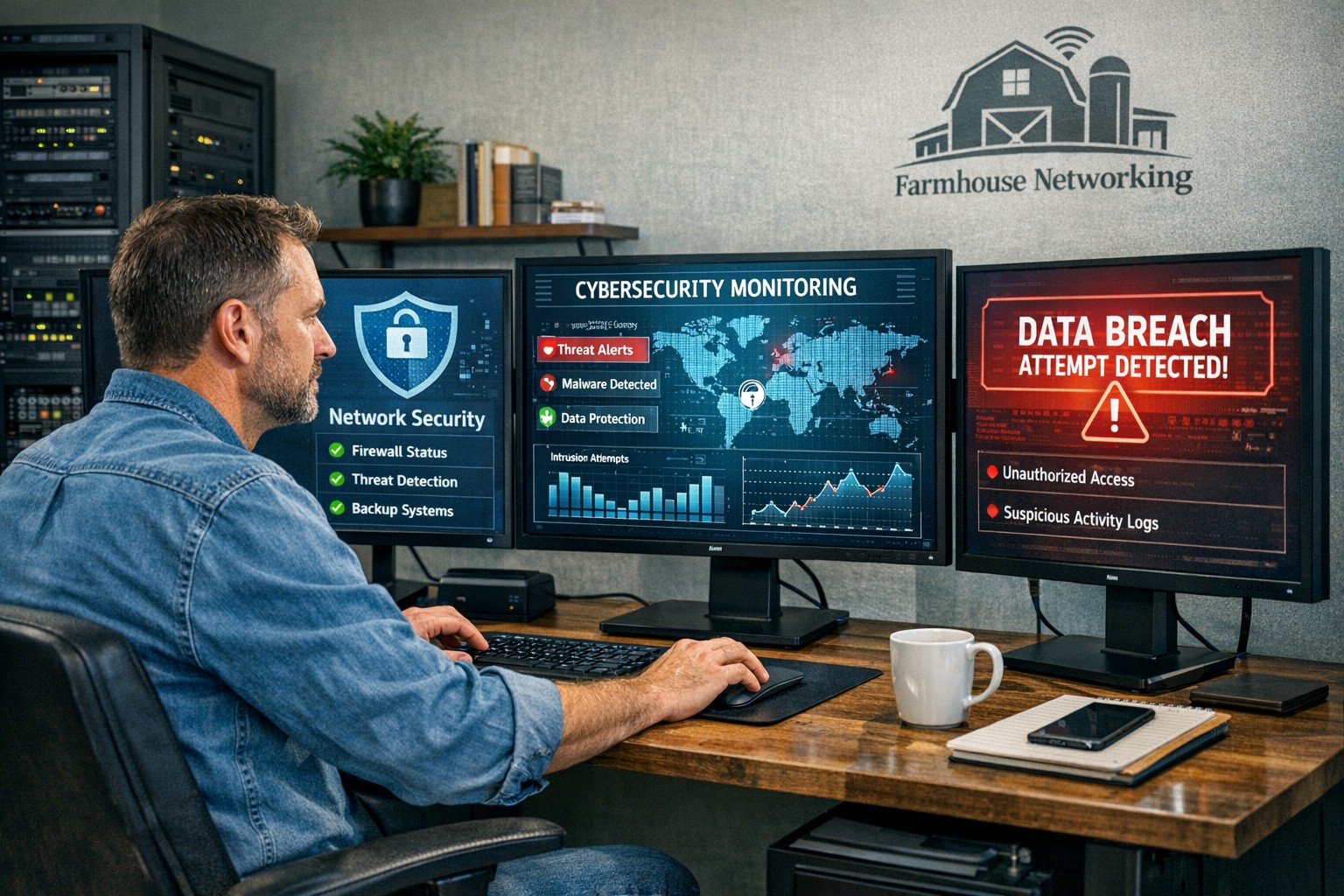
Proactive cybersecurity measures help business owners protect critical data and prevent costly security breaches.
One security breach can cost your business more than money — it can cost your reputation. From phishing scams to ransomware attacks, data security threats are becoming more sophisticated each year. But here’s the good news: with the right protection strategies, you can dramatically reduce your risk.
Whether you’re running a small company or a growing enterprise, protecting business data is no longer optional — it’s a core part of your business strategy.
Why Business Data Security Matters
Cybercriminals target businesses of all sizes — especially small and midsize companies that often have fewer security defenses. According to IBM’s Cost of a Data Breach Report, the average small business breach costs over $4 million when factoring in downtime, lost trust, and legal fees.
Beyond financial losses, breaches can leak customer information, expose proprietary data, and permanently erode credibility. In short: the most successful companies treat cybersecurity as an investment, not an expense.
Action Steps to Protect Your Business Data
Here are practical steps you and your IT team can take today to guard your systems from digital threats:
Implement Multi-Factor Authentication (MFA) Require MFA across all systems — especially for email, remote access, and cloud platforms. It adds an extra layer of defense beyond passwords.
Keep Software and Devices Updated Outdated systems are one of the easiest entry points for cyberattacks. Regularly patch software, update firmware, and remove unsupported devices from your network.
Encrypt Sensitive Data Data encryption ensures that even if files are stolen, they’re unreadable without authorization. Use encryption for files both at rest (stored) and in transit (sent).
Train Employees on Cybersecurity Best Practices Human error accounts for nearly 9 in 10 breaches. Conduct regular training on phishing awareness, password hygiene, and safe device handling.
Back Up Data Securely and Frequently Maintain automated backups stored in secure, isolated environments. Test your recovery process regularly to ensure data can be restored quickly.
Use Endpoint Protection and Firewalls Deploy advanced endpoint protection tools that include antivirus, intrusion detection, and behavior analysis. Combine this with a next-generation firewall to monitor network traffic.
Establish an Incident Response Plan Have a clearly documented procedure for detecting, reporting, and containing breaches. This reduces downtime and ensures a coordinated response if an attack occurs.
Client Questions and Expert Answers
Q: What’s the biggest cybersecurity risk for small businesses today? A: Phishing attacks remain the top threat. Cybercriminals trick employees into revealing passwords or installing malicious software via deceptive emails. Continuous employee training is the best defense.
Q: How often should we audit our security systems? A: At least once per year — but ideally every six months. Regular security assessments can uncover vulnerabilities before they evolve into costly breaches.
Q: We already use antivirus software. Isn’t that enough? A: Unfortunately, antivirus alone can’t detect modern threats like ransomware or insider attacks. A layered approach — combining advanced endpoint protection, MFA, and encrypted backups — provides broader coverage.
Q: What if we don’t have an in-house IT team? A: Partnering with a managed IT provider, like Farmhouse Networking, ensures your security systems are monitored, updated, and optimized by professionals without needing to hire full time staff.
How Farmhouse Networking Can Help
At Farmhouse Networking, we specialize in helping businesses strengthen their cybersecurity from the ground up. Our team provides proactive services that protect your data, improve network reliability, and ensure compliance with today’s data protection standards.
Here’s how we can support your efforts:
Comprehensive Security Audits: Identify weaknesses and design customized security improvements.
Managed IT & Monitoring: 24/7 system monitoring and rapid-threat response to prevent downtime.
Employee Security Training: Ongoing education sessions to keep your team prepared against the latest threats.
Data Backup and Recovery Planning: Secure cloud backup solutions designed to safeguard business continuity.
With Farmhouse Networking, you gain a trusted partner who’s dedicated to protecting your systems so you can focus on running your business with confidence.
Take the Next Step
Your business data deserves protection that’s proactive, not reactive. Don’t wait until an attack happens — act now to build a secure digital foundation.
Email support@farmhousenetworking.com to learn how Farmhouse Networking can help secure your data, reduce risk, and keep your operations running smoothly.
A small business owner leveraging modern cybersecurity tools—firewalls, multi‑factor authentication, and backups—to protect their company’s network and sensitive client data from cyber threats.
You may think cyberattacks are a “big‑company problem.” In 2026, that assumption is one of the most dangerous blind spots you can have. Cybercriminals increasingly target SMBs precisely because budgets are tighter, security is lighter, and breaches in small environments can be just as costly as in large enterprises. The question is no longer if a threat will hit your business, but when—and whether your people, data, and reputation are ready.
For a business‑owner audience, this post breaks down what “good cybersecurity” actually looks like in practice, gives you concrete steps your team can take, answers common client‑facing concerns, and shows how Farmhouse Networking can help you implement and maintain these protections without overhauling your operations.
Why SMBs Are Prime Targets
Cybercriminals are opportunistic: they look for the path of least resistance. SMBs often have limited IT staff, minimal security budgets, and patchy policies around email, passwords, and backups. That combination makes them ideal targets for ransomware, phishing, and data‑theft campaigns that can cripple operations and destroy customer trust in a matter of hours.
Regulatory scrutiny is also tightening. Even if you’re not a multinational, you may still face fines or contractual penalties if client or partner data is lost in a breach. Investing in cybersecurity is no longer “optional overhead”—it’s a core cost of doing business in 2026.
Practical Cybersecurity Steps for Business Owners
You don’t need a Fortune‑500‑level security team, but you do need structure. Here are the key areas every small or mid‑size business should address, along with specific actions your owner and IT team can immediately act on.
1. Lock Down Access with Strong Authentication
Require multi‑factor authentication (MFA) for all accounts that hold customer data, email, banking, or cloud services.
Prefer authenticator apps or hardware keys over SMS‑based codes to reduce phishing and SIM‑swapping risk.
Enforce strong password policies and provide a company‑approved password manager so teams don’t reuse passwords across personal and business services.
2. Patch Systems and Secure Endpoints
Turn on automatic updates for operating systems, browsers, and core business software (accounting, CRM, practice management).
Deploy next‑generation antivirus or EDR tools that monitor unusual behavior, not just known malware signatures.
Ensure every device that touches business data has disk encryption, screen‑lock timing, and basic firewall rules enabled.
3. Protect Networks and Wi‑Fi
Use business‑grade firewalls with default‑deny rules and logging, and avoid exposing unnecessary ports to the internet.
Configure Wi‑Fi networks with WPA3 encryption (or WPA2‑Enterprise), and keep guest Wi‑Fi on a separate, isolated segment.
Segment your network so that high‑value systems (financial and HR data, servers) sit on a separate, more tightly controlled segment.
4. Back Up Data and Plan for Incidents
Define what data is critical (client records, financials, contracts) and back it up regularly to an encrypted, cloud‑ or off‑site‑based solution.
Store multiple recovery points and test restorations periodically to ensure backups actually work.
Put a simple incident response plan in place: who gets notified, who talks to clients, and how you’ll isolate affected systems during a breach.
5. Train Your Team and Manage Email Risk
Conduct regular, short security training focused on phishing, password hygiene, and safe handling of sensitive data.
Deploy an email security gateway that scans attachments, rewrites malicious URLs, and quarantines suspicious messages before they reach inboxes.
Establish clear rules for sharing sensitive data via email (e.g., no client SSNs or insurance numbers in plain text) and enforce them.
Common Client Questions (and How to Answer Them)
When you talk to clients about cybersecurity, they’ll naturally ask around cost, risk, and responsibility. Framing these clearly builds trust and positions your business as a professional partner, not just a vendor.
“Won’t this slow down our operations?”
Answer: Modern security tools are designed to run quietly in the background. Properly configured firewalls, MFA, and endpoint protection add minimal friction while stopping the vast majority of automated attacks. Think of it like seat belts and airbags: you don’t feel them every day, but they’re critical when something goes wrong.
“We’re a small business; do we really need this much protection?”
Answer: Cybercriminals are increasingly using AI‑driven tools to probe and exploit small businesses precisely because defenses are weaker. A single breach can mean downtime, legal fees, and reputational damage that can take years to recover from. Basic, layered security is now table stakes for reputable SMBs.
“How do you know if our network is secure enough?”
Answer: There’s no “perfectly secure” state, but there are measurable baselines:
Are critical systems encrypted and backed up?
Is MFA enforced on all key accounts?
Are software and firmware updated regularly?
Are there clear policies and training for staff? A third‑party security audit or network assessment can map these gaps and prioritize where to invest next.
How Farmhouse Networking Can Help
Farmhouse Networking is built to help small and mid‑size businesses implement, manage, and maintain these cybersecurity measures without the overhead of a full‑time, in‑house security team. We focus on practical, cost‑effective solutions that fit your budget and workflow.
Here’s how we support your cybersecurity efforts:
Network and firewall configuration: We design and harden your network so that only necessary services are exposed, and sensitive systems are segmented and monitored.
Endpoint protection and patch management: We deploy and manage modern antivirus/EDR tools, ensure automatic updates, and enforce device‑level security policies across laptops, desktops, and mobile devices.
MFA, password policy, and access controls: We help you implement MFA everywhere it matters and set up role‑based access so employees only see the data they need.
Backup and incident readiness: We design a backup strategy tailored to your business‑critical data and help you define a simple incident response playbook so you know what to do if something goes wrong.
Ongoing monitoring and training support: We can monitor key security events and provide guidance on regular, brief security training sessions so your team stays alert without disrupting daily operations.
Take the Next Step Today
If you’re a small or mid‑size business owner, now is the time to treat cybersecurity as a core business function, not an afterthought. Simple, layered defenses—strong authentication, regular patching, secure networks, and reliable backups—can dramatically reduce your risk and keep your operations running even when threats emerge.
If you’d like to see how Farmhouse Networking can help you implement these steps with minimal disruption to your team, email us atsupport@farmhousenetworking.comfor a consultation. We’ll review your current setup, identify your top risks, and build a tailored plan that keeps your data, customers, and reputation safe in 2026 and beyond.
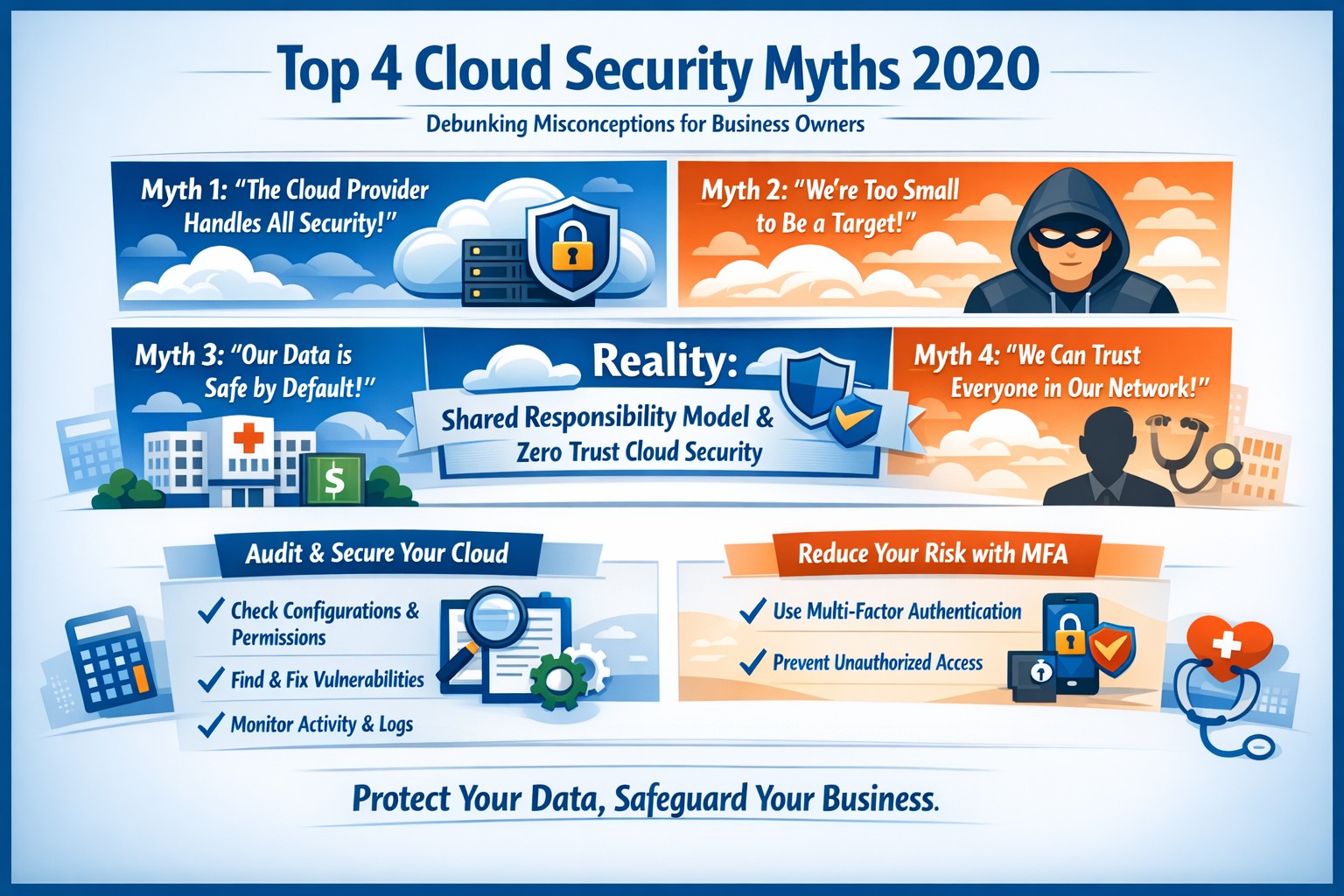
Breaking down 2020 cloud security myths: Shared responsibility, tool overload, and visibility gaps—key facts for businesses.
Cloud adoption surged in 2020, with businesses in accounting, healthcare, and nonprofits relying on it for scalability and cost savings. Yet persistent myths about cloud security created hesitation, exposing firms to real risks like data breaches that cost millions. This post debunks the top four myths from 2020 insights, empowering you with facts and actionable steps.
Myth 1: Cloud Providers Handle All Security
Many owners assumed providers like AWS or Microsoft secured everything end-to-end. In reality, the shared responsibility model meant providers handled infrastructure, but you owned data protection, access controls, and configurations.
Misconfigurations caused 80% of breaches, not provider failures. Businesses shifting to cloud without internal controls faced gaps in identity management and encryption.
Myth 2: More Security Tools Mean Better Protection
Stacking tools from multiple vendors seemed smart, but it often created blind spots. Surveys showed 70% of firms used over 100 controls, leading to fragmented visibility and overlooked threats.
Too many tools increased complexity without unified threat detection. Attackers exploited overlaps, as seen in hybrid environments where on-prem and cloud silos persisted.
Myth 3: Cloud Is Inherently Safer Than On-Premises
Cloud hype fueled this, but sprawl across multi-cloud setups amplified risks like unmanaged identities. Providers patched well, yet customer errors—such as exposed APIs—drove most incidents.
Fact: On-prem breaches outnumbered pure cloud ones, but hybrid risks blended endpoints and cloud, demanding end-to-end auditing.
Myth 4: Cloud Visibility Is Simple
Owners thought dashboards provided full insight, but dynamic resources (e.g., auto-scaled servers) hid shadow IT. Without continuous monitoring, you missed rogue accounts or vulnerabilities.
Breaches often started outside cloud via stolen credentials, underscoring the need for holistic views.
Practical Action Steps
Take these steps with your IT team to secure cloud operations:
Audit Configurations Weekly: Use native tools like AWS Config or Azure Policy to scan for public buckets and weak IAM roles. Remediate high-risk items immediately.
Implement Zero-Trust Access: Enforce multi-factor authentication (MFA) and least-privilege policies via tools like Okta. Rotate keys quarterly.
Centralize Monitoring: Deploy SIEM (e.g., Splunk Cloud) integrated with CSP logs for real-time alerts on anomalies.
Encrypt Everything: Apply AES-256 for data at rest/transit; test decryption quarterly to verify compliance (HIPAA-relevant for healthcare).
Conduct Penetration Tests: Hire ethical hackers biannually to simulate attacks, focusing on API endpoints.
These reduce breach risk by 50%+ per industry benchmarks.
Step
Tool/Example
Expected Outcome
Audit Configurations
AWS Config
Identifies 90% of misconfigs
Zero-Trust Access
Okta MFA
Blocks 99% credential attacks
Centralize Monitoring
Splunk Cloud
Cuts detection time to minutes
Encrypt Data
AWS KMS
Meets HIPAA/GDPR standards
Pen Tests
External firm
Uncovers hidden exploits
Client FAQ
Q: How do we know our data is safe from provider access? A: Providers like Microsoft use multi-tenant isolation; engineers need just-in-time approval. Your encryption keys stay under your control.
Q: What if we’re in accounting/healthcare with strict compliance? A: Map controls to NIST or HIPAA via frameworks like FedRAMP. Regular audits ensure audit trails for client trust.
Q: Multi-cloud adds complexity—how to manage? A: Use unified platforms like Prisma Cloud for cross-provider visibility, avoiding vendor lock-in.
Q: What’s the ROI on fixing these myths? A: Firms with mature cloud security report 30% lower breach costs and faster recovery.
How Farmhouse Networking Helps
Farmhouse Networking specializes in B2B cloud security for accounting, healthcare, and charities. We conduct free audits to expose misconfigs, design zero-trust architectures, and integrate monitoring tailored to your stack. Our SEO-optimized websites and lead-gen strategies drive organic traffic growth, converting visitors into long-term partners. We handle compliance mapping, reducing your IT burden while boosting client confidence.
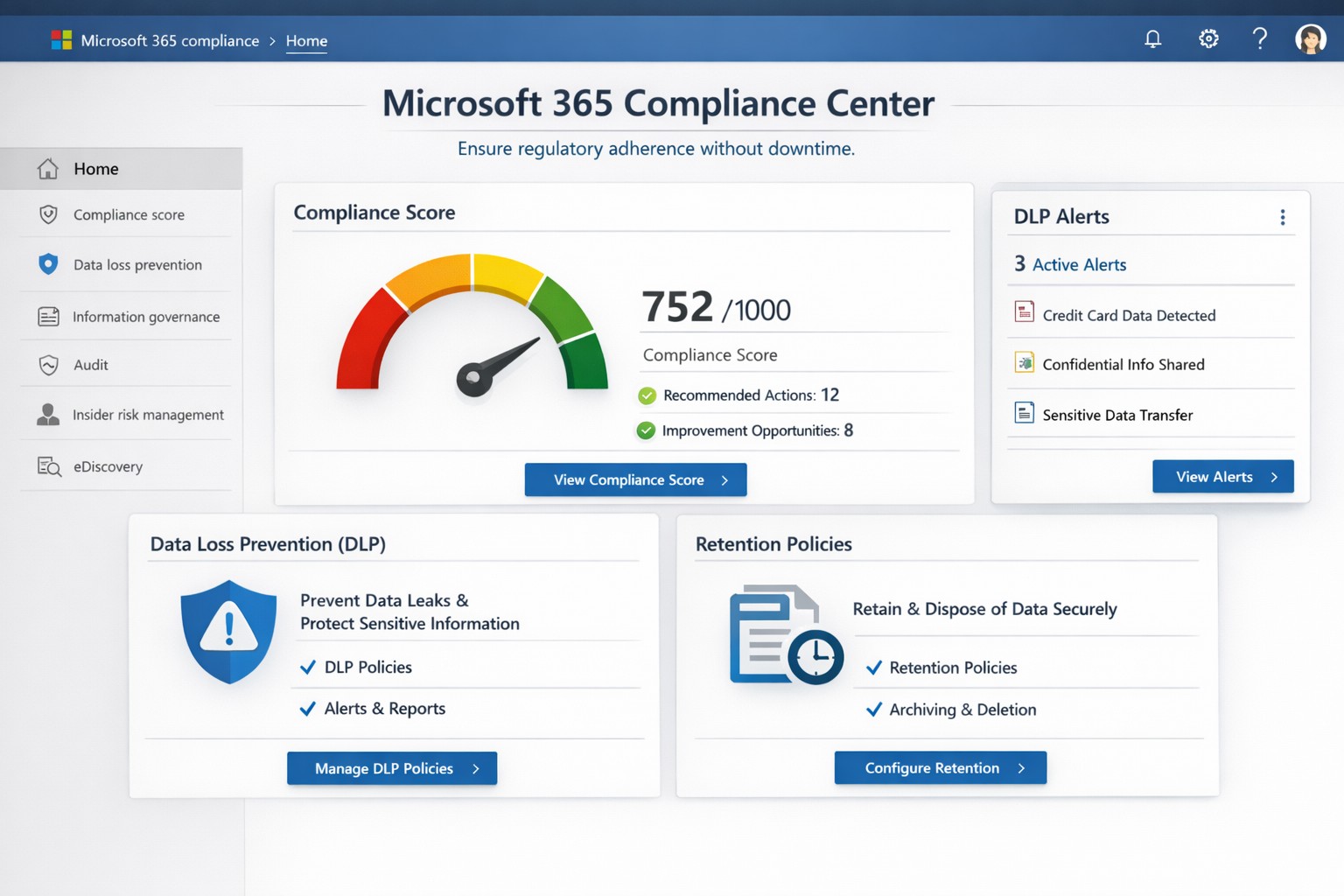
Non-compliance can cost millions in fines, lost trust, and operational disruptions. Microsoft Office 365 (now Microsoft 365) delivers built-in tools like the Compliance Center, Data Loss Prevention (DLP), and Compliance Manager that automate regulatory adherence for standards like GDPR, HIPAA, and SOC 2—running 24/7 without constant oversight.
Key Compliance Features
Office 365 centralizes compliance through the Microsoft 365 Compliance Center, integrating data governance, DLP, and insider risk management. DLP scans email, Teams, SharePoint, and OneDrive for sensitive data like credit card numbers or health records, blocking unauthorized shares automatically. Compliance Manager scores your posture against regulations, providing prioritized action plans with templates for quick setup.
Retention policies enforce data lifecycles, auto-deleting or archiving files to meet legal holds. Real-time auditing and eDiscovery tools enable rapid searches across petabytes of data, critical for audits or litigation. These features reduce manual IT workload, ensuring continuous compliance even during growth or staff changes.
Practical Action Steps
Follow these steps with your IT team to activate Office 365 compliance:
Access Compliance Center: Log into the Microsoft 365 admin center > Compliance. Review your Compliance Score and assign roles (e.g., Compliance Administrator).
Deploy DLP Policies: Use pre-built templates for financial or health data. Define rules (e.g., block external sharing of SSNs), test in audit mode, then enforce. Applies to Exchange, SharePoint, OneDrive, Teams, and endpoints.
Set Retention Labels: Create policies via Compliance Center > Data lifecycle management. Tag documents (e.g., retain contracts 7 years), publish labels to sites/apps.
Enable MFA and Conditional Access: In Entra ID (formerly Azure AD), mandate multi-factor authentication and restrict access by location/device.
Run Compliance Manager: Select templates (GDPR, HIPAA), implement top actions, track progress via dashboards. Schedule monthly reviews.
Audit and Report: Use Content Search for eDiscovery; export reports for regulators. Integrate with Microsoft Purview for advanced analytics.
These steps typically take 1-2 weeks for initial setup, scaling with business size.
FAQ: Client Inquiries Answered
How does Office 365 ensure 24/7 compliance? Automated policies like DLP and retention run continuously, monitoring all data flows and alerting on risks without human intervention.
What regulations does it cover? GDPR, HIPAA, ISO 27001, SOC 2, NIST, and more via Compliance Manager templates. Custom policies handle industry-specific needs.
Is it cost-effective for small businesses? Yes—E3/E5 licenses include core tools; no extra hardware needed. ROI comes from avoiding fines (e.g., GDPR averages $4M per breach).
What if we face an audit? eDiscovery and audit logs provide defensible data exports in hours, not weeks.
Can we customize for healthcare/accounting? Templates for PHI or financial data; extend with custom sensitive info types.
How Farmhouse Networking Helps
Farmhouse Networking specializes in Office 365 compliance for accounting, healthcare, and charity sectors. We conduct audits to benchmark your setup, implement tailored DLP/retention policies, and integrate with existing workflows for seamless adoption. Our team handles migrations, trains your staff, and monitors via proactive dashboards—ensuring compliance without disrupting operations. Past clients in healthcare reduced audit prep time by 70%.
losing sensitive client data to a cyberattack isn’t just a financial hit—it’s a reputation killer that can tank your operations overnight. Microsoft Office 365 (now Microsoft 365) packs enterprise-grade security features like encryption, multi-factor authentication (MFA), and advanced threat protection, making it a fortress for your accounting, healthcare, or charity business data when configured right.
Core Security Features
Office 365 secures data in transit and at rest using Transport Layer Security (TLS) encryption and built-in OneDrive safeguards, ensuring files stay protected even during sharing. Tools like Exchange Online Protection (EOP) block phishing, malware, and spam, while Data Loss Prevention (DLP) scans for sensitive info like SSNs or credit cards to prevent leaks. Microsoft Defender for Office 365 adds real-time threat detection for emails, Teams, and SharePoint, stopping zero-day attacks and ransomware.
Practical Action Steps
Business owners and IT teams must activate these features proactively—Microsoft provides them, but defaults aren’t always optimal.
Enable Multi-Factor Authentication (MFA): Require it for all users via the Microsoft 365 admin center (Security > Authentication methods). This blocks 99.9% of automated hacks.
Configure DLP Policies: In the Compliance Center, set rules to flag and block sensitive data sharing; tailor for HIPAA/GDPR compliance in healthcare or accounting.
Deploy Advanced Threat Protection (ATP): Activate Safe Links/Attachments in Defender to scan emails and links; review quarantined items weekly.
Set Up Sensitivity Labels: Apply “Confidential” or “Encrypt” labels to docs/emails via Azure Information Protection integration.
Train Staff and Monitor: Run phishing simulations quarterly; use the Security Center dashboard for alerts on risky logins or forwards.
Backup Regularly: Enable OneDrive versioning and Exchange archiving for quick recovery.
Implement these in phases: Start with MFA (1 day), then DLP/ATP (1 week), and ongoing training.
Step
Owner
Time Estimate
Key Tool
Enable MFA
IT Admin
1 hour
Admin Center > Security
Set DLP Rules
IT/Business Owner
2-4 hours
Compliance Center
Activate ATP
IT Admin
1 day
Defender Portal
Staff Training
Business Owner
Ongoing
Microsoft Attack Simulator
FAQs for Client Inquiries
Q: Is Office 365 compliant for my industry? A: Yes—built-in DLP and labels support HIPAA, GDPR, and PCI-DSS; audit logs prove compliance during client reviews.
Q: What if an employee clicks a phishing link? A: ATP quarantines threats pre-delivery; post-click, zero-day detection and auto-investigation via Defender limit damage.
Q: How secure is data sharing with external clients? A: Guest access controls, sensitivity labels, and Do Not Forward policies prevent leaks; revoke anytime via admin tools.
Q: Can hackers still breach us? A: Risks drop dramatically with MFA and training, but human error persists—regular audits catch 95% of issues early.
Q: What’s the backup plan for outages? A: Redundant global data centers ensure 99.9% uptime; OneDrive versioning restores ransomware-hit files.
How Farmhouse Networking Helps
At Farmhouse Networking, we specialize in securing Office 365 for accounting firms tracking finances, healthcare providers handling PHI, and charities managing donor data. Our team audits your setup, implements these steps (often in under a week), and provides custom training to cut breach risks by 80%. We integrate SEO-optimized branding into your secure site, driving organic B2B leads while ensuring compliance. Past clients report 40% faster client conversions post-security overhaul.
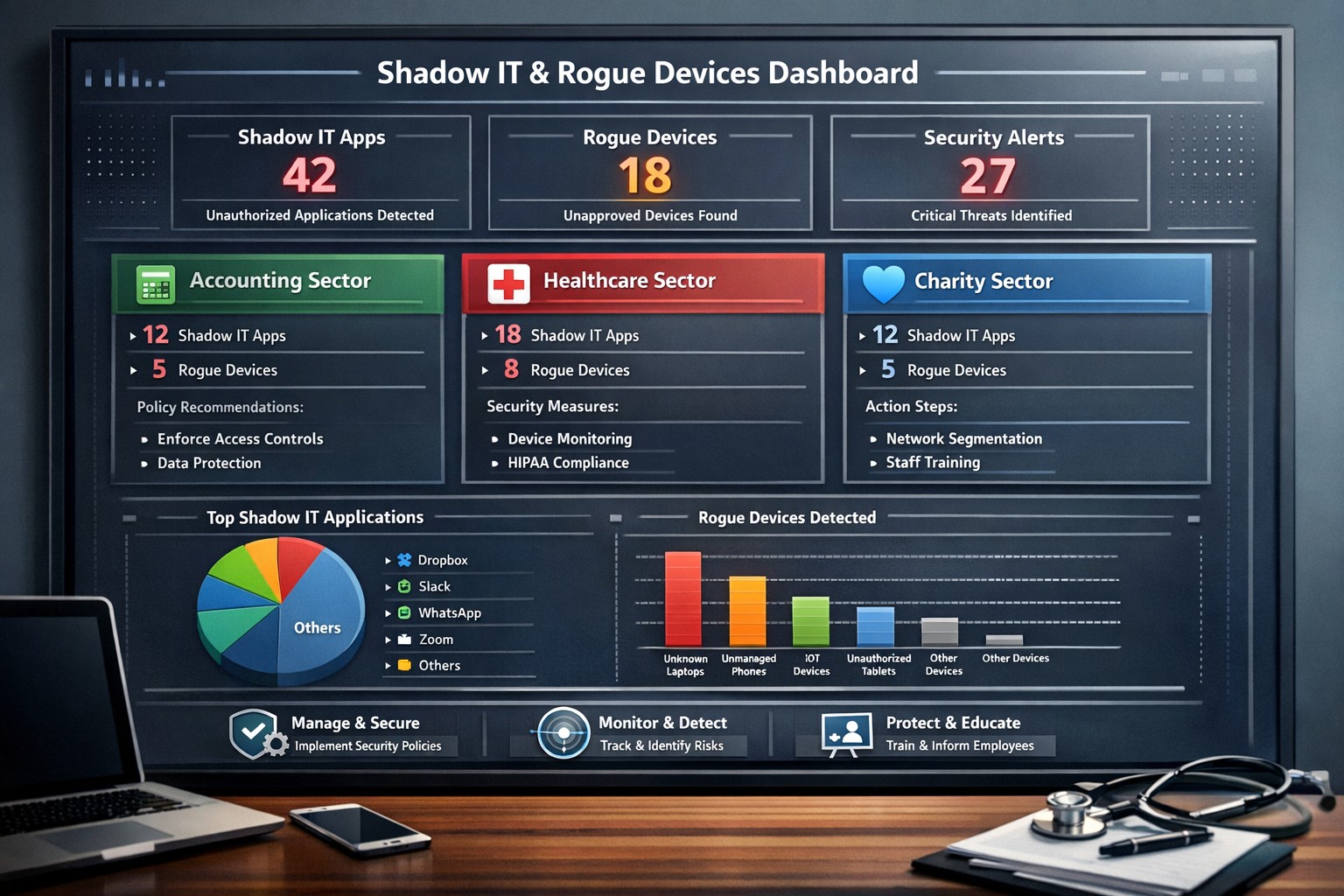
Discovering unauthorized apps or devices on your network can feel like finding hidden leaks in your revenue stream—silent threats draining security and compliance. Shadow IT (unsanctioned software and cloud services) and rogue devices (unapproved hardware like personal laptops or IoT gadgets) expose you to data breaches, regulatory fines, and productivity black holes, with studies showing companies often have 8-10x more unknown SaaS apps than expected. This guide delivers practical steps to detect, manage, and policy-proof your operations, keeping your business agile and protected.
Spotting Shadow IT and Rogue Devices
Start with network traffic analysis using tools like Wireshark or SolarWinds to flag unusual DNS queries, encrypted traffic to unknown IPs, or data spikes indicating unsanctioned cloud uploads. Deploy endpoint detection and response (EDR) solutions such as CrowdStrike or Microsoft Defender for Endpoint to inventory software on devices, spot unauthorized installs, and monitor browser extensions that sneak in risks. Conduct quarterly audits: Review firewall logs, SIEM systems for anomalous patterns, and survey departments on their tools—many shadow IT instances stem from unmet needs like faster collaboration.
Practical Steps to Manage and Secure
Follow these actionable steps with your IT team to reclaim control.
Audit and Inventory Everything: Run full network scans and correlate with identity systems (e.g., SSO logs) to map users, apps, and devices. Prioritize high-risk items like apps without MFA or excessive data access.
Implement Detection Tech: Layer network monitoring (Nagios), EDR, and Cloud Access Security Brokers (CASBs) for continuous visibility. Automate alerts for new SaaS signups or rogue MAC addresses.
Contain and Remediate: Enforce identity controls—lock non-SSO accounts, apply MFA everywhere, and quarantine rogues via NAC (Network Access Control). Onboard valuable shadow tools by sanctioning them with policies.
Roll Out Policies: Draft a clear Shadow IT policy covering app approvals, device registration, and data handling. Require fast-track requests for new tools to avoid workarounds.
Train and Iterate: Hold mandatory sessions on risks (e.g., data leaks from unvetted apps) and alternatives. Review quarterly, adjusting based on audits.
These steps reduce risks without stifling innovation—block outright less, guide instead.
FAQs: Client Questions Answered
Q: How much shadow IT does a typical business have? A: Expect 80-90% of apps to be unmanaged initially, with 8-10x more SaaS accounts than tracked—common even in mid-sized firms.
Q: What are the biggest risks? A: Data breaches via weak OAuth scopes, no MFA, orphaned accounts; compliance failures (GDPR, HIPAA); and expanded attack surfaces from rogue IoT.
Q: Can I fully eliminate shadow IT? A: No, but manage it via discover-evaluate-mitigate loops: Continuous identity-based discovery, risk-tiering, and automated controls keep it in check.
Q: What tools work best for small businesses? A: Start with Microsoft Defender for Cloud Apps for discovery/blocking, or free tiers of Wireshark/EDR trials. Scale to SIEM for growth.
Q: How do policies prevent recurrence? A: Define approval workflows, penalties, and approved alternatives; communicate via training to build a security-first culture.
How Farmhouse Networking Supercharges Your Efforts
Farmhouse Networking specializes in tailored strategies for accounting, healthcare, and charity sectors—industries hit hard by compliance demands like HIPAA or SOC 2. We deploy advanced EDR, CASB, and NAC setups customized to your network, conduct initial shadow IT audits, and craft enforceable policies that align with your workflows. Our team integrates Microsoft 365 security for app risk analysis and rogue device monitoring, ensuring seamless mobility without breaches. Past clients cut unmanaged apps by 70% in months, boosting security scores while freeing IT for growth initiatives.
Take Control Today
Don’t let shadow IT sabotage your business—email support@farmhousenetworking.com now for a free shadow IT risk assessment and personalized roadmap.
And God will generously provide all you need. Then you will always have everything you need and plenty left over to share with others. As the Scriptures say,
“They share freely and give generously to the poor. Their good deeds will be remembered forever.”
For God is the one who provides seed for the farmer and then bread to eat. In the same way, he will provide and increase your resources and then produce a great harvest of generosity in you. - 2 Corinthians 9:8-10
We use cookies to ensure that we give you the best experience on our website. If you continue to use this site we will assume that you are happy with it.