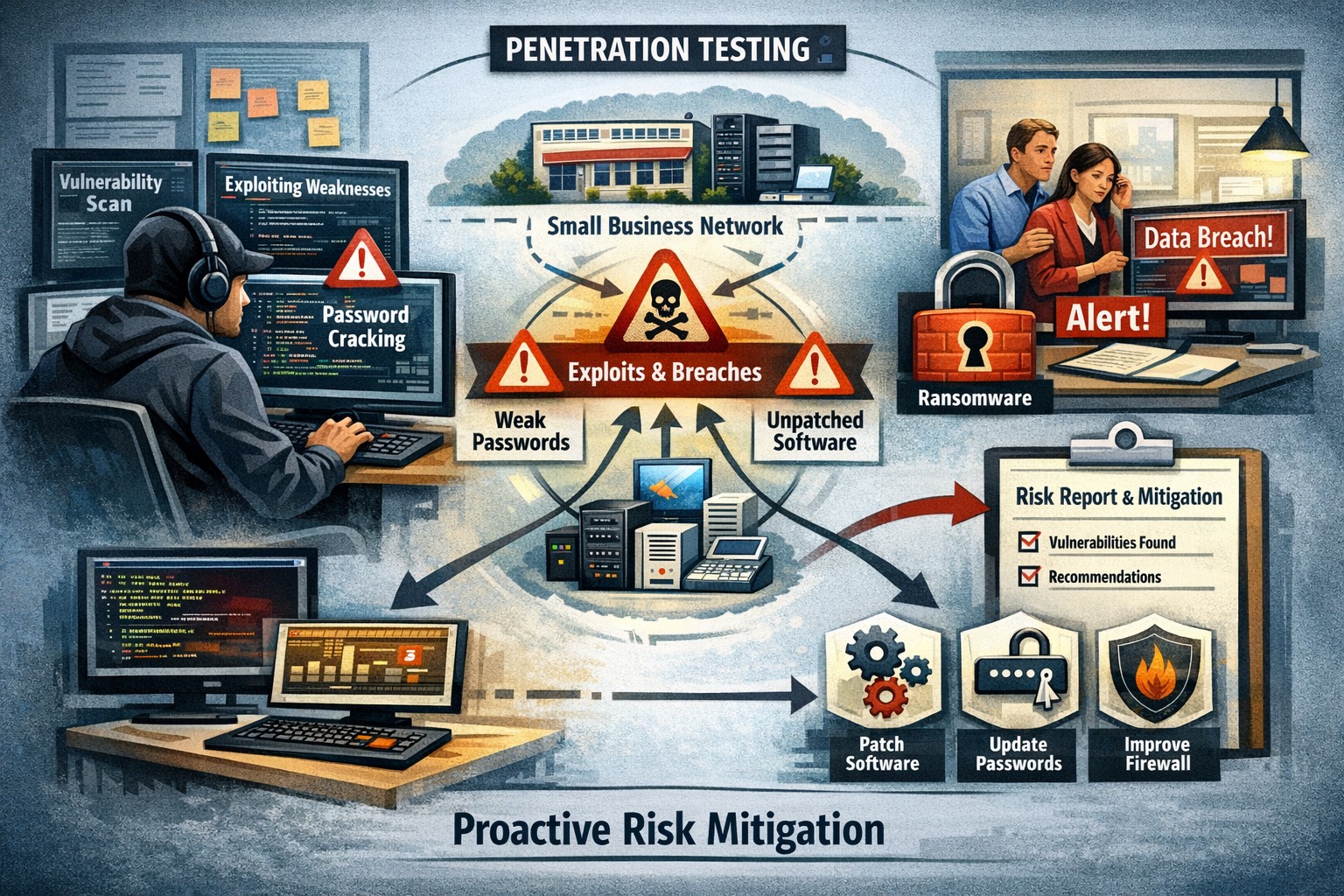
Penetration testing identifies risks before hackers exploit them
Small and midsize businesses (SMBs) face the same cyber risks as big enterprises—sometimes more. One breach can threaten your business. Penetration testing is proactive protection that keeps you ahead of cybercriminals and in step with regulations.
Practical Action Steps:
Conduct a cybersecurity review of your business systems.
Schedule monthly or at least semi-annual penetration testing to find and fix weaknesses.
Educate employees on safe online behavior.
Maintain records to meet regulatory requirements such as PCI DSS or state privacy laws.
Common Client Q&A: Q: Isn’t our firewall enough? A: No; penetration testing simulates real attacks to discover deeper vulnerabilities.
Q: Are tests only for big companies? A: No; many regulations require SMBs to perform regular risk assessments and penetration testing.
How Farmhouse Networking Helps: We tailor penetration testing to your industry and provide step-by-step guidance—so your business stays protected and compliant.
Take control of your cybersecurity. Email Farmhouse Networking for more information on securing your business.
How Employee Security Training Protects SMBs from Cyber Threats
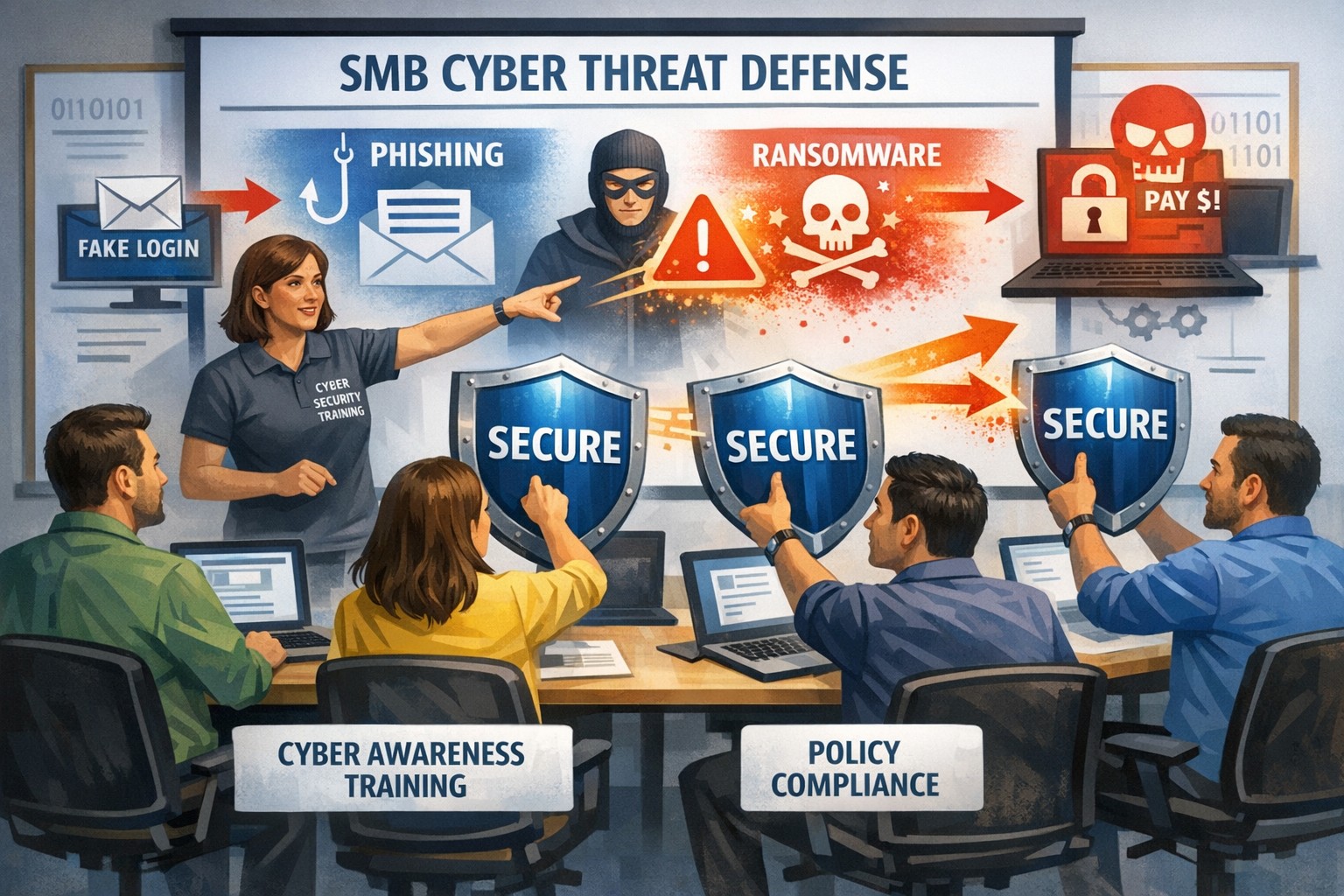
Infographic: How employee cybersecurity training protects small businesses from rising cyber threats.
Small and medium-sized businesses (SMBs) face an ever-evolving array of cyber threats. While investing in advanced security technologies is crucial, it’s equally important to recognize that employees are often the first line of defense against these threats. Employee security training is not just a nicety; it’s a necessity for safeguarding your business from potential breaches and financial losses.
Why Employee Security Training Matters
Cyber attacks frequently exploit human vulnerabilities rather than technological ones. Tactics like phishing, social engineering, and malware rely on manipulating individuals into divulging sensitive information or clicking on malicious links. By educating employees about these tactics, businesses can transform their staff from potential vulnerabilities into proactive defenders.
Benefits of Employee Training:
– Prevention of Costly Attacks: Comprehensive cybersecurity training helps prevent costly cyber attacks by equipping employees with the knowledge to identify and avoid threats. – Building a Culture of Cybersecurity: It fosters a culture where all employees take responsibility for protecting company data. – Enhanced Compliance: Well-informed employees are better equipped to comply with industry regulations, reducing the risk of fines and legal consequences.
Essential Components of Effective Training Programs
An effective cybersecurity training program should include several key components:
1. Phishing Prevention: Teach employees how to recognize suspicious emails and links. 2. Social Engineering Awareness: Educate staff on verifying identities and questioning unusual requests. 3. Malware Recognition: Focus on safe internet practices to avoid downloading unverified attachments. 4. Interactive Sessions: Use real-world simulations to reinforce learning. 5. Ongoing Updates: Regularly update content to reflect evolving threats.
Engaging Employees in Cybersecurity
To ensure that training is impactful:
– Use interactive methods like workshops or role-playing scenarios. – Utilize content that is fun and engaging – Incorporate real-world examples relevant to specific departments. – Gamify learning materials through quizzes or challenges.
By engaging employees meaningfully in cybersecurity efforts, businesses can foster a proactive security culture where everyone feels invested in protecting company assets.
Employee security training is no longer optional; it’s essential for SMBs looking to protect themselves against cyber threats effectively. By investing in comprehensive cybersecurity education, you not only safeguard your business but also empower your workforce as vigilant defenders against evolving digital dangers.
If you’re ready to shield your business from cyber threats by empowering your team with the latest knowledge and skills, contact Farmhouse Networking today! Our expert trainers will help you develop an effective employee security training program tailored specifically for your organization’s needs—ensuring that every employee becomes part of your robust defense strategy against cybercrime.
TaaS delivers scalable cloud infrastructure for future-ready accounting firms.
The accounting industry is on the cusp of a technological revolution, with emerging trends set to reshape how firms operate and deliver value to their clients. As we look ahead to 2025 and beyond, it’s crucial for accounting practices to stay ahead of the curve and embrace these innovations. Let’s explore the key technologies that are poised to transform the accounting landscape and discuss how firms can prepare for this exciting future.
Artificial Intelligence and Machine Learning
Artificial Intelligence (AI) and Machine Learning (ML) are at the forefront of the accounting technology revolution. The AI in accounting market is expected to reach $4.791 billion by 2024, growing at an impressive compounded annual growth (CAGR) of 48.4%. This rapid growth is driven by AI’s ability to automate repetitive tasks, streamline workflows, and provide valuable insights.
Key applications of AI in accounting include:
Automated data entry and reconciliation
Intelligent fraud detection
Advanced financial forecasting
Natural language processing for document analysis
To prepare for this AI-driven future, firms should invest in AI-powered accounting software and prioritize training programs to help staff leverage these new tools effectively.
Cloud-Based Accounting Solutions
Cloud technology has already transformed the accounting industry, and its importance will only grow in the coming years. The global Cloud Accounting Software market is projected to reach $7567.54 million by 2028, expanding at a CAGR of 10.56%.
Benefits of cloud-based accounting include:
Real-time collaboration and data access
Enhanced data security and backup
Scalability and cost-efficiency
Seamless integration with other business systems
Accounting firms should consider migrating their operations to cloud-based platforms to improve efficiency and provide better service to clients.
Blockchain Technology
While often associated with cryptocurrencies, blockchain technology has far-reaching implications for the accounting industry. The accounting blockchain market is expected to reach $868 million by 2025.
Potential applications of blockchain in accounting:
Enhanced transaction transparency and security
Streamlined auditing processes
Improved record-keeping and data integrity
Simplified reconciliations
Firms should start exploring blockchain technology and its potential applications to stay ahead of this emerging trend.
Data Analytics and Forecasting Tools
As businesses generate more data than ever before, the ability to analyze and derive insights from this information is becoming crucial. Advanced data analytics tools are enabling accountants to provide more strategic advice to their clients.
Key areas where data analytics can add value:
Predictive financial modeling
Risk assessment and management
Performance benchmarking
Identifying cost-saving opportunities
Accounting practices should invest in robust data analytics tools and develop their team’s skills in data interpretation and visualization.
Cybersecurity and Data Protection
With the increasing digitization of financial data, cybersecurity has become a top priority for accounting firms. Protecting sensitive client information is not just a legal requirement but also a crucial aspect of maintaining trust and credibility.
Essential cybersecurity measures:
Implementing multi-factor authentication
Regular security audits and penetration testing
Employee training on cybersecurity best practices
Adoption of managed detection and response technologies
Firms must prioritize cybersecurity investments and stay updated on the latest threats and protection measures.
Robotic Process Automation (RPA)
RPA is set to revolutionize routine accounting tasks by automating repetitive processes. This technology can significantly improve efficiency and reduce errors in areas such as accounts payable, receivable, and financial close processes.
Benefits of RPA in accounting:
Increased accuracy in data entry and processing
Faster completion of routine tasks
Reduced operational costs
Improved compliance and audit trails
Accounting practices should identify processes that can be automated using RPA and implement these solutions to boost productivity.
The Evolving Role of Accountants
As technology automates many traditional accounting tasks, the role of accountants is evolving. Future-focused firms will need to shift their focus from number-crunching to providing high-value advisory services.
Skills for the future accountant:
Strategic financial planning
Data analysis and interpretation
Technology proficiency
Soft skills such as communication and problem-solving
Firms should invest in continuous learning and development programs to help their staff adapt to these changing roles.
Preparing for the Future
To future-proof your accounting practice, consider the following steps:
Conduct a technology audit to identify areas for improvement
Develop a digital transformation strategy aligned with your firm’s goals
Invest in staff training and development to build necessary skills
Stay informed about emerging technologies and industry trends
Collaborate with technology partners to implement new solutions
The accounting industry is on the brink of a technological revolution, and firms that embrace these emerging technologies will be well-positioned for success in the years to come.
Ready to navigate the complex world of accounting technology and future-proof your practice? Contact Farmhouse Networking today. Our expert team can help you assess your current technology stack, identify areas for improvement, and implement cutting-edge solutions tailored to your firm’s unique needs. Don’t let your practice fall behind – take the first step towards a technologically advanced future by reaching out to Farmhouse Networking now.
Proactive pentesting safeguards SMBs from cyber threats and ensures compliance
Cyberattacks are on the rise and the cost of data breaches continues to climb – it’s crucial for every organization, regardless of its size, to prioritize cybersecurity. Small and medium-sized businesses (SMBs) often assume they are not attractive targets for hackers due to their perceived limited resources. However, this very assumption can leave them vulnerable to cyber threats. In this blog post, we will explore the value of penetration testing for SMBs and highlight how they can play a crucial role in protecting your business from potential attacks.
Understanding Penetration Tests:
Penetration tests, also known as pentests or ethical hacking, involve simulating real-world cyberattacks on your organization’s systems and networks. This process aims to identify vulnerabilities and weaknesses that could potentially be exploited by malicious actors. By conducting comprehensive testing, you can gain insights into your organization’s security posture, discover any weaknesses, and take proactive measures to mitigate risks.
Value for SMBs:
A common misconception is that penetration tests are only suitable for large enterprises with extensive resources. However, SMBs can significantly benefit from these tests as well. Here are some compelling reasons why penetration tests are valuable for SMBs:
Proactive Defense: Penetration tests allow SMBs to adopt a proactive approach in identifying vulnerabilities and addressing them before malicious actors can exploit them. This helps prevent potential cyberattacks and the subsequent damage to your business, reputation, and customer trust.
Risk Mitigation: SMBs often lack the robust security measures and dedicated teams that larger organizations have. Conducting penetration tests helps identify and prioritize vulnerabilities, allowing you to allocate resources effectively and address the most critical risks within your limited budget.
Compliance Requirements: Many SMBs operate in highly regulated industries such as healthcare, finance, or legal sectors. Compliance standards often require regular security testing, including penetration tests. By conducting such tests, SMBs can demonstrate compliance with industry regulations and avoid potential penalties or legal complications.
Challenges and Considerations:
While penetration tests offer numerous advantages for SMBs, it’s essential to understand and address potential challenges:
Cost: Budget constraints are a common concern for SMBs. However, bear in mind that the potential cost of a data breach or cyberattack can be far more detrimental to your business. Prioritize your security investments wisely and consider partnering with a reputable and cost-effective cybersecurity provider like Farmhouse Networking.
Skill Gap: SMBs may lack in-house expertise to conduct penetration tests. Engaging a skilled and reputable penetration testing firm can provide expert insights and tailor the tests to your specific requirements.
By investing in proactive security measures, SMBs can stay one step ahead of cyber threats and build a resilient foundation for sustained growth and success. Partner with a trusted cybersecurity provider to conduct regular penetration tests and fortify your organization’s security posture.
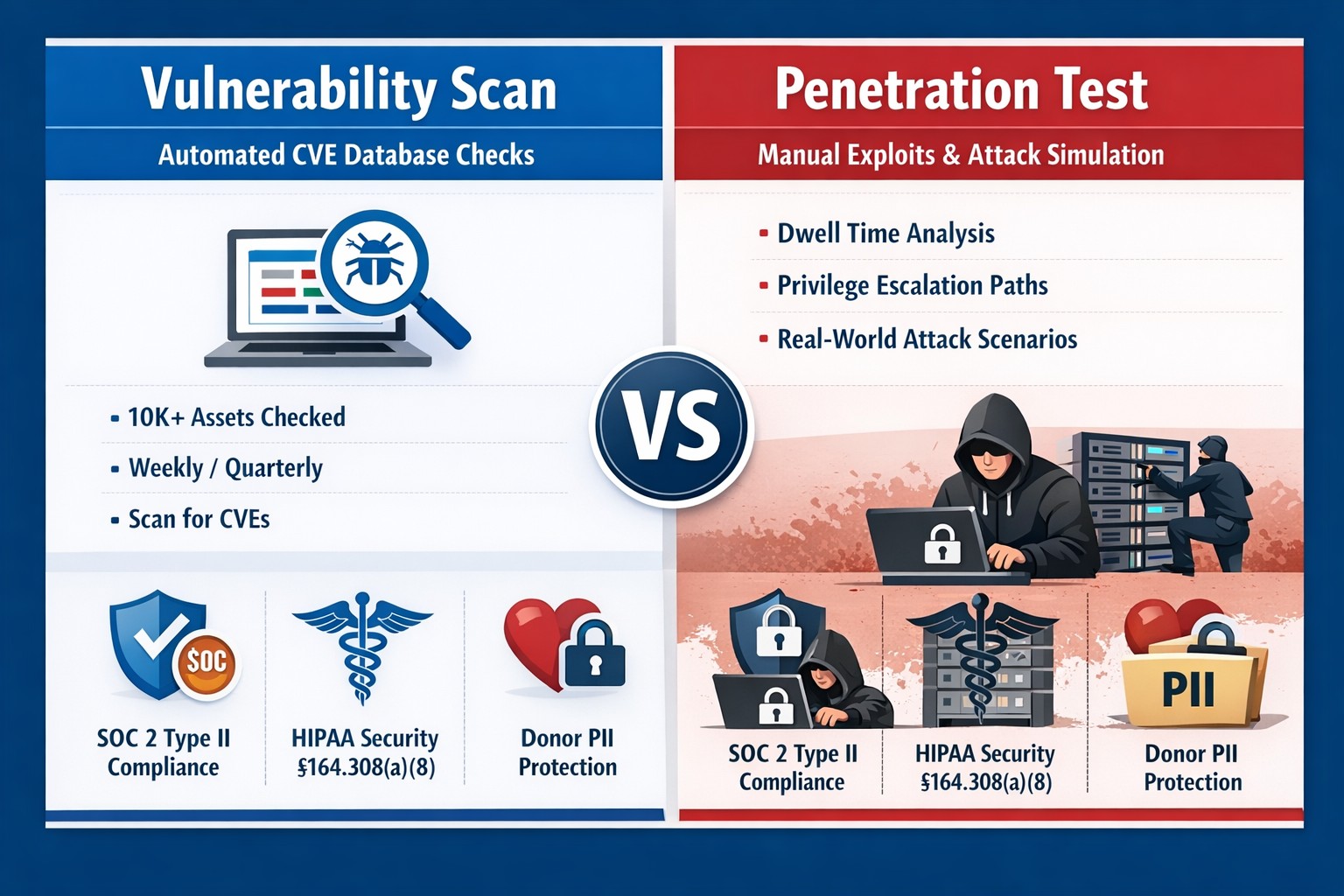
Compliance penetration test report mapping findings to HIPAA SOC 2 PCI DSS controls.
Compliance is and always has been a complicated matter. Here are the quotes from the three types of compliance – CMMC, HIPAA, and PCI:
“CMMC – Risk AssessmentL2-3.11.2 – VULNERABILITY SCAN: Scan for vulnerabilities in organizational systems and applications periodically and when new vulnerabilities affecting those systems and applications are identified.”
“HIPAA – § 164.308 Administrative safeguards. (a)(1)(ii)(A) –Risk analysis (Required). Conduct an accurate and thorough assessment of the potential risks and vulnerabilities to the confidentiality, integrity, and availability of electronic protected health information held by the covered entity or business associate.”
“PCI – 11.3: External and internal vulnerabilities are regularly identified, prioritized, and addressed”
To summarize what this all mean – compliance requires penetration testing and vulnerability scanning. Networks have to be tested regularly to make sure that there has been nothing missed which would allow a hacker to breach the network and steal the treasure of information. Our recommendation is to scan at least quarterly, if not monthly, to find these vulnerabilities and address them before the hackers find them.
If your company has compliance requirements that you need consulting for, then contact us for assistance.
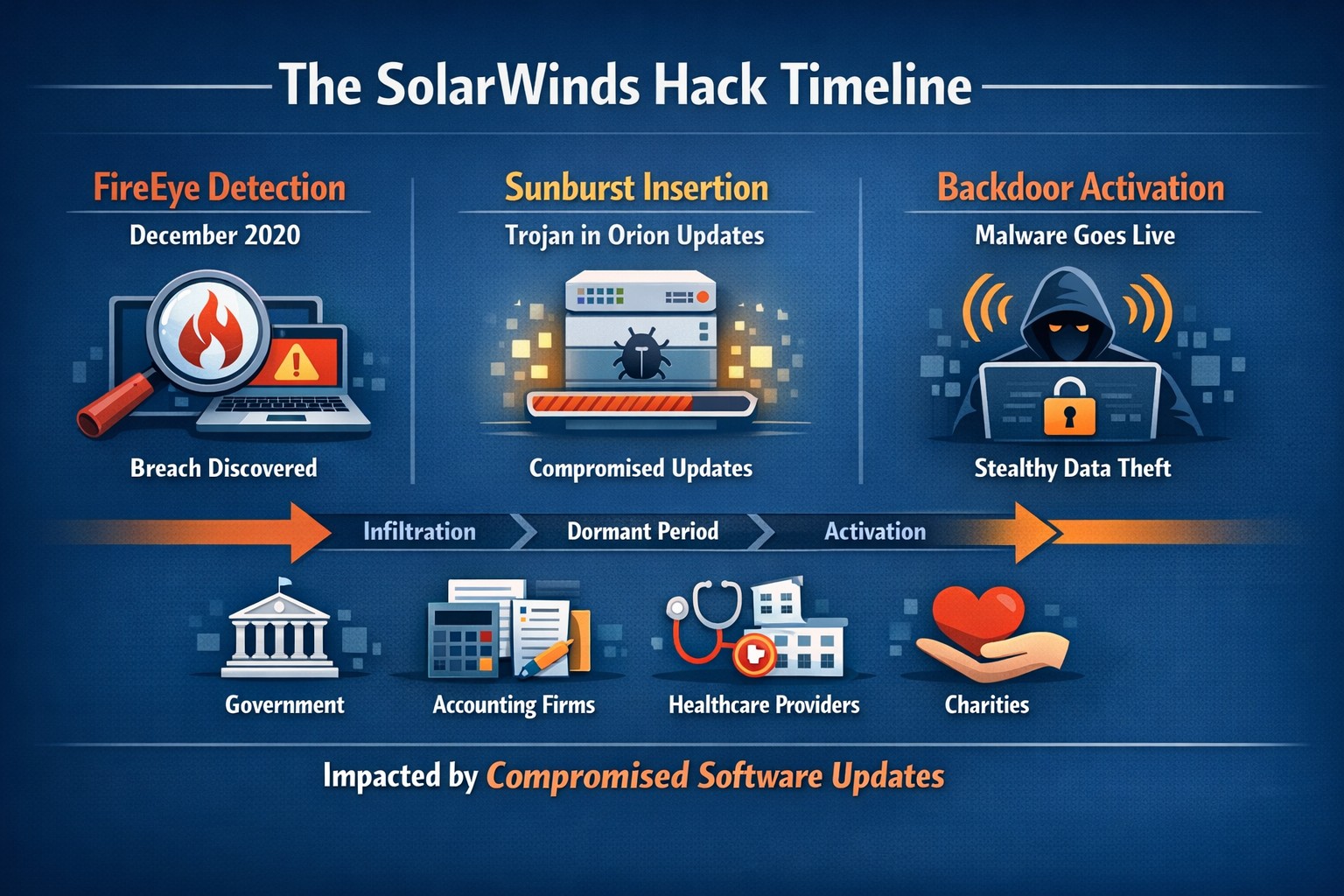
Timeline of the stealthy SolarWinds supply chain breach
We feel the need to make a full disclosure about the recent news of a hack of Solarwinds since we use the Solarwinds Remote Monitoring and Maintenance platform to manage our monthly clients. Based on a cyber incident write-up by FireEye, an enterprise security research firm, Solarwinds had one of their software packages called Orion compromised by files included in update files. This attack has effected many large organizations including many governmental agencies and larger firms worldwide. The software under attack is used by these larger organizations to monitor the performance of their networks even across multiple locations. This software is completely different from the product that we use and we have been assured by Solarwinds that no compromise of the Remote Monitoring and Maintenance platform has occurred.
We continue business as usual including allowing users to use this platform for remote access to their business. We continue to add further automation into the system to better monitor and maintain your networks and computers.
If your company is going to use full disk encryption or has compliance requirements that you need consulting for, then contact us for assistance.
Many industries we serve are under some sort of compliance requirements – HIPAA, PCI, GDPR, etc. and several of these require some sort of vulnerability scans or penetration testing:
HIPAA Section 164.308(a)(1)(ii)(A) states:
RISK ANALYSIS (Required). Conduct an accurate and thorough assessment of the potential risks and vulnerabilities to the confidentiality, integrity, and availability of electronic protected health information held by the [organization].
PCI DSS Requirement 11.3:
The scope of a penetration test, as defined in PCI DSS Requirement 11.3, must include the entire CDE perimeter and any critical systems that may impact the security of the CDE as well as the environment in scope for PCI DSS. This includes both the external perimeter (public-facing attack surfaces) and the internal perimeter of the CDE (LAN-LAN attack surfaces).
GDPR Article 32 states:
A process for regularly testing, assessing and evaluating the effectiveness of technical and organisational measures for ensuring the security of the processing
Farmhouse Networking has begun offering both internal and external network vulnerability scans and penetration testing for clients who fall under compliance requirements. We also provide remediation planning and implementation for any issues found during the scans.
If your company is has compliance requirements for internal or external vulnerability scans or penetration testing, then contact us for assistance.
And God will generously provide all you need. Then you will always have everything you need and plenty left over to share with others. As the Scriptures say,
“They share freely and give generously to the poor. Their good deeds will be remembered forever.”
For God is the one who provides seed for the farmer and then bread to eat. In the same way, he will provide and increase your resources and then produce a great harvest of generosity in you. - 2 Corinthians 9:8-10
We use cookies to ensure that we give you the best experience on our website. If you continue to use this site we will assume that you are happy with it.