How technology has transformed workplaces: a diverse team using cloud‑based tools and secure connections to collaborate more efficiently
The promise (and the reality) of workplace tech
When most business leaders adopted cloud tools, collaboration platforms, and automation over the last decade, the pitch was simple: technology will make work faster, smoother, and more productive. In many ways, that promise has delivered. Cloud‑based platforms now underpin hybrid work, AI‑driven analytics help you spot bottlenecks, and digital workflows have cut hours of manual effort.
Yet for many mid‑sized business owners, the reality feels messier. Tools are scattered. Systems don’t talk to each other. Employees juggle logins, notifications, and legacy apps that slow them down instead of speeding them up. The real question isn’t whether tech should make work better—it’s how to align your technology stack with your business model, your people, and your growth ambitions.
How technology has already transformed workplaces
Modern workplaces are no longer defined by cubicles and paper; they’re defined by data, connectivity, and automation.
Hybrid and remote work became mainstream, supported by cloud applications, collaboration suites, and secure remote‑access infrastructure.
Cloud adoption now stands at or near saturation for most organizations, enabling scalability, resilience, and faster deployment of new capabilities.
AI and automation are moving from pilot projects to core operations, with 24% of organizations reporting enterprise‑wide AI adoption in 2026—up from 12% in 2025.
Digital‑first workflows have replaced many manual processes, with nearly 90% of companies already relying on cloud technology as a baseline.
For mid‑sized business owners, that means the bar for “modern workplace” is no longer about buying a single tool; it’s about orchestrating a coherent, secure, and scalable technology ecosystem. Failing to manage that ecosystem properly can quietly erode productivity, raise security risks, and slow growth.
Practical steps for you and your IT team
If you’re a mid‑sized business owner, treat your technology stack as a growth‑enabling asset, not just a cost center. Here’s how you and your IT department can turn that promise into results:
1. Audit your current tech stack
Inventory all tools (CRM, accounting, HR, communications, file‑sharing, monitoring, etc.) and map how they connect.
Identify redundancies, unsanctioned tools (“shadow IT”), and gaps in security or integration.
2. Define one source of truth for data
Pick a primary system (e.g., a cloud ERP or CRM) and align reporting, workflows, and user‑experience around it.
Ensure that key systems can sync customer, employee, and financial data so decisions are based on one consistent dataset.
3. Standardize secure access and collaboration
Implement single sign‑on (SSO), multi‑factor authentication (MFA), and role‑based access controls for all cloud and on‑prem systems.
Standardize collaboration tools (e.g., one primary messaging platform and one video‑conferencing suite) to reduce training overhead and context switching.
4. Automate low‑value, repeatable tasks
Identify repetitive workflows (invoices, approvals, ticket handling, onboarding, reports) and automate them using workflow automation or RPA where appropriate.
Measure before and after: time saved per task, error reduction, and impact on customer‑facing SLAs.
5. Invest in continuous training and change management
Treat technology adoption as a change‑management project, not a “one‑and‑done” rollout.
Provide regular training sessions, quick reference guides, and “power‑user” champions in each department to drive adoption.
6. Revisit your security and compliance posture
Ensure cloud‑workload security, data‑retention policies, and endpoint protection keep pace with your growth and regulatory obligations.
Conduct periodic risk assessments and penetration testing, especially as AI‑driven tools and more data‑centric workflows come online.
For mid‑sized owners, these steps should be treated as ongoing disciplines, not one‑time projects. The goal is to build a workplace where technology recedes into the background and employees simply get more done.
Clients’ likely questions—answered
Q: “We already have a lot of tools—why can’t we just keep adding whatever we need?” A: More tools mean more complexity, more security gaps, and more training overhead. Modern mid‑sized businesses get better outcomes by streamlining around fewer, integrated platforms than by stringing together dozens of siloed apps.
Q: “How do we know if our tech is actually improving productivity?” A: Tie technology to measurable KPIs: cycle times, error rates, support‑ticket resolution time, and employee‑time‑spent‑on‑manual‑work. If you can’t quantify the benefit, you’re likely drifting into “tech for tech’s sake.”
Q: “Isn’t AI just hype for bigger companies?” A: AI is now a practical tool for any business that deals with data, workflows, or customer interactions. For mid‑sized firms, it often means automating routine tasks, surfacing insights from operational data, and improving customer service, not building bespoke AI models.
Q: “How do we protect ourselves from ransomware and data breaches while modernizing?” A: Modernization must include proactive security: cloud‑workload protection, endpoint detection and response, secure access controls, and regular backups. A well‑architected environment is actually more secure than a fragmented, legacy‑heavy one.
How Farmhouse Networking can help
Farmhouse Networking partners with mid‑sized business owners to turn technology from a cost center into a competitive advantage. For companies already operating in hybrid or distributed environments, we help:
Map and rationalize your technology stack so tools actually work together instead of against each other.
Design and implement secure, scalable cloud‑enabled workspaces, including secure remote access, SSO, and unified collaboration tooling.
Identify and automate repetitive workflows so your employees spend less time on manual tasks and more time on value‑add work.
Strengthen your security and compliance posture as you adopt AI‑driven tools, cloud services, and new data sources.
We don’t just sell equipment or licenses; we work with your leadership and IT team to align your technology with your business model, culture, and growth plans.
Ready to make technology work for you?
If you’re a mid‑sized business owner and you’ve ever thought, “We all knew tech would make work better—but it still feels like it’s making everything more complicated,” you’re not alone—and you’re in the right place.
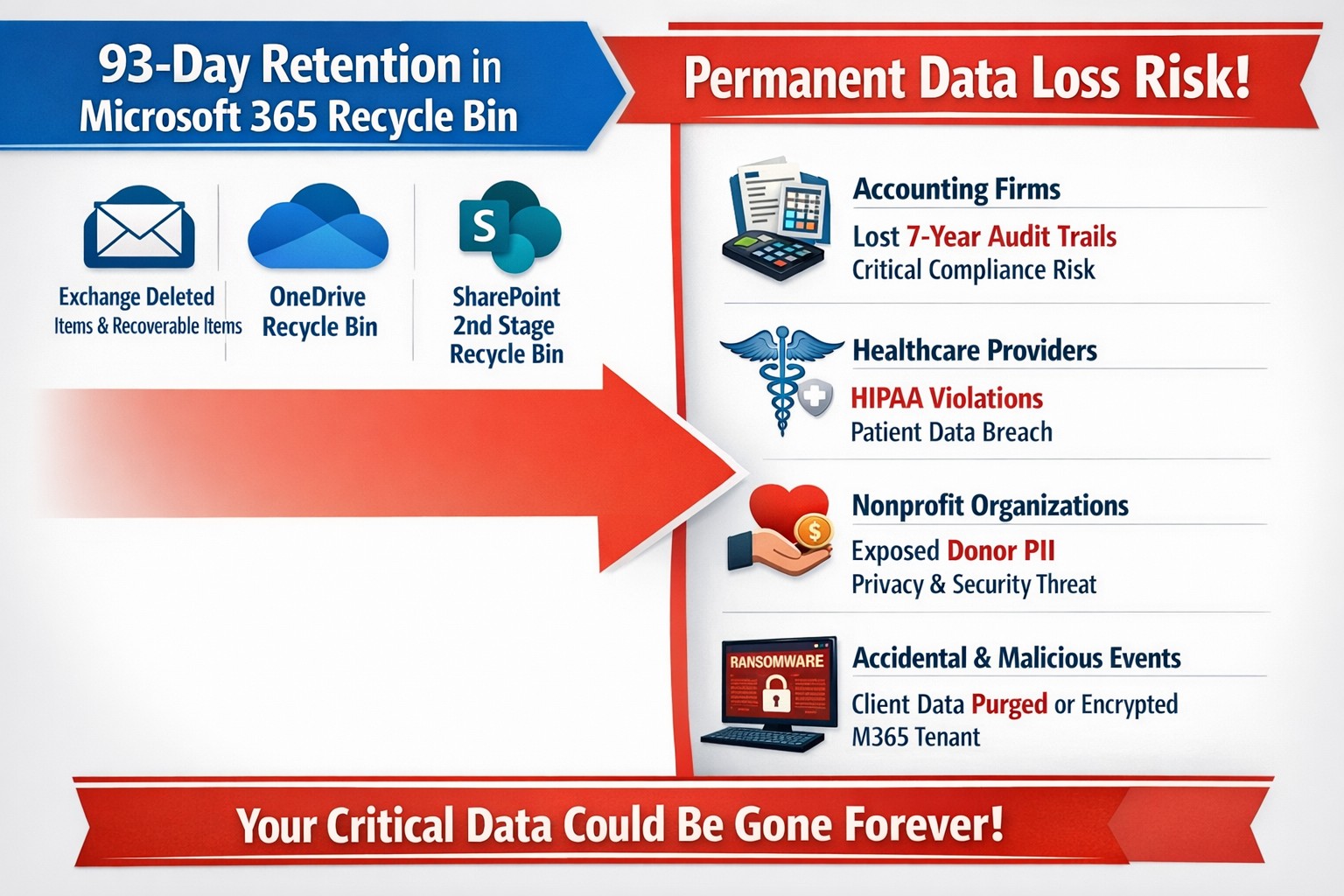
This question came to light while talking to a vendor about backups. It turns out that Microsoft does not backup any of your Office 365 data but does have aggressive redundancy in place. This is both good and bad, here is why:
Email
Microsoft has several levels of redundancy / resiliency / protection to keep email data from being corrupted, keep multiple copies of all email data, and scan emails for security threats. If there is ever any data issues then their systems automatically detect the problem and work to fix them or when threats are detected they are automatically remediated. There is also a recycle bin for emails and users that lasts from 30 to 90 days. Once that time is over there is no recourse for getting the data back.
Sharepoint & OneDrive
Microsoft here again has deep redundancy to protect your data from corruption, but they do nothing to check for malware or cryptoware. There is something called versioning that can help with some cryptoware, but not all. There is also a recycle bin for these services that could possibly help.
There are several apparent gaps in coverage that Microsoft does not deal with, but there are third-party services that have stepped in to do just that. If your company is looking to keep their Office 365 data safe from internal and external threats, then contact us for assistance.
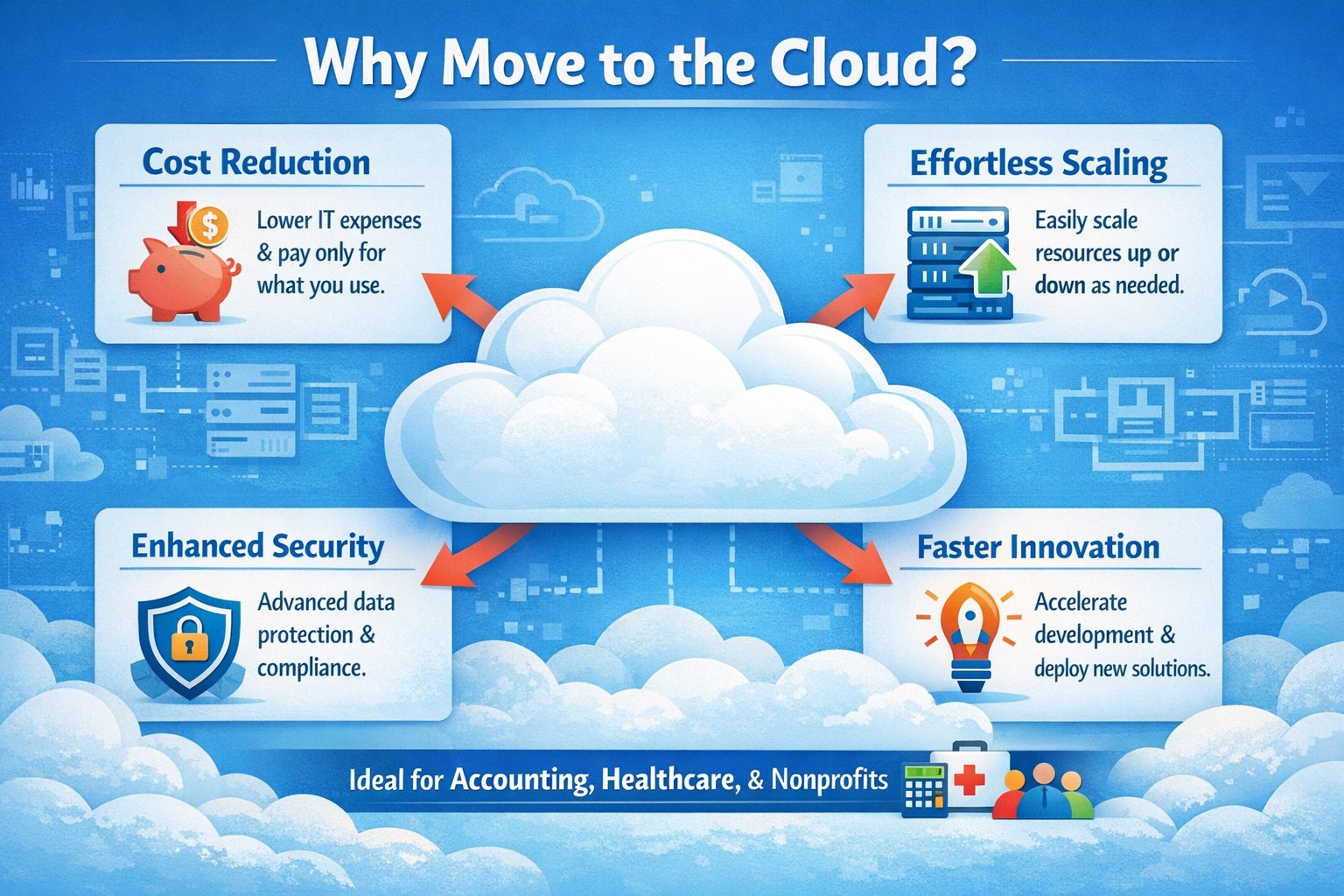
Business owner reviewing 4 reasons to move to cloud migration on laptop for cost savings and scalability
You’re constantly balancing growth ambitions with tight budgets and operational hurdles. Moving to the cloud isn’t just a tech upgrade—it’s a strategic pivot that cuts costs, boosts agility, and future-proofs your operations, as seen in widespread adoption by organizations prioritizing speed and innovation.
Reason 1: Slash IT Costs Dramatically
Cloud eliminates hefty upfront hardware investments and ongoing maintenance, shifting to a pay-as-you-use model. Businesses save on data center overhead like electricity and staffing, with many reporting lower total IT spend post-migration. For accounting firms handling sensitive financials or healthcare providers managing patient records, this means predictable budgeting without overprovisioning servers.
Reason 2: Scale Effortlessly with Demand
Traditional servers lock you into fixed capacity, but cloud auto-scales resources instantly during peaks—like tax season for accountants or patient surges in healthcare. This flexibility supports remote teams and global reach without downtime, enhancing reliability through built-in failover. Charities scaling donation drives benefit too, handling traffic spikes cost-effectively.
Reason 3: Strengthen Security and Compliance
Modern clouds offer enterprise-grade security surpassing most on-premises setups, with automated updates, encryption, and compliance tools for HIPAA or nonprofit regulations. Providers manage patches and backups, reducing breach risks that plague outdated systems. Your IT team focuses on business logic, not constant vulnerability scans.
Reason 4: Accelerate Innovation and Collaboration
Cloud unlocks AI, analytics, and real-time collaboration tools, speeding product launches and remote work. Teams access data from anywhere, fostering efficiency without version control headaches. For B2B sectors like yours, this drives faster client service and competitive edges.
Practical Action Steps for Migration
Follow these steps to transition smoothly, involving your IT department:
Assess Inventory: Catalog apps, data, and dependencies; tag by cloud-fit (e.g., lift-and-shift email vs. refactor custom CRM).
Set Goals and Choose Provider: Align on cost savings or scalability; evaluate AWS, Azure, or Google Cloud for your industry (e.g., HIPAA-compliant for healthcare).
Build Landing Zone: Establish security baselines, networking, and policies before migration.
Migrate in Phases: Start with low-risk workloads; test hybrid setups to minimize disruption.
Train and Monitor: Roll out employee training; use dashboards for cost/performance tracking post-go-live.
FAQs: Client Inquiries Answered
How long does migration take? Phased approaches span weeks to months, depending on complexity—small businesses often complete in 4-8 weeks with planning.
What about data security during transition? Encrypt data in transit/rest; conduct risk audits and use provider tools for zero-downtime moves.
Will it disrupt operations? Minimal with pilots and weekends; hybrid models keep critical systems on-prem initially.
Is cloud cheaper long-term? Yes, for most—avoid CapEx, pay OpEx, and optimize via auto-scaling; ROI hits in 12-18 months.
Hybrid or full cloud? Hybrid suits regulated industries like healthcare for compliance; full cloud maximizes agility.
How Farmhouse Networking Supports Your Move
Farmhouse Networking specializes in tailored cloud migrations for accounting, healthcare, and charity clients. We handle assessments, secure setups, and optimizations—integrating SEO-driven websites with cloud backends for lead-gen boosts. Our team manages compliance (e.g., HIPAA), trains your staff, and monitors ROI, ensuring seamless B2B growth.
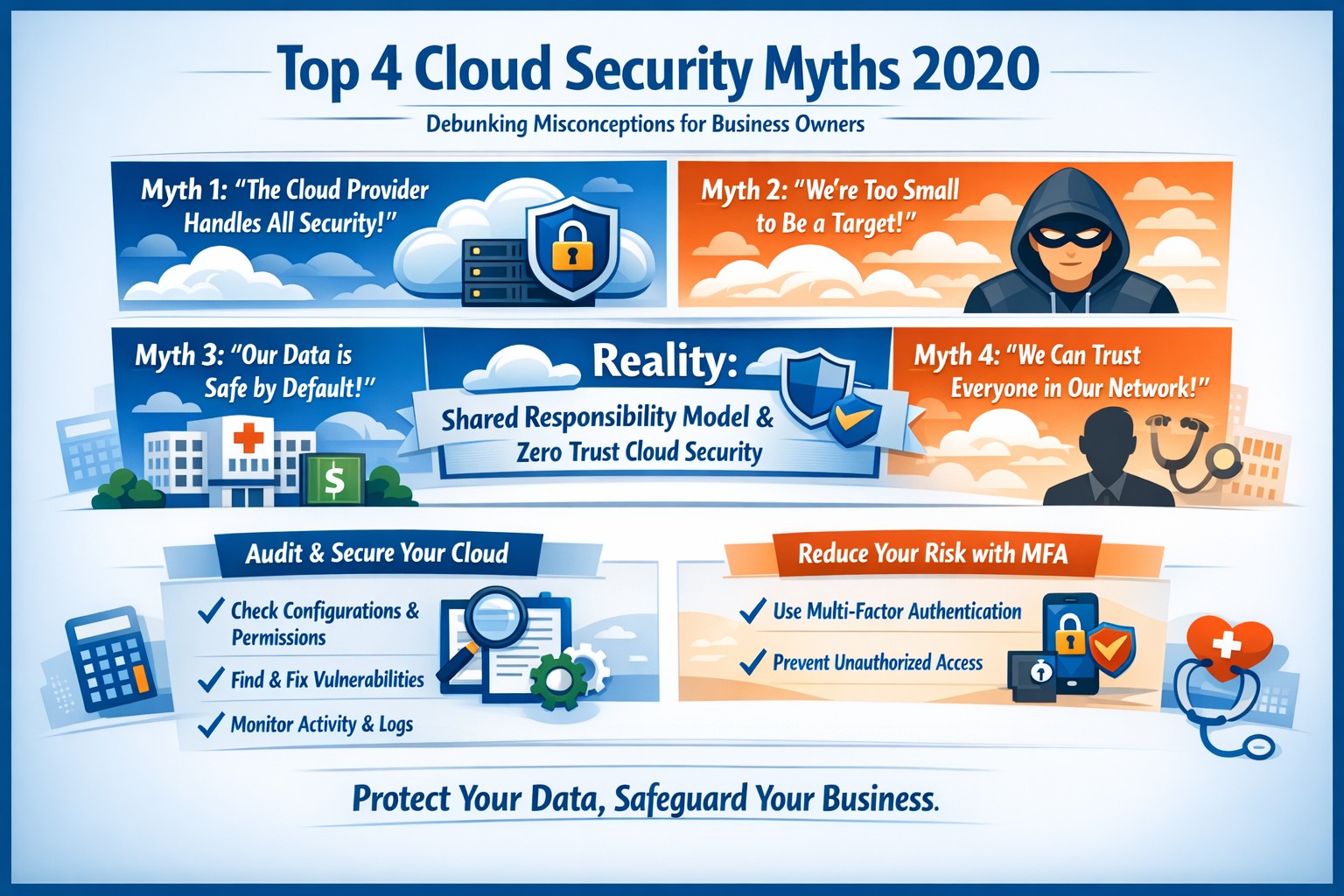
Breaking down 2020 cloud security myths: Shared responsibility, tool overload, and visibility gaps—key facts for businesses.
Cloud adoption surged in 2020, with businesses in accounting, healthcare, and nonprofits relying on it for scalability and cost savings. Yet persistent myths about cloud security created hesitation, exposing firms to real risks like data breaches that cost millions. This post debunks the top four myths from 2020 insights, empowering you with facts and actionable steps.
Myth 1: Cloud Providers Handle All Security
Many owners assumed providers like AWS or Microsoft secured everything end-to-end. In reality, the shared responsibility model meant providers handled infrastructure, but you owned data protection, access controls, and configurations.
Misconfigurations caused 80% of breaches, not provider failures. Businesses shifting to cloud without internal controls faced gaps in identity management and encryption.
Myth 2: More Security Tools Mean Better Protection
Stacking tools from multiple vendors seemed smart, but it often created blind spots. Surveys showed 70% of firms used over 100 controls, leading to fragmented visibility and overlooked threats.
Too many tools increased complexity without unified threat detection. Attackers exploited overlaps, as seen in hybrid environments where on-prem and cloud silos persisted.
Myth 3: Cloud Is Inherently Safer Than On-Premises
Cloud hype fueled this, but sprawl across multi-cloud setups amplified risks like unmanaged identities. Providers patched well, yet customer errors—such as exposed APIs—drove most incidents.
Fact: On-prem breaches outnumbered pure cloud ones, but hybrid risks blended endpoints and cloud, demanding end-to-end auditing.
Myth 4: Cloud Visibility Is Simple
Owners thought dashboards provided full insight, but dynamic resources (e.g., auto-scaled servers) hid shadow IT. Without continuous monitoring, you missed rogue accounts or vulnerabilities.
Breaches often started outside cloud via stolen credentials, underscoring the need for holistic views.
Practical Action Steps
Take these steps with your IT team to secure cloud operations:
Audit Configurations Weekly: Use native tools like AWS Config or Azure Policy to scan for public buckets and weak IAM roles. Remediate high-risk items immediately.
Implement Zero-Trust Access: Enforce multi-factor authentication (MFA) and least-privilege policies via tools like Okta. Rotate keys quarterly.
Centralize Monitoring: Deploy SIEM (e.g., Splunk Cloud) integrated with CSP logs for real-time alerts on anomalies.
Encrypt Everything: Apply AES-256 for data at rest/transit; test decryption quarterly to verify compliance (HIPAA-relevant for healthcare).
Conduct Penetration Tests: Hire ethical hackers biannually to simulate attacks, focusing on API endpoints.
These reduce breach risk by 50%+ per industry benchmarks.
Step
Tool/Example
Expected Outcome
Audit Configurations
AWS Config
Identifies 90% of misconfigs
Zero-Trust Access
Okta MFA
Blocks 99% credential attacks
Centralize Monitoring
Splunk Cloud
Cuts detection time to minutes
Encrypt Data
AWS KMS
Meets HIPAA/GDPR standards
Pen Tests
External firm
Uncovers hidden exploits
Client FAQ
Q: How do we know our data is safe from provider access? A: Providers like Microsoft use multi-tenant isolation; engineers need just-in-time approval. Your encryption keys stay under your control.
Q: What if we’re in accounting/healthcare with strict compliance? A: Map controls to NIST or HIPAA via frameworks like FedRAMP. Regular audits ensure audit trails for client trust.
Q: Multi-cloud adds complexity—how to manage? A: Use unified platforms like Prisma Cloud for cross-provider visibility, avoiding vendor lock-in.
Q: What’s the ROI on fixing these myths? A: Firms with mature cloud security report 30% lower breach costs and faster recovery.
How Farmhouse Networking Helps
Farmhouse Networking specializes in B2B cloud security for accounting, healthcare, and charities. We conduct free audits to expose misconfigs, design zero-trust architectures, and integrate monitoring tailored to your stack. Our SEO-optimized websites and lead-gen strategies drive organic traffic growth, converting visitors into long-term partners. We handle compliance mapping, reducing your IT burden while boosting client confidence.
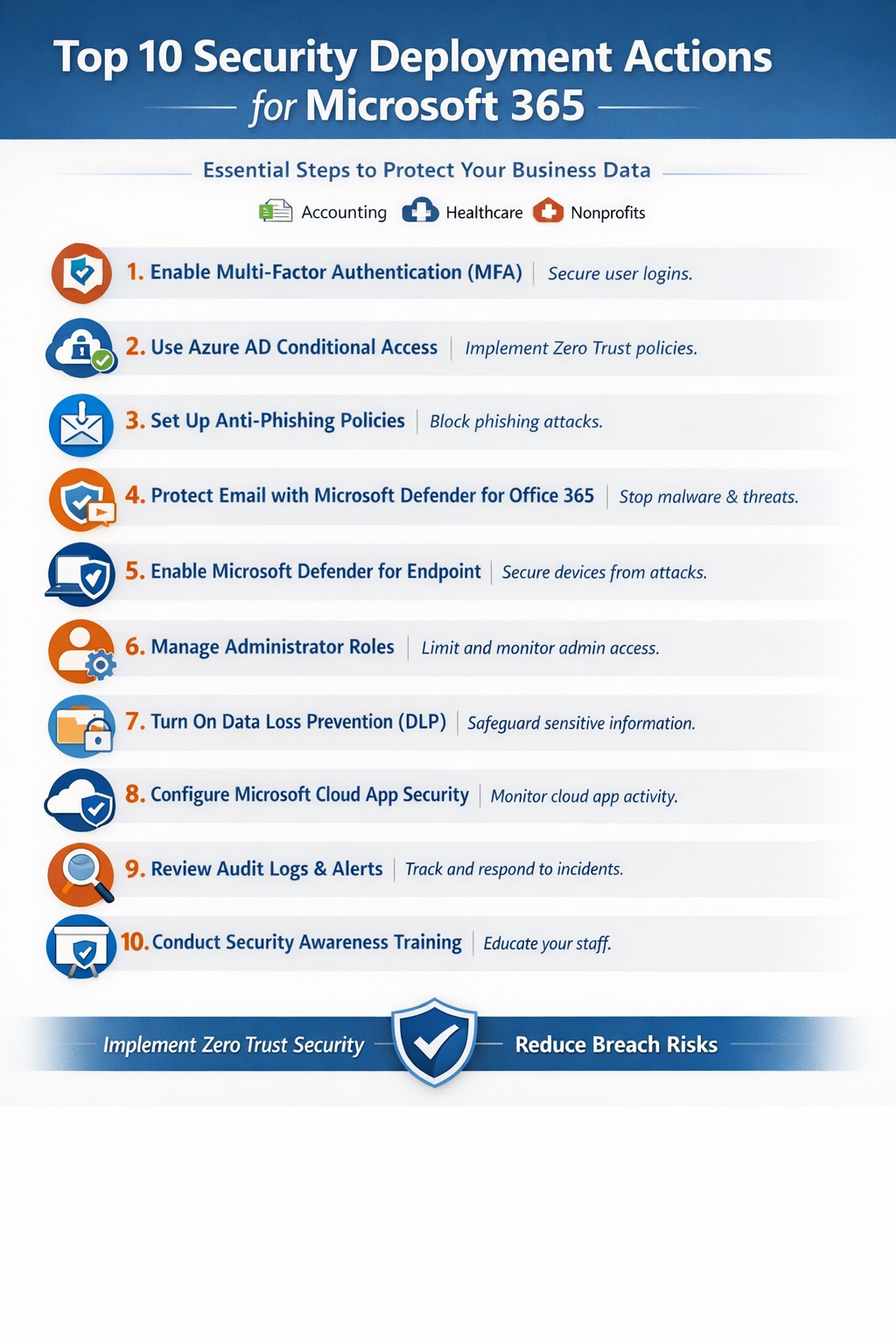
Relying on Microsoft 365 for productivity exposes you to rising cyber threats like phishing and data breaches. Implementing these top 10 security deployment actions fortifies your defenses, protects sensitive data, and ensures compliance—directly impacting your bottom line.
Action Steps for Deployment
Work with your IT team to execute these prioritized steps, drawn from Microsoft-recommended practices. Each targets users, devices, apps, and data for layered protection.
Deploy Azure AD for Unified Identities: Connect on-premises directories to Azure Active Directory (now Entra ID). Create single identities for secure access across resources. Enable in the Microsoft Entra admin center.
Enable Multi-Factor Authentication (MFA): Mandate MFA for all users, prioritizing admins. Use Conditional Access policies to enforce based on location, device, or risk. Start in report-only mode to test.
Set Up Single Sign-On (SSO): Configure SSO in Entra ID for seamless authentication across cloud, devices, and on-premises apps. Reduces password fatigue while enhancing security.
Implement Anti-Phishing Policies: Activate anti-phishing in Microsoft Defender for Office 365. Enable impersonation protection, spoof intelligence, and mailbox intelligence to block targeted attacks.
Configure Data Loss Prevention (DLP): Set DLP policies in Microsoft Purview to classify, label, and protect sensitive data in emails, documents, and Teams. Block sharing of financial or health records.
Enable Safe Links and Safe Attachments: Turn on these Defender features to scan URLs and attachments in real-time. Uses sandboxing to detonate malware safely.
Deploy Microsoft Intune for Devices: Enroll devices in Intune for compliance policies, encryption, and app protection. Integrate with Defender for Endpoint to block threats.
Block Legacy Authentication: Disable POP, IMAP, and SMTP protocols via Conditional Access. Force modern auth to support MFA and cut legacy risks.
Apply Security Baselines and Updates: Use Microsoft security baselines for M365, Exchange, and Windows. Automate patches via Azure Update Manager and monitor compliance.
Monitor with Defender XDR: Activate Microsoft Defender XDR for unified threat detection across endpoints, identity, email, and apps. Review executive reports monthly.
These steps create a zero-trust model, reducing breach risks by up to 99% per Microsoft data.
FAQ: Client Inquiries Answered
How long does implementation take? Most actions deploy in 1-2 weeks for small businesses, starting with MFA and DLP. Full rollout with testing spans 4-6 weeks.
What if we have limited IT staff? Prioritize quick wins like MFA and anti-phishing via the Microsoft 365 Defender portal. Outsource complex configs to experts for speed and compliance.
Does this cover compliance like HIPAA? Yes—DLP and Purview handle healthcare data; Intune ensures device compliance. Audit logs support regulations.
How do we train employees? Use Attack Simulation Training in Defender to run phishing drills. Pair with monthly awareness sessions targeting high-risk users.
What about costs? Core features are in E3/E5 licenses; advanced ones may need add-ons. ROI comes from avoiding $4.45M average breach costs.
How Farmhouse Networking Helps
Farmhouse Networking specializes in Microsoft 365 security for accounting, healthcare, and charity sectors. We audit your tenant, deploy these 10 actions via customized roadmaps, and optimize SEO-friendly sites to attract B2B leads. Our lead gen strategies convert traffic into clients, while branding enhances trust. We’ve helped similar firms cut threats by 80% through Intune and Defender setups.
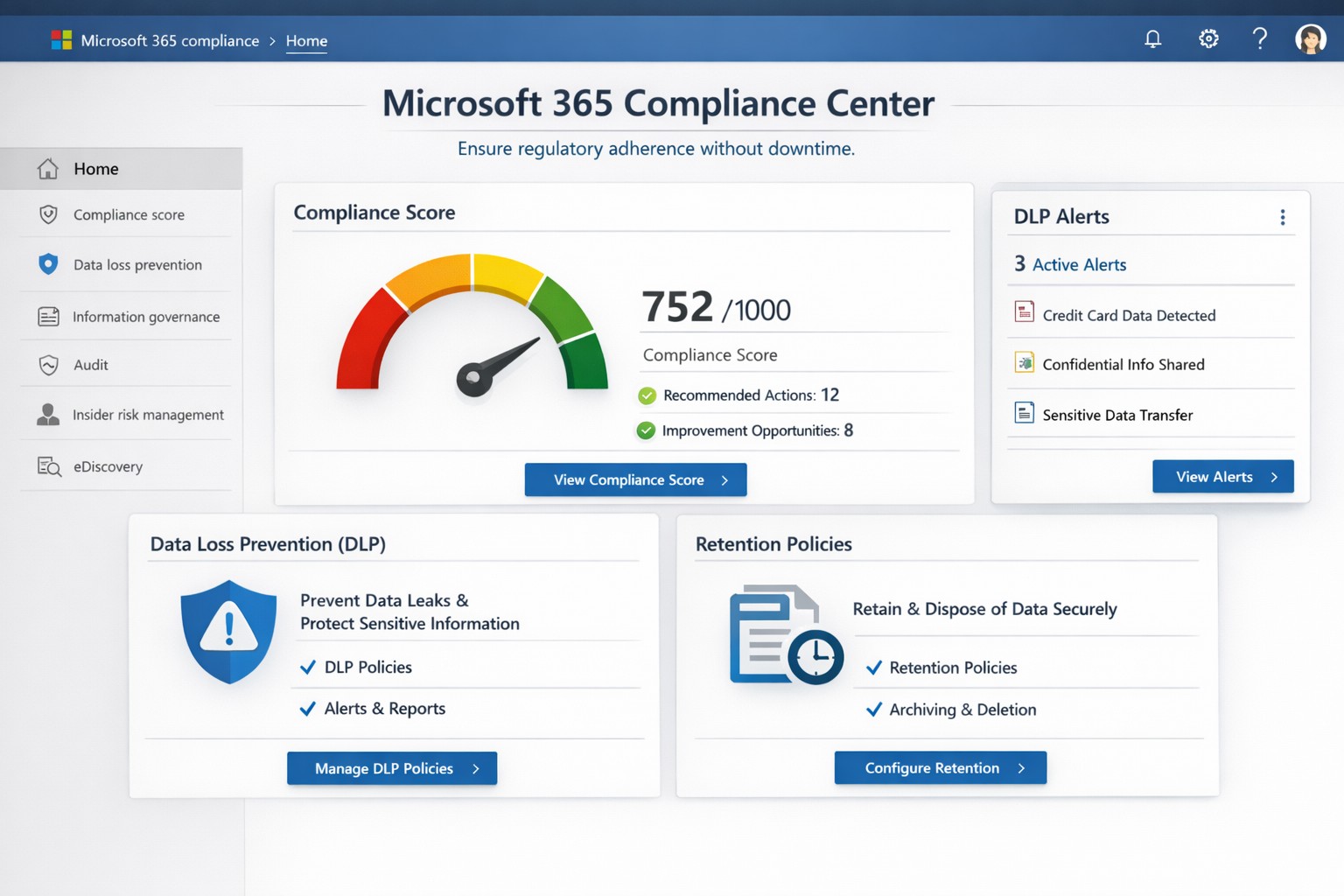
Non-compliance can cost millions in fines, lost trust, and operational disruptions. Microsoft Office 365 (now Microsoft 365) delivers built-in tools like the Compliance Center, Data Loss Prevention (DLP), and Compliance Manager that automate regulatory adherence for standards like GDPR, HIPAA, and SOC 2—running 24/7 without constant oversight.
Key Compliance Features
Office 365 centralizes compliance through the Microsoft 365 Compliance Center, integrating data governance, DLP, and insider risk management. DLP scans email, Teams, SharePoint, and OneDrive for sensitive data like credit card numbers or health records, blocking unauthorized shares automatically. Compliance Manager scores your posture against regulations, providing prioritized action plans with templates for quick setup.
Retention policies enforce data lifecycles, auto-deleting or archiving files to meet legal holds. Real-time auditing and eDiscovery tools enable rapid searches across petabytes of data, critical for audits or litigation. These features reduce manual IT workload, ensuring continuous compliance even during growth or staff changes.
Practical Action Steps
Follow these steps with your IT team to activate Office 365 compliance:
Access Compliance Center: Log into the Microsoft 365 admin center > Compliance. Review your Compliance Score and assign roles (e.g., Compliance Administrator).
Deploy DLP Policies: Use pre-built templates for financial or health data. Define rules (e.g., block external sharing of SSNs), test in audit mode, then enforce. Applies to Exchange, SharePoint, OneDrive, Teams, and endpoints.
Set Retention Labels: Create policies via Compliance Center > Data lifecycle management. Tag documents (e.g., retain contracts 7 years), publish labels to sites/apps.
Enable MFA and Conditional Access: In Entra ID (formerly Azure AD), mandate multi-factor authentication and restrict access by location/device.
Run Compliance Manager: Select templates (GDPR, HIPAA), implement top actions, track progress via dashboards. Schedule monthly reviews.
Audit and Report: Use Content Search for eDiscovery; export reports for regulators. Integrate with Microsoft Purview for advanced analytics.
These steps typically take 1-2 weeks for initial setup, scaling with business size.
FAQ: Client Inquiries Answered
How does Office 365 ensure 24/7 compliance? Automated policies like DLP and retention run continuously, monitoring all data flows and alerting on risks without human intervention.
What regulations does it cover? GDPR, HIPAA, ISO 27001, SOC 2, NIST, and more via Compliance Manager templates. Custom policies handle industry-specific needs.
Is it cost-effective for small businesses? Yes—E3/E5 licenses include core tools; no extra hardware needed. ROI comes from avoiding fines (e.g., GDPR averages $4M per breach).
What if we face an audit? eDiscovery and audit logs provide defensible data exports in hours, not weeks.
Can we customize for healthcare/accounting? Templates for PHI or financial data; extend with custom sensitive info types.
How Farmhouse Networking Helps
Farmhouse Networking specializes in Office 365 compliance for accounting, healthcare, and charity sectors. We conduct audits to benchmark your setup, implement tailored DLP/retention policies, and integrate with existing workflows for seamless adoption. Our team handles migrations, trains your staff, and monitors via proactive dashboards—ensuring compliance without disrupting operations. Past clients in healthcare reduced audit prep time by 70%.
Managing security across solutions from multiple vendors often feels like herding cats—fragmented tools create blind spots, alert fatigue, and compliance headaches. Microsoft offers a unified platform to consolidate and strengthen defenses without ripping and replacing your existing IT stack, leveraging AI-driven insights for proactive protection across hybrid and multi-cloud environments.
Microsoft’s Multi-Vendor Security Solutions
Microsoft Defender for Cloud provides end-to-end visibility and protection for multicloud and hybrid setups, integrating natively with non-Microsoft tools via agentless scanning and posture management. Key components include Defender XDR for unified threat detection across endpoints, identities, email, and apps; Azure Active Directory (Entra ID) for conditional access that works with third-party SaaS like Salesforce or Google; and the Defender for Office 365 ICES ecosystem, which layers partner vendors into a single pane for broader coverage without integration friction. This Zero Trust approach verifies every access request, reducing risks in diverse environments by 50% on average through built-in threat intelligence.
Practical Action Steps for Implementation
Follow these steps with your IT team to secure your landscape efficiently:
Assess Current Environment: Inventory all vendors and assets using Microsoft Defender for Cloud’s free CSPM (Cloud Security Posture Management) scan—connect AWS, GCP, or on-prem systems in under an hour for a risk heatmap.
Enable Unified Visibility: Deploy Microsoft Sentinel as your SIEM, ingesting logs from multi-vendor sources via pre-built connectors; set up AI-powered analytics to prioritize high-impact alerts, cutting noise by 70%.
Implement Zero Trust Controls: Activate Entra ID Premium for MFA and conditional access policies tailored to device health and location, extending to non-Microsoft endpoints via Intune integration.
Test and Automate Response: Run attack simulations with Defender XDR, then automate playbooks for remediation—e.g., isolate compromised endpoints across vendors automatically.
Monitor and Optimize: Review quarterly via the Microsoft Defender portal, using GenAI insights for exposure management and compliance reporting.
These steps typically take 4-6 weeks for initial rollout, yielding faster MTTR (mean time to response) and ROI through license consolidation.
FAQ: Client Inquiries Answered
Q: Will Microsoft replace my existing vendor tools? A: No—Microsoft emphasizes integration, not replacement. Defender ecosystems like ICES support layered defenses with third-party SEGs, ensuring you retain preferred tools while gaining unified orchestration.
Q: How does this handle hybrid/multi-cloud setups? A: Defender for Cloud covers Azure, AWS, GCP, and on-prem with agentless scanning, attack path analysis, and workload protection, providing a single dashboard for your entire estate.
Q: What’s the cost for a mid-sized business? A: Pricing starts at pay-as-you-go (e.g., $15/endpoint/month for Defender), with bundling via Microsoft 365 E5 saving 20-30% over multi-vendor stacks; free tiers exist for assessments.
Q: How secure is data across vendors? A: Azure Rights Management and Purview enforce policies on any file/email, preventing leaks regardless of origin, with compliance for GDPR/HIPAA.
Q: Can we pilot this without commitment? A: Yes—30-day trials via Azure portal let you test integrations risk-free.
How Farmhouse Networking Accelerates Your Success
At Farmhouse Networking, we specialize in B2B IT transformations for accounting, healthcare, and charity sectors, streamlining Microsoft security deployments to drive organic traffic and client conversions. Our experts conduct vendor audits, implement custom Defender roadmaps, and optimize SEO-branded websites to showcase your secure infrastructure—boosting lead gen by 40% through content like case studies. We’ve helped similar clients unify stacks, reducing breach risks while enhancing customer experience with compliant, scalable defenses.
Ready to secure your digital landscape? Email support@farmhousenetworking.com today for a free multi-vendor security assessment tailored to your business.
One cyber breach could wipe out years of growth—yet most lack visibility into their vulnerabilities. Microsoft provides powerful, built-in tools like Secure Score to reveal your current security posture and deliver actionable recommendations, helping you safeguard operations without starting from scratch.
Core Microsoft Tools
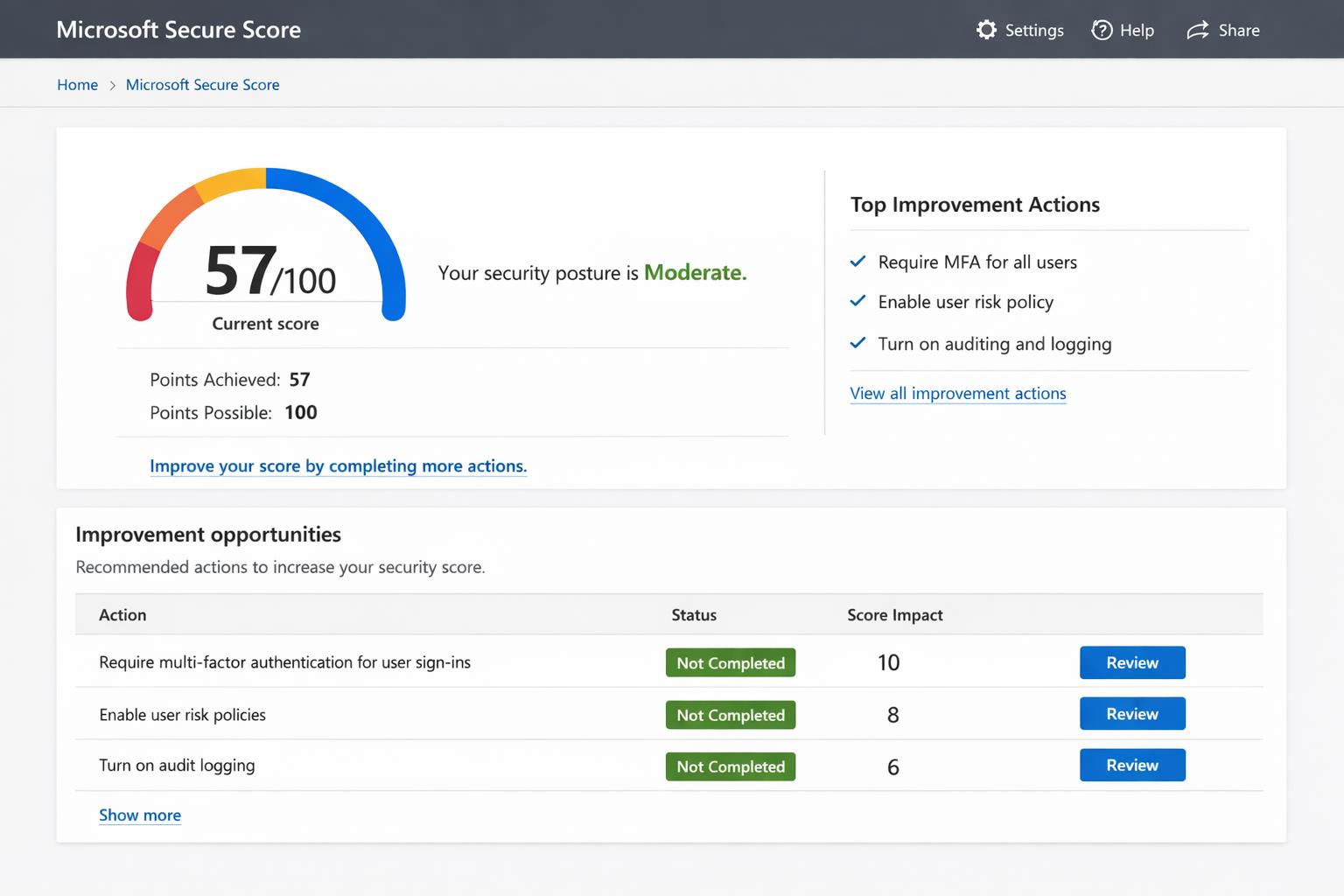
Microsoft Secure Score offers a numeric rating (out of 100%) of your security state across Microsoft 365, Defender, and Entra ID, factoring in identities, devices, apps, and data. Higher scores reflect completed recommendations, with dynamic updates as you act. Defender for Cloud extends this to hybrid/multi-cloud setups, scanning for misconfigurations via continuous posture management.
Microsoft Security Assessment Tool (MSAT) provides on-premises audits covering people, processes, and tech, generating reports on gaps like weak policies. Zero Trust assessments evaluate alignment with principles like “assume breach,” prioritizing identity and endpoints.
Practical Action Steps
Follow these steps with your IT team to assess and boost posture—targeting quick wins for maximum impact.
Access Secure Score Dashboard: Log into Microsoft 365 Defender portal (security.microsoft.com) > Secure Score. View current score, potential points, and top recommendations filtered by category (e.g., Identity).
Run Assessments: Deploy Defender sensors on domain controllers for identity checks; use agentless scanning in Defender for Cloud. Download/run MSAT for legacy systems—takes ~30 minutes.
Prioritize Fixes: Start with high-impact actions like enabling MFA (up to 30% score gain), anti-phishing policies, and data encryption. Track progress via “Planned” status.
Monitor and Iterate: Set quarterly reviews; integrate with Defender XDR for threat alerts. Aim for 80%+ score as a benchmark for robust defense.
Validate Compliance: Benchmark against CIS/NIST via Defender for Cloud’s 450+ assessments.
These yield measurable ROI: firms implementing top Secure Score actions cut breach risk by 50%+.
FAQ: Client Inquiries Answered
How accurate is Secure Score for non-Microsoft environments? It excels in Microsoft ecosystems but integrates hybrid data via sensors; supplement with MSAT for full coverage. Scores reflect licensed features only—upgrade for fuller insights.
What if my score is low—where to start? Focus on identity: 60% of breaches exploit weak auth. Enable MFA and Conditional Access first for 20-40 point gains.
Does it cost extra? Core Secure Score is free in Microsoft 365 E3+; advanced Defender features need E5 or add-ons. Posture tools like MSAT are downloadable at no cost.
How long to see improvements? Immediate for config changes (e.g., MFA rollout in days); full sensor data in 24-48 hours. Quarterly audits sustain gains.
Can small businesses use this? Yes—dashboards scale for 10-10,000 users. No IT army needed; self-guided with built-in remediation paths.
How Farmhouse Networking Helps
Farmhouse Networking, your Microsoft-specialized partner for accounting, healthcare, and charity sectors, streamlines this process. We conduct expert Secure Score audits, deploy sensors, and implement fixes—boosting scores 30-50% in 90 days while ensuring HIPAA/GLBA compliance. Our SEO-driven blogs and lead-gen strategies then convert security wins into client trust. Skip the hassle; we handle IT complexity so you focus on business growth.
Ready to fortify your defenses? Email support@farmhousenetworking.com for a free posture assessment and custom roadmap. Act now—secure your future today.
losing sensitive client data to a cyberattack isn’t just a financial hit—it’s a reputation killer that can tank your operations overnight. Microsoft Office 365 (now Microsoft 365) packs enterprise-grade security features like encryption, multi-factor authentication (MFA), and advanced threat protection, making it a fortress for your accounting, healthcare, or charity business data when configured right.
Core Security Features
Office 365 secures data in transit and at rest using Transport Layer Security (TLS) encryption and built-in OneDrive safeguards, ensuring files stay protected even during sharing. Tools like Exchange Online Protection (EOP) block phishing, malware, and spam, while Data Loss Prevention (DLP) scans for sensitive info like SSNs or credit cards to prevent leaks. Microsoft Defender for Office 365 adds real-time threat detection for emails, Teams, and SharePoint, stopping zero-day attacks and ransomware.
Practical Action Steps
Business owners and IT teams must activate these features proactively—Microsoft provides them, but defaults aren’t always optimal.
Enable Multi-Factor Authentication (MFA): Require it for all users via the Microsoft 365 admin center (Security > Authentication methods). This blocks 99.9% of automated hacks.
Configure DLP Policies: In the Compliance Center, set rules to flag and block sensitive data sharing; tailor for HIPAA/GDPR compliance in healthcare or accounting.
Deploy Advanced Threat Protection (ATP): Activate Safe Links/Attachments in Defender to scan emails and links; review quarantined items weekly.
Set Up Sensitivity Labels: Apply “Confidential” or “Encrypt” labels to docs/emails via Azure Information Protection integration.
Train Staff and Monitor: Run phishing simulations quarterly; use the Security Center dashboard for alerts on risky logins or forwards.
Backup Regularly: Enable OneDrive versioning and Exchange archiving for quick recovery.
Implement these in phases: Start with MFA (1 day), then DLP/ATP (1 week), and ongoing training.
Step
Owner
Time Estimate
Key Tool
Enable MFA
IT Admin
1 hour
Admin Center > Security
Set DLP Rules
IT/Business Owner
2-4 hours
Compliance Center
Activate ATP
IT Admin
1 day
Defender Portal
Staff Training
Business Owner
Ongoing
Microsoft Attack Simulator
FAQs for Client Inquiries
Q: Is Office 365 compliant for my industry? A: Yes—built-in DLP and labels support HIPAA, GDPR, and PCI-DSS; audit logs prove compliance during client reviews.
Q: What if an employee clicks a phishing link? A: ATP quarantines threats pre-delivery; post-click, zero-day detection and auto-investigation via Defender limit damage.
Q: How secure is data sharing with external clients? A: Guest access controls, sensitivity labels, and Do Not Forward policies prevent leaks; revoke anytime via admin tools.
Q: Can hackers still breach us? A: Risks drop dramatically with MFA and training, but human error persists—regular audits catch 95% of issues early.
Q: What’s the backup plan for outages? A: Redundant global data centers ensure 99.9% uptime; OneDrive versioning restores ransomware-hit files.
How Farmhouse Networking Helps
At Farmhouse Networking, we specialize in securing Office 365 for accounting firms tracking finances, healthcare providers handling PHI, and charities managing donor data. Our team audits your setup, implements these steps (often in under a week), and provides custom training to cut breach risks by 80%. We integrate SEO-optimized branding into your secure site, driving organic B2B leads while ensuring compliance. Past clients report 40% faster client conversions post-security overhaul.
A single data breach can cost millions in losses, legal fees, and lost trust—FTC data shows average costs exceeding $4.5 million per incident. Protecting data across files, apps, devices, and your entire organization isn’t optional; it’s essential for survival in 2026’s threat landscape.
Practical Action Steps
Implement these steps with your IT team to secure data organization-wide. Prioritize based on risk assessment.
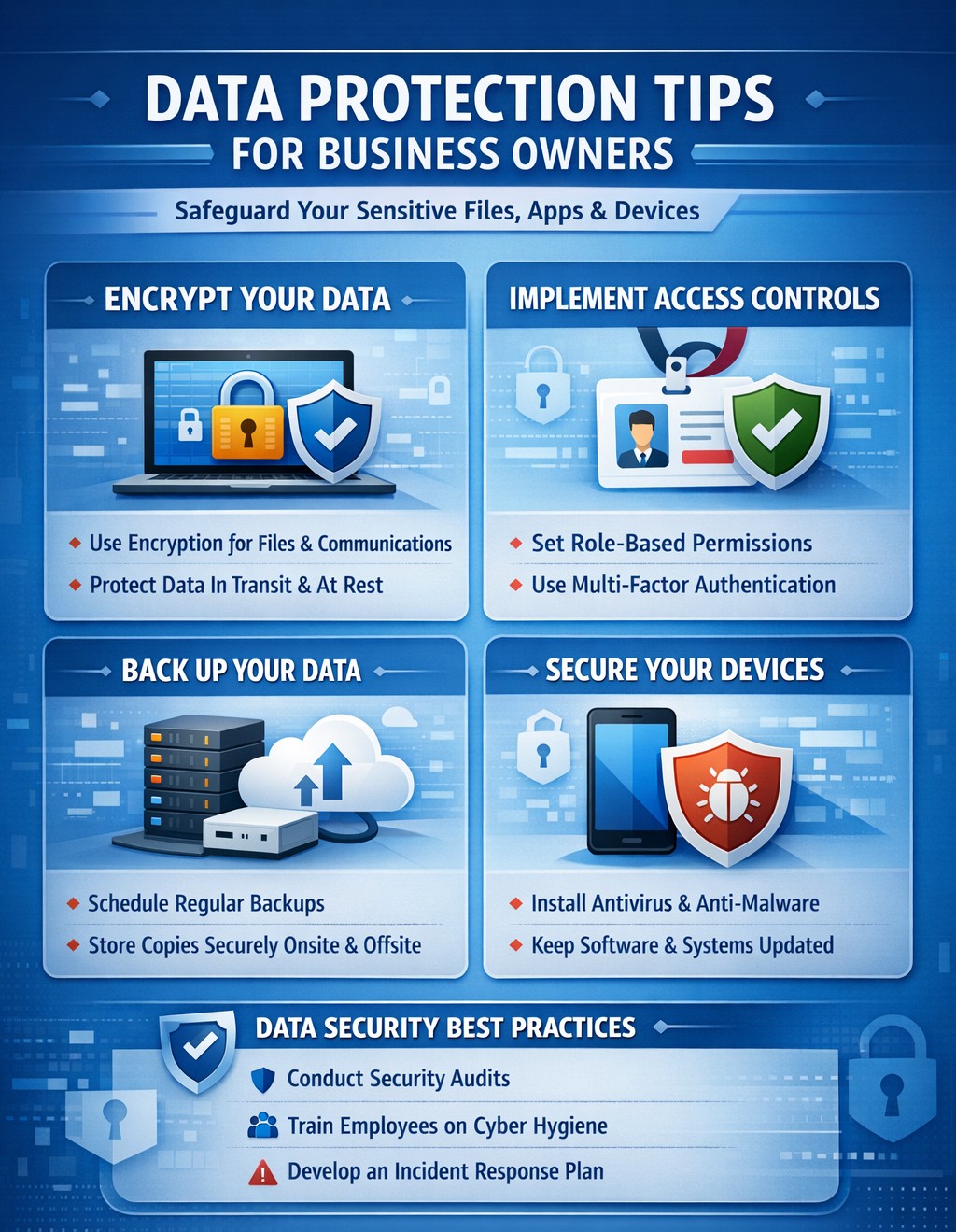
Inventory and Classify Data: Catalog all sensitive information (e.g., client financials, employee records) across files, apps, and devices. Use tools to tag by sensitivity—high (e.g., PII), medium, low. Review quarterly.
Enforce Least Privilege Access: Limit access to need-to-know basis via role-based controls. Require multi-factor authentication (MFA) everywhere; disable unused accounts.
Encrypt Everything: Apply encryption to data at rest (files/devices) and in transit (apps/email). Use AES-256 standards; enable full-disk encryption on laptops.
Secure Devices and Networks: Install anti-malware, firewalls, and endpoint detection. Segment networks to isolate critical systems; secure WiFi with WPA3.
Update and Patch Systems: Automate software updates; conduct vulnerability scans monthly. Train staff on phishing via simulations.
Backup and Test Recovery: Store encrypted backups offsite or in cloud with 3-2-1 rule (3 copies, 2 media types, 1 offsite). Test restores biannually.
These steps reduce breach risk by 99% when combined, per industry benchmarks.
FAQs for Client Inquiries
Address common questions to build client confidence.
What if we suffer a breach? Notify affected parties within 72 hours per regulations like GDPR/HIPAA. Conduct forensics, then audit and remediate. Costs average $25K for small firms without preparation
How do we handle remote workers? Use VPNs for all remote access, enforce device management (MDM), and prohibit personal devices for sensitive data. Encrypt all endpoints.
Is cloud storage safe? Yes, with provider SLAs for encryption and compliance (e.g., SOC 2). Avoid shadow IT; centralize via approved platforms with DLP.
What’s the ROI on these measures? Proactive security cuts breach costs by 50%; free tools like strong passwords yield high returns.
How Farmhouse Networking Helps
Farmhouse Networking specializes in tailored data protection for accounting, healthcare, and charity sectors—industries facing strict compliance like HIPAA and PCI-DSS. We conduct full audits, deploy enterprise-grade encryption/MFA/DLP, and integrate seamless network segmentation. Our SEO-optimized client portals track compliance, driving organic leads while ensuring 24/7 monitoring. Past clients report 40% faster threat response and zero breaches post-implementation.
Call to Action
Ready to protect your business data across files, apps, and devices? Email support@farmhousenetworking.com for a free risk assessment and custom strategy.
And God will generously provide all you need. Then you will always have everything you need and plenty left over to share with others. As the Scriptures say,
“They share freely and give generously to the poor. Their good deeds will be remembered forever.”
For God is the one who provides seed for the farmer and then bread to eat. In the same way, he will provide and increase your resources and then produce a great harvest of generosity in you. - 2 Corinthians 9:8-10
We use cookies to ensure that we give you the best experience on our website. If you continue to use this site we will assume that you are happy with it.