4 Reasons Businesses Should Make the Move to Cloud
Business owner reviewing 4 reasons to move to cloud migration on laptop for cost savings and scalability
You’re constantly balancing growth ambitions with tight budgets and operational hurdles. Moving to the cloud isn’t just a tech upgrade—it’s a strategic pivot that cuts costs, boosts agility, and future-proofs your operations, as seen in widespread adoption by organizations prioritizing speed and innovation.
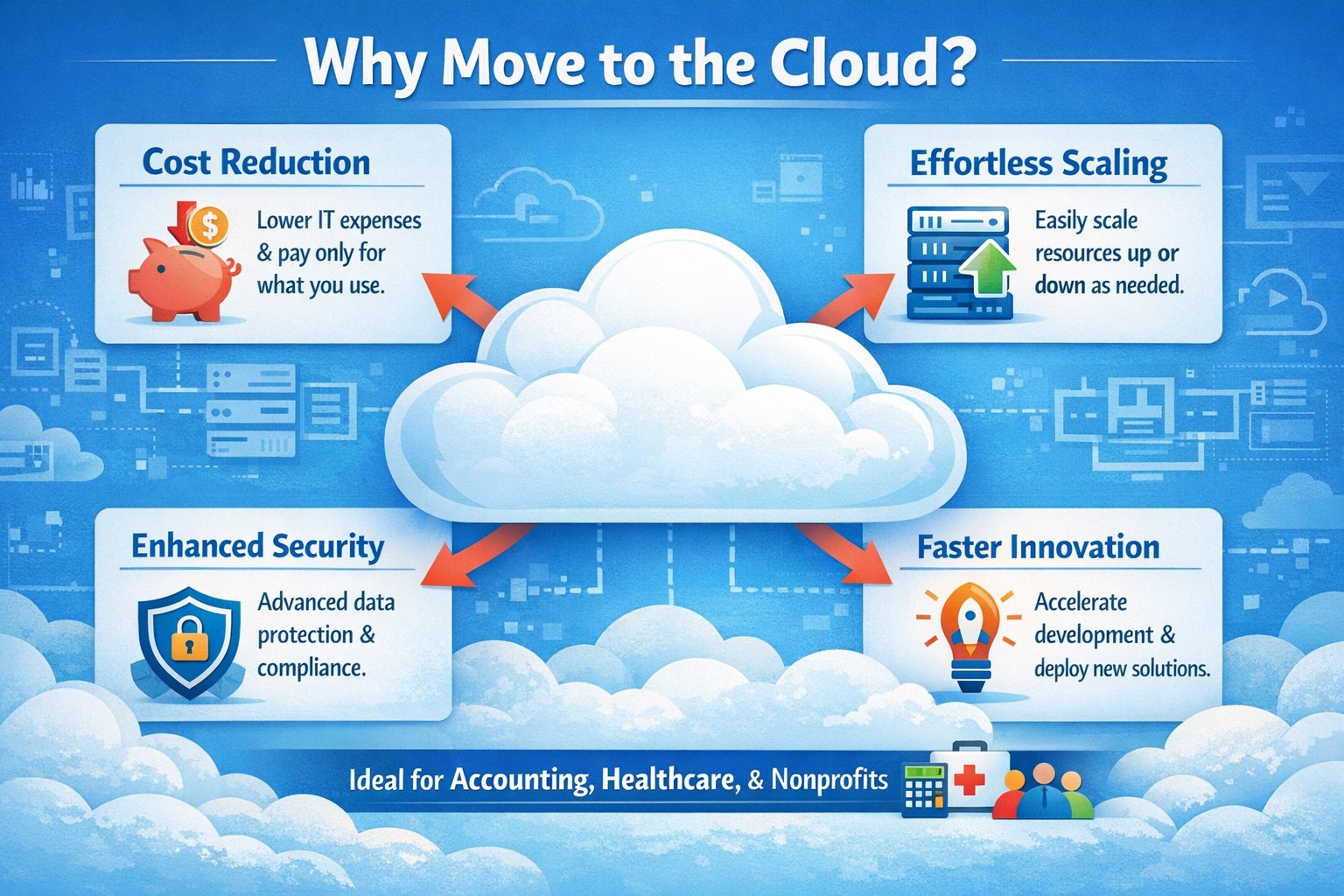
Reason 1: Slash IT Costs Dramatically
Cloud eliminates hefty upfront hardware investments and ongoing maintenance, shifting to a pay-as-you-use model. Businesses save on data center overhead like electricity and staffing, with many reporting lower total IT spend post-migration. For accounting firms handling sensitive financials or healthcare providers managing patient records, this means predictable budgeting without overprovisioning servers.
Reason 2: Scale Effortlessly with Demand
Traditional servers lock you into fixed capacity, but cloud auto-scales resources instantly during peaks—like tax season for accountants or patient surges in healthcare. This flexibility supports remote teams and global reach without downtime, enhancing reliability through built-in failover. Charities scaling donation drives benefit too, handling traffic spikes cost-effectively.
Reason 3: Strengthen Security and Compliance
Modern clouds offer enterprise-grade security surpassing most on-premises setups, with automated updates, encryption, and compliance tools for HIPAA or nonprofit regulations. Providers manage patches and backups, reducing breach risks that plague outdated systems. Your IT team focuses on business logic, not constant vulnerability scans.
Reason 4: Accelerate Innovation and Collaboration
Cloud unlocks AI, analytics, and real-time collaboration tools, speeding product launches and remote work. Teams access data from anywhere, fostering efficiency without version control headaches. For B2B sectors like yours, this drives faster client service and competitive edges.
Practical Action Steps for Migration
Follow these steps to transition smoothly, involving your IT department:
Assess Inventory: Catalog apps, data, and dependencies; tag by cloud-fit (e.g., lift-and-shift email vs. refactor custom CRM).
Set Goals and Choose Provider: Align on cost savings or scalability; evaluate AWS, Azure, or Google Cloud for your industry (e.g., HIPAA-compliant for healthcare).
Build Landing Zone: Establish security baselines, networking, and policies before migration.
Migrate in Phases: Start with low-risk workloads; test hybrid setups to minimize disruption.
Train and Monitor: Roll out employee training; use dashboards for cost/performance tracking post-go-live.
FAQs: Client Inquiries Answered
How long does migration take? Phased approaches span weeks to months, depending on complexity—small businesses often complete in 4-8 weeks with planning.
What about data security during transition? Encrypt data in transit/rest; conduct risk audits and use provider tools for zero-downtime moves.
Will it disrupt operations? Minimal with pilots and weekends; hybrid models keep critical systems on-prem initially.
Is cloud cheaper long-term? Yes, for most—avoid CapEx, pay OpEx, and optimize via auto-scaling; ROI hits in 12-18 months.
Hybrid or full cloud? Hybrid suits regulated industries like healthcare for compliance; full cloud maximizes agility.
How Farmhouse Networking Supports Your Move
Farmhouse Networking specializes in tailored cloud migrations for accounting, healthcare, and charity clients. We handle assessments, secure setups, and optimizations—integrating SEO-driven websites with cloud backends for lead-gen boosts. Our team manages compliance (e.g., HIPAA), trains your staff, and monitors ROI, ensuring seamless B2B growth.
And God will generously provide all you need. Then you will always have everything you need and plenty left over to share with others. As the Scriptures say,
“They share freely and give generously to the poor. Their good deeds will be remembered forever.”
For God is the one who provides seed for the farmer and then bread to eat. In the same way, he will provide and increase your resources and then produce a great harvest of generosity in you. - 2 Corinthians 9:8-10
We use cookies to ensure that we give you the best experience on our website. If you continue to use this site we will assume that you are happy with it.