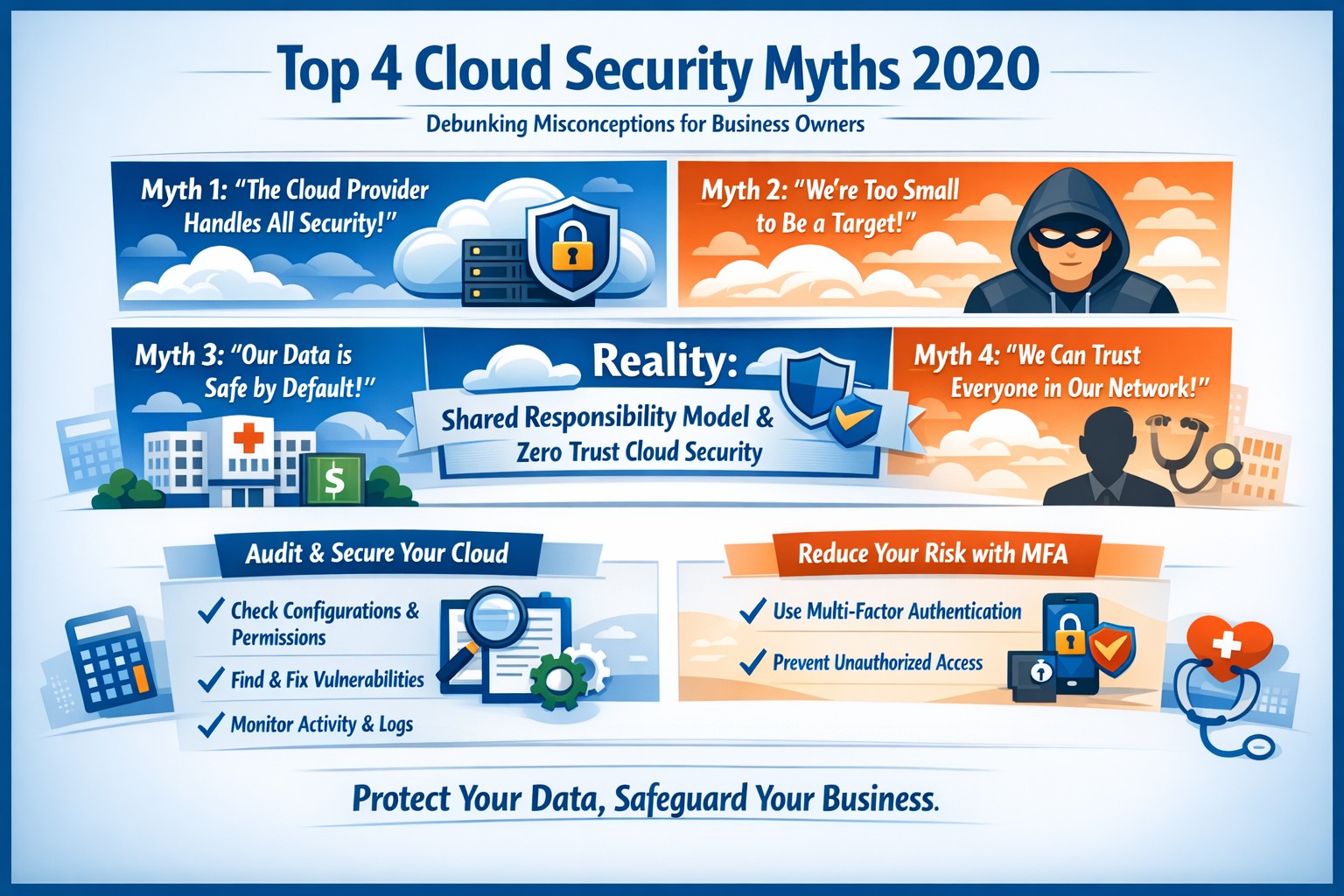
Breaking down 2020 cloud security myths: Shared responsibility, tool overload, and visibility gaps—key facts for businesses.
Cloud adoption surged in 2020, with businesses in accounting, healthcare, and nonprofits relying on it for scalability and cost savings. Yet persistent myths about cloud security created hesitation, exposing firms to real risks like data breaches that cost millions. This post debunks the top four myths from 2020 insights, empowering you with facts and actionable steps.
Myth 1: Cloud Providers Handle All Security
Many owners assumed providers like AWS or Microsoft secured everything end-to-end. In reality, the shared responsibility model meant providers handled infrastructure, but you owned data protection, access controls, and configurations.
Misconfigurations caused 80% of breaches, not provider failures. Businesses shifting to cloud without internal controls faced gaps in identity management and encryption.
Myth 2: More Security Tools Mean Better Protection
Stacking tools from multiple vendors seemed smart, but it often created blind spots. Surveys showed 70% of firms used over 100 controls, leading to fragmented visibility and overlooked threats.
Too many tools increased complexity without unified threat detection. Attackers exploited overlaps, as seen in hybrid environments where on-prem and cloud silos persisted.
Myth 3: Cloud Is Inherently Safer Than On-Premises
Cloud hype fueled this, but sprawl across multi-cloud setups amplified risks like unmanaged identities. Providers patched well, yet customer errors—such as exposed APIs—drove most incidents.
Fact: On-prem breaches outnumbered pure cloud ones, but hybrid risks blended endpoints and cloud, demanding end-to-end auditing.
Myth 4: Cloud Visibility Is Simple
Owners thought dashboards provided full insight, but dynamic resources (e.g., auto-scaled servers) hid shadow IT. Without continuous monitoring, you missed rogue accounts or vulnerabilities.
Breaches often started outside cloud via stolen credentials, underscoring the need for holistic views.
Practical Action Steps
Take these steps with your IT team to secure cloud operations:
Audit Configurations Weekly: Use native tools like AWS Config or Azure Policy to scan for public buckets and weak IAM roles. Remediate high-risk items immediately.
Implement Zero-Trust Access: Enforce multi-factor authentication (MFA) and least-privilege policies via tools like Okta. Rotate keys quarterly.
Centralize Monitoring: Deploy SIEM (e.g., Splunk Cloud) integrated with CSP logs for real-time alerts on anomalies.
Encrypt Everything: Apply AES-256 for data at rest/transit; test decryption quarterly to verify compliance (HIPAA-relevant for healthcare).
Conduct Penetration Tests: Hire ethical hackers biannually to simulate attacks, focusing on API endpoints.
These reduce breach risk by 50%+ per industry benchmarks.
Step
Tool/Example
Expected Outcome
Audit Configurations
AWS Config
Identifies 90% of misconfigs
Zero-Trust Access
Okta MFA
Blocks 99% credential attacks
Centralize Monitoring
Splunk Cloud
Cuts detection time to minutes
Encrypt Data
AWS KMS
Meets HIPAA/GDPR standards
Pen Tests
External firm
Uncovers hidden exploits
Client FAQ
Q: How do we know our data is safe from provider access? A: Providers like Microsoft use multi-tenant isolation; engineers need just-in-time approval. Your encryption keys stay under your control.
Q: What if we’re in accounting/healthcare with strict compliance? A: Map controls to NIST or HIPAA via frameworks like FedRAMP. Regular audits ensure audit trails for client trust.
Q: Multi-cloud adds complexity—how to manage? A: Use unified platforms like Prisma Cloud for cross-provider visibility, avoiding vendor lock-in.
Q: What’s the ROI on fixing these myths? A: Firms with mature cloud security report 30% lower breach costs and faster recovery.
How Farmhouse Networking Helps
Farmhouse Networking specializes in B2B cloud security for accounting, healthcare, and charities. We conduct free audits to expose misconfigs, design zero-trust architectures, and integrate monitoring tailored to your stack. Our SEO-optimized websites and lead-gen strategies drive organic traffic growth, converting visitors into long-term partners. We handle compliance mapping, reducing your IT burden while boosting client confidence.
And God will generously provide all you need. Then you will always have everything you need and plenty left over to share with others. As the Scriptures say,
“They share freely and give generously to the poor. Their good deeds will be remembered forever.”
For God is the one who provides seed for the farmer and then bread to eat. In the same way, he will provide and increase your resources and then produce a great harvest of generosity in you. - 2 Corinthians 9:8-10
We use cookies to ensure that we give you the best experience on our website. If you continue to use this site we will assume that you are happy with it.