Case Study – Remote HIPAA-Compliant Network Setup for Texas O&P Clinic’s New Building
Client and context
A Texas‑based Orthotics & Prosthetics clinic was moving into a significantly larger, newly remodeled building and needed a reliable, HIPAA‑aware network in place before opening day. The clinic was recently acquired by an O&P group that already partners with Farmhouse for IT support, and as part of that transition they decided to move away from their previous IT provider and standardize on Farmhouse’s approach.
Because we’re keeping client details private, the case study will refer to them as “a growing O&P clinic in Texas” and focus on the business and technical outcomes rather than names or locations. The project was driven by the need to support more exam rooms, more staff, and a better patient experience in the new space—all under a tight two‑week go‑live deadline.
Starting point and challenges
The clinic was moving into a remodeled building that had some existing low‑voltage wiring, but the cabling needed to be expanded and cleaned up to support their new layout. A trusted local low‑voltage contractor, approved by Farmhouse, extended and organized the cabling to match our network design.
From a business perspective, the leadership team was focused on three main concerns:
-
Protecting PHI and staying aligned with HIPAA expectations.
-
Eliminating the unreliable Wi‑Fi that clinicians had dealt with in exam rooms at the previous site.
-
Keeping overall project costs in check while still doing things “the right way.”
On the technical side, they needed:
-
Separate VLANs and SSIDs for clinical use and guest Wi‑Fi.
-
Consistent wired and wireless connectivity throughout the building.
-
A solution based on UniFi hardware, which aligned with their parent organization’s standards.
HIPAA was explicitly called out as a requirement, and the two‑week window between planning and move‑in added pressure to get the design right the first time.
Remote engagement from Oregon to Texas
Farmhouse delivered the entire project remotely from Oregon, using a clear, phased approach: a kickoff conversation, a site survey and design package from the local low‑voltage contractor, a hardware quote, on‑site installation by the contractor, and remote configuration with help from the local office manager.
The low‑voltage partner provided detailed design specifications for the building. Based on those plans, we instructed them exactly where to place network drops and equipment to support clinical workflows and staff movement. Scheduling was handled by coordinating dedicated time with both the contractor and the office manager, with the local team managing physical access for the on‑site work.
All UniFi hardware was drop‑shipped directly from our wholesaler to the Texas location, keeping logistics simple and reducing delays. Because the engagement was fully remote, the client avoided any travel expenses or extra on‑site labor beyond their existing remote support agreement with Farmhouse. The biggest friction point was that the previous IT company did not share any configuration details or credentials for the old network, so we designed and deployed a brand‑new environment from scratch rather than attempting a partial migration.
Solution design and architecture
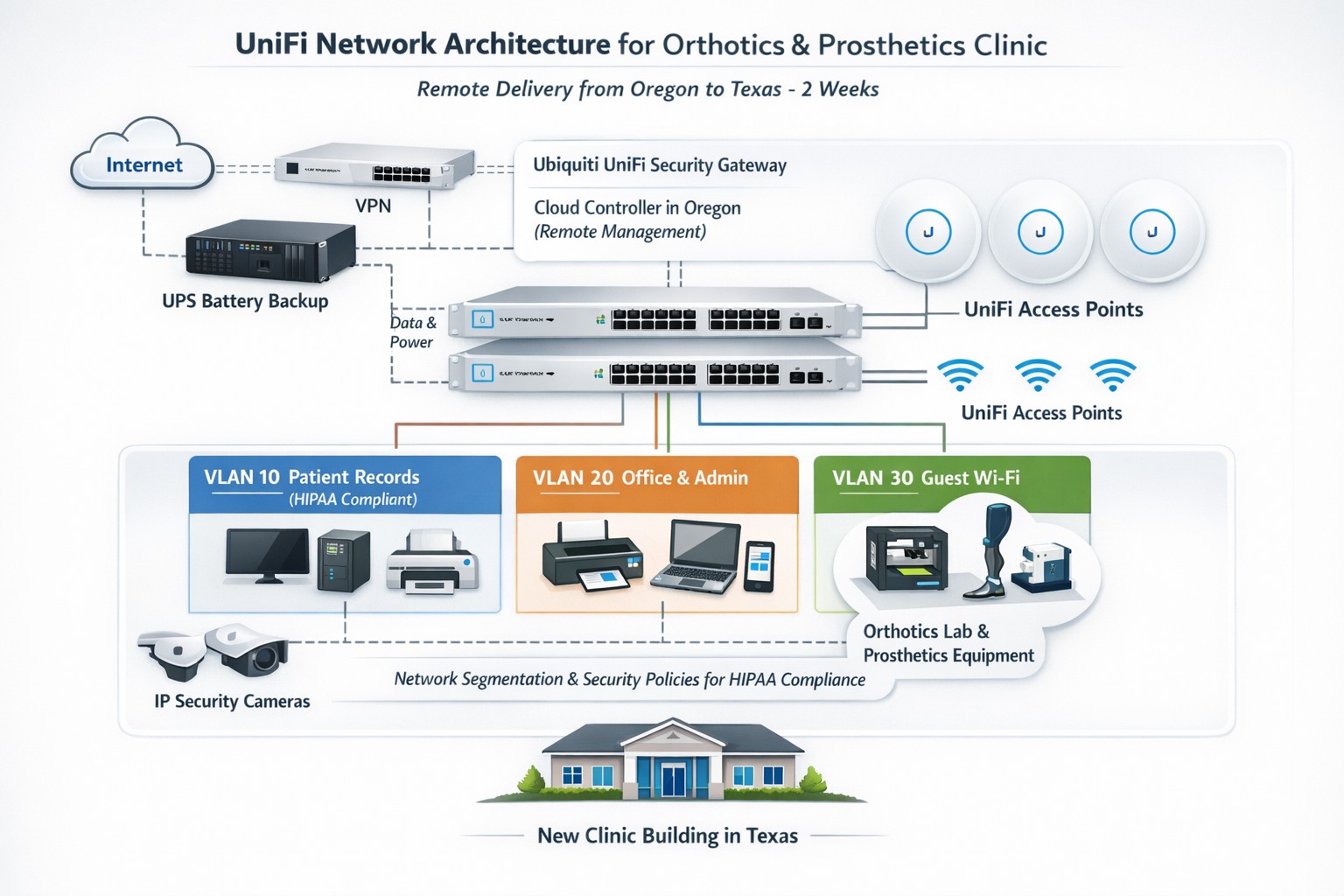
Farmhouse implemented an end‑to‑end Ubiquiti (UniFi) network stack tailored to the new building. The high‑level design included:
-
A UniFi security gateway/router at the core.
-
UniFi PoE switches with sufficient ports to serve all wall jacks and connected devices.
-
Multiple UniFi wireless access points strategically placed to provide full coverage in exam rooms, offices, and shared spaces.
To align with HIPAA expectations and reduce risk, we segmented the environment into separate VLANs and SSIDs—one dedicated to clinical systems that handle PHI, and another for guest Wi‑Fi. This approach limits the blast radius of any potential issue on the guest side and keeps clinical traffic isolated.
For reliability and performance, the network includes battery backup to ride through short power interruptions, as well as QoS tuned for VoIP and video conferencing so that phones and telehealth visits stay stable even during peak usage. Ubiquiti’s management console provides centralized monitoring and alerting, allowing Farmhouse to keep an eye on the environment and respond quickly to issues, while internal documentation captures the full network layout and configuration for ongoing support.
The final stack consisted of a UniFi router, PoE switches, UniFi access points, and an appropriately sized UPS to protect network gear.
Implementation and collaboration
Implementation followed a streamlined, repeatable pattern:
-
The low‑voltage contractor shared building design plans and notes.
-
Farmhouse translated those plans into a detailed network design, mapping equipment locations and wall jack placement.
-
Hardware was ordered and drop‑shipped directly to the clinic.
-
The local contractor installed all cabling and mounted the UniFi gear according to the design.
-
Farmhouse worked with the on‑site office manager to gain remote access and complete configuration, testing, and tuning.
The local low‑voltage vendor handled all physical cabling and hardware installation, guided by Farmhouse’s instructions and remote coordination. Before opening day, Farmhouse and the office manager tested the network to confirm that equipment powered on correctly, Wi‑Fi coverage was available where needed, and core services operated as expected. The team also provided wireless access codes and basic guidance so staff could quickly connect on day one.
There were no last‑minute emergencies; the combination of clear plans, responsive communication, and aligned vendors kept the project on track. Farmhouse continues to provide ongoing monitoring and management of the equipment as part of their remote support.
Business outcomes and positioning
The clinic opened the new building on time with a modern network that simply worked from day one. Compared with their previous environment, staff immediately benefited from stronger, more consistent Wi‑Fi coverage and faster, more reliable access to key systems, including patient intake workflows, imaging, and video conferencing for remote consultations.
By segmenting the guest network away from clinical systems, Farmhouse helped the organization improve its security posture and better align with HIPAA expectations, while still offering convenient guest access for patients and visitors. The clinic also avoided the cost of hiring a local IT firm to design and deploy the network, instead leveraging Farmhouse’s remote expertise and coordination with existing vendors.
The engagement built a strong working relationship characterized by frequent, clear communication and rapid responsiveness. From the client’s perspective, the experience could be summarized as:
“It was easy to work with Farmhouse from the initial planning meeting through move‑in just a couple of weeks later. They saved us a ton on installation by handling the project remotely—and we had zero headaches.”
Looking ahead, Farmhouse is expanding its support by taking on VoIP phone services and ongoing monthly management for the clinic. For similar O&P and healthcare practices, this project highlights three differentiators:
-
Deep experience with Orthotics & Prosthetics clients and their clinical workflows.
-
The ability to coordinate effectively with local low‑voltage vendors to control costs.
-
Proven expertise in designing and implementing new office networks remotely, on tight timelines, without sacrificing security or reliability.
Get Your IT Project Started Today!
Give us a call. It’s that easy.