Case Study: Rebuilding Security After a Breach
The Situation
A precision manufacturer with two locations, one in the western U.S. and the other in the eastern U.S., with a small staff suffered a data breach in fall 2026. The company also handles some controlled government-related data, so security standards such as CMMC and NIST matter to how it does business.
The company brought in Farmhouse Networking to help gather incident response data for an outside digital forensics firm. Based on the work so far, the attacker is understood to have entered through remote access that was reachable from the internet, a common setup for staff who work from home. The information involved included business files and older archived email, and the company learned of the incident when the attacker contacted it directly.
When Farmhouse Networking became involved, the forensic and legal reviews were still underway. This case study does not describe exactly what was taken or draw conclusions about cause. Those questions belong to the investigators and the company’s advisors. Our job was to steady the environment and build a stronger foundation.
What We Found
We started by mapping the environment as it stood. Several findings stood out, and none is unusual for a small manufacturer that has grown over time.
Email filtering and DNS were run through third parties, and the previous setup was not documented. DNS is the internet’s address book, the service that tells the world where your email and website live. Each piece had to be traced back to whoever controlled it, and DNS itself sat in a vendor-managed cloud account the company did not control.
The Microsoft 365 licenses did not include advanced security features such as Conditional Access, which lets an organization set rules about who can sign in, from where, and under what conditions. The company also still ran on an on-premises Active Directory domain, the older system that tracks users and computers inside the building.
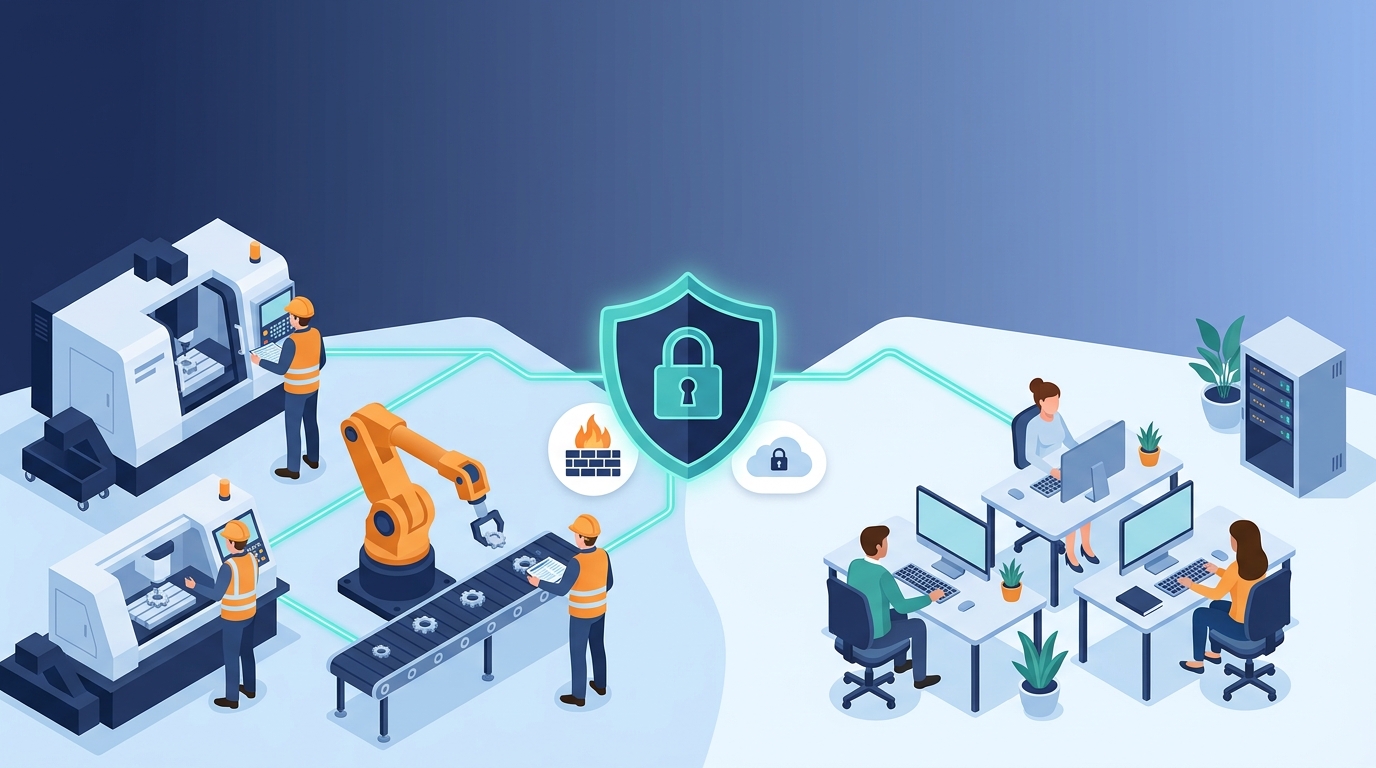
On the network side, remote access for staff working from home was exposed to the internet, and the factory-floor network and the office network were not separated. Some legacy factory equipment ran old operating systems, which is common because industrial equipment is built to last for decades. Ongoing security monitoring was minimal.
What We Did
We focused the first phase on the changes that reduce risk fastest with the least disruption to production.
- Took control of DNS. We moved it to a registrar account owned by the company, rebuilt the records, and removed the dependency on the legacy email filter in a planned, staged cutover. Mail kept flowing with no loss of service.
- Upgraded licensing and created emergency access. We moved the company to Microsoft 365 Business Premium and created “break-glass” administrator accounts, which are held in reserve for use only if normal admin access fails.
- Turned on Conditional Access. Every user and administrator now needs multi-factor authentication (MFA, a second proof of identity beyond a password). Older sign-in methods that cannot support MFA are blocked, and so are sign-ins from other countries.
- Moved endpoint protection and began backup repair. Endpoint protection, the software that guards laptops, desktops, and servers, now runs in Farmhouse’s managed security stack. We also started rebuilding the file-server backup.
- Began compliance alignment and a staged plan. We started aligning the environment to CMMC Level 1 and NIST requirements and mapped the next phase.
Where They Are Now
The engagement is in its early phase, so this is a story of progress and a clear roadmap, not a finished result. The company now controls its own DNS, requires MFA at sign-in, runs managed endpoint protection, and has backup and compliance work underway.
The next phase is staged to protect production. It moves the company off on-premises Active Directory to cloud identity with Windows Hello, which lets staff sign in with a face, fingerprint, or PIN tied to their device. Remote access will be tied to that cloud identity before the exposed ports are closed, so people can keep working from home without a gap. It also separates the factory and office networks, adds patch management and immutable backups that cannot be altered even by an administrator, and brings 24/7 monitoring through a SIEM, a system that gathers security logs and watches them around the clock. Periodic penetration testing, where authorized specialists look for weaknesses first, rounds out the plan.
A manufacturer with a small staff is closing gaps in a deliberate order, one stage at a time.
The Takeaway for Other Small Manufacturers
You do not need to fix everything at once. A few steps tend to matter most early on.
- Know who controls your DNS and email filtering, and document it.
- Turn on MFA for everyone, and put remote access behind your identity system before closing old ports.
- Separate the shop floor from the office, because legacy equipment cannot always be updated.
- Build compliance in stages, starting with CMMC Level 1 and NIST basics.
Progress comes from steady, well-sequenced work, and each stage makes the next one easier.
Worried your organization has the same blind spots?
A Farmhouse Networking security assessment gives you a plain-English picture of where you stand today and a prioritized plan for what to do next.